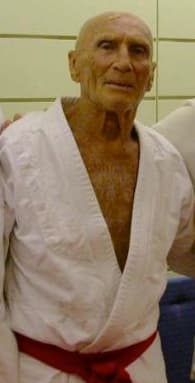
Creator credit recorded on the linked source page: Satorijits · CC BY-SA 3.0
Hélio Gracie
Hélio Gracie (1913–2009) taught jiu-jitsu in Rio and helped his family bring its art to the first UFC.
Biography
Sources for this profile
David Hay, “Hélio Gracie,” The Guardian, February 9, 2009.(opens in a new tab)
Born 1913.
Where in the source: Closing biographical line, birth date.
Accessed:
Died 2009.
Where in the source: Closing biographical line, death date.
Accessed:
Co-founder with Carlos; Rio academy opened 1940.
Where in the source: Opening paragraph; academy paragraph containing 1940.
Accessed:
Kimura 1951: best-known fight; Royce’s UFC wins broadened reach.
Where in the source: Academy and Kimura paragraph; following legacy paragraph.
Accessed:
Gracie University, “About the Gracies: History Overview,” undated.(opens in a new tab)
The family timeline places Carlos’s Rio academy in 1925 and Hélio’s first substitute private lesson in 1928, after he had watched his brothers instruct.
Where in the source: History Overview, entries for 1925 and 1928.
Accessed:
Gracie University dates Hélio’s bout with Masahiko Kimura to 1951 and acknowledges that Carlos stopped the fight while Kimura held a shoulder lock.
Where in the source: History Overview, 1951 entry.
Accessed:
MMA Fighting, “Helio Gracie passes away at 95,” January 29, 2009.(opens in a new tab)
In an interview published in 2002, Hélio recalled observing techniques Carlos had learned and seeking ways for a smaller person to control an opponent through technique.
Where in the source: Article paragraph introducing the May 2002 Kakuto Striking Spirit interview.
Accessed:
José Cairus, “Nationalism, Immigration and Identity: The Gracies and the Making of Brazilian Jiu-Jitsu, 1934–1943,” Martial Arts Studies 9 (2020), 28–42. DOI 10.18573/mas.105.(opens in a new tab)
Historian José Cairus situates the Gracies’ developing ground-oriented style within their 1930s encounters with Japanese immigrants. His account explains the guard as a defensive position from which they also attacked with submissions.
Where in the source: Printed pp. 30 and 35, discussion of standing versus ground techniques and defensive strategy.
Accessed:
Cairus records a draw between Hélio and Yassuiti Ono in 1935, citing contemporary newspaper coverage that credited Hélio’s defense with neutralizing Ono’s attacks.
Where in the source: Printed p. 33, Yassuiti Ono discussion and footnote 26 citing Jornal dos Sports, December 6, 1935.
Accessed:
Masahiko Kimura, “My Judo,” autobiographical excerpt reproduced in English at Judo Info.(opens in a new tab)
Kimura’s own account describes ending his bout with Hélio by applying an arm lock, after which a towel was thrown into the ring and Kimura was declared the winner.
Where in the source: Brazil passage after the caption showing Kimura applying a joint lock; end of match narrative.
Accessed:
Riqueldi Straub Lise, Natasha Santos and André Mendes Capraro, “‘A legenda dos Gracie’: uma análise da crônica de Nelson Rodrigues,” Movimento 20(4) (2014), 1329–1349.(opens in a new tab)
A study of 1955 newspaper writing records Hélio’s defeat by former pupil Waldemar Santana earlier that year and explains that his nephew Carlson subsequently challenged Santana in defense of the family reputation.
Where in the source: Printed p. 1330, opening newspaper extract, authors’ explanation and footnote 1; p. 1342, Santana relationship and aftermath.
Accessed:
Jose Fraguas, “Helio Gracie Interview,” originally Masters Magazine, republished by Balance Studios September 27, 2010; original conversation date unspecified.(opens in a new tab)
Explaining his teaching approach to Jose Fraguas, Hélio argued that pupils should learn by performing throws on the instructor, rather than mainly being thrown by the instructor.
Where in the source: Question about teaching and martial-arts philosophy.
Accessed:
Hélio told Fraguas that he taught women and remained involved in teaching while his sons spread the art. He singled out Rorion’s work in the United States and Royce and Rickson as fighters and teachers.
Where in the source: Questions about women, popularity, and whether he still taught.
Accessed:
Thomas Gerbasi, “UFC 20: Royce Gracie,” UFC, October 30, 2013.(opens in a new tab)
Royce Gracie said the decision that he would represent the family at the first UFC was made by his father Hélio and his brother Rorion. UFC’s retrospective places that tournament on November 12, 1993 and records Royce winning it.
Where in the source: Royce interview, explanation of who selected him; opening account of the first UFC.
Accessed:
Thomas Gerbasi, “The Gracie Way,” UFC, 2009; quotes Royce Gracie’s 2006 interview.(opens in a new tab)
Royce recalled in 2006 that his father encouraged him to learn jiu-jitsu but left him free to decide whether to use it, describing his eventual UFC participation as his own choice.
Where in the source: Final Royce quotation explicitly identified as a 2006 interview.
Accessed:
Hélio Gracie, Gracie Jiu-Jitsu, Gracie Publications, first edition 2005; revised edition 2020, official publisher preview.(opens in a new tab)
Hélio’s instructional book Gracie Jiu-Jitsu first appeared in 2005. In its acknowledgements Rorion recalls organizing a photographic project at the Torrance academy in 2000 so his father could demonstrate the techniques for the book.
Where in the source: Preview PDF pp. 3–6: title, copyright, foreword and Rorion’s acknowledgements.
Accessed:
The book’s contents organize instruction around standing self-defense and ground positions including mount, guard, side mount and back mount, showing the breadth of the curriculum Hélio demonstrated.
Where in the source: Preview PDF pp. 7–8, full two-page contents with chapter headings and technique listings.
Accessed:
Kaelan Crisosto, “2026 Jiu-Jitsu Con | Engaging Exhibits and Displays,” IBJJF, August 26, 2026.(opens in a new tab)
IBJJF’s 2026 Jiu-Jitsu Con announcement names Hélio alongside Carlos Sr., Carlson and Rolls in its Gracie Legacy display honoring the family’s historical influence.
Where in the source: Gracie Legacy Display section, read alongside the separate Hall-of-Fame and Crown sections.
Accessed: