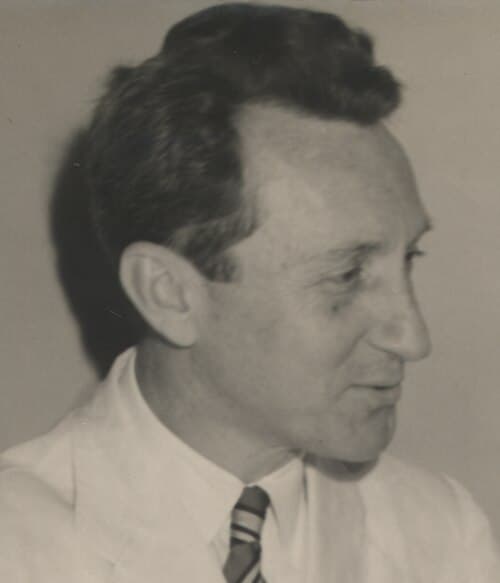
Creator credit recorded on the linked source page: Unknown photographer; Arquivo Nacional Collection · Public domain
Carlos Gracie
Carlos Gracie (1902–1994) taught generations of his family and helped build the Gracie school tradition in Rio.
Biography
Sources for this profile
IBJJF, The Ultimate Guide to Jiu-Jitsu CON, the Biggest Jiu-Jitsu Event on the Planet (2022).(opens in a new tab)
The IBJJF's 2022 Jiu-Jitsu CON tribute honored Carlos and Hélio Gracie as founders and credited Carlos with spreading jiu-jitsu among his family and students.
Where in the source: Honoring Carlos and Helio Gracie; Carlos paragraph.
Accessed:
The IBJJF tribute says Carlos participated in challenge matches intended to demonstrate jiu-jitsu's use in self-defense.
Where in the source: Carlos paragraph within the founders tribute.
Accessed:
Gracie Barra, História, undated organizational timeline.(opens in a new tab)
- Conflicting accounts
Gracie Barra dates the first Gracie school to 1925 at Rua Marquês de Abrantes 106 in Rio. Its account describes Carlos using a small house's living room for training and involving his younger brothers.
Where in the source: 1925 timeline entry, opening three paragraphs.
Accessed:
Gracie Barra describes Carlos as Hélio's instructor and mentor, while crediting Gastão and Oswaldo with Hélio's earliest lessons. It says Hélio later took over the family academy's management as Carlos increasingly focused on diet, exercise and spiritual interests.
Where in the source: 1932 timeline entry, paragraphs on instruction and later academy management.
Accessed:
- Conflicting accounts
Riqueldi Straub Lise, Natasha Santos, Fernando Renato Cavichiolli and André Mendes Capraro, A biografia escrita por Reila Gracie e as fontes jornalísticas: revisando a história hegemônica, Movimento 23(4), 2017, DOI 10.22456/1982-8918.65100.(opens in a new tab)
- Conflicting accounts
Lise and colleagues report that three Rio newspapers recorded an academy inauguration at Marquês de Abrantes 106 on September 6, 1930. Their quoted reports identify Donato Pires dos Reis as founder or director and Carlos and Jorge Gracie as instructors, with Jorge also described as a monitor.
Where in the source: Section 3; academy discussion and quotations from A Noite, September 8, 1930 p.7; Diário de Notícias, September 7 p.23; Correio da Manhã, September 9.
Accessed:
- Conflicting accounts
Gracie University, About: History Overview, undated.(opens in a new tab)
- Conflicting accounts
Gracie University's family history also dates the Rio academy to 1925 and says Carlos and his brothers taught Japanese jiu-jitsu techniques he had learned from Maeda.
Where in the source: 1925 timeline entry.
Accessed:
Gracie University's account says Carlos stopped Hélio's 1951 contest against Masahiko Kimura to protect his brother when Kimura applied a shoulder lock.
Where in the source: 1951 timeline entry.
Accessed:
- Conflicting accounts
Riqueldi Straub Lise and André Mendes Capraro, Primórdios do jiu-jitsu e dos confrontos intermodalidades no Brasil: contestando uma memória consolidada, Revista Brasileira de Ciências do Esporte 40(3), 2018, DOI 10.1016/j.rbce.2018.03.003.(opens in a new tab)
Lise and Capraro document interstyle contests in Rio in 1909, before the Gracies' challenge campaigns, and reject an exclusively Gracie origin for those contests.
Where in the source: Miyako e os desafios intermodalidades; Considerações finais.
Accessed:
José Cairus, Modernization, nationalism and the elite: the Genesis of Brazilian jiu-jitsu, 1905–1920, Tempo e Argumento 3(2), 2011, pp.100–121, DOI 10.5965/2175180303022011100.(opens in a new tab)
Historian José Cairus places Carlos's adolescent training in Maeda's Belém dojo and identifies Maeda's senior local student Jacyntho Ferro as another instructor. Cairus describes a program combining judo techniques with wrestling in a prizefighting environment.
Where in the source: Belém apprenticeship discussion surrounding notes 75–89; note 86 identifies Ferro as chief instructor.
Accessed:
Cairus gives Carlos Gracie's birth year as 1902 and birthplace as Belém.
Where in the source: Footnote 75.
Accessed:
Mário Magalhães, Para clã, lutar é 'obrigação divina', Folha de S.Paulo, May 21, 1995.(opens in a new tab)
Mário Magalhães's 1995 report identifies Oswaldo, George, Gastão and Hélio as the four younger brothers whom Carlos taught jiu-jitsu.
Where in the source: Opening account of Carlos becoming a teacher and teaching four brothers.
Accessed:
Folha de S.Paulo's May 1995 report states that Carlos Gracie died in 1994.
Where in the source: Second paragraph of the article's family history.
Accessed:
An interview with Carlson Gracie, former Carlson Gracie Jiu-Jitsu academy website hosted at UCLA; page last modified May 21, 1996, interview undated.(opens in a new tab)
In an interview preserved on the Carlson Gracie academy's old website, Carlson recalled that his father had taught him jiu-jitsu from his earliest memories.
Where in the source: Question about jiu-jitsu's effect on Carlson's life.
Accessed:
Carlson credited Carlos with developing the Gracie Diet and described its emphasis on combinations of foods and intervals between meals.
Where in the source: Question about the Gracie diet.
Accessed:
Gracie Barra, Fundador: Carlos Gracie Jr., undated organizational biography.(opens in a new tab)
Gracie Barra's account of Carlos Jr's upbringing describes a large Teresópolis household where the children of Carlos Sr and Hélio lived and trained together. It presents that shared environment and Carlos Sr's teachings as formative influences on Carlos Jr.
Where in the source: Opening biographical paragraphs, before the school-expansion section.
Accessed:
M.A.Z., Heróis do Ringue, Museu Brasileiro de Rádio e Televisão, May 20, 2007.(opens in a new tab)
The Brazilian Radio and Television Museum credits Carlos with coordinating Heróis do Ringue on Rio's TV Continental, a weekly program featuring jiu-jitsu fighters against practitioners of other styles. Its listed fighters include Carlson Gracie and João Alberto Barreto.
Where in the source: Program entry, first two paragraphs beneath TV Continental.
Accessed:
Genealogy and source research: Josh Simon, simonbjj.com(opens in a new tab)
Early training: what the sources establish
1929 newspaper report
Reported instructor: Mitsuyo Maeda
A 1929 newspaper report described Mitsuyo Maeda as Carlos Gracie’s teacher. The extent and duration of Carlos’s direct instruction from Maeda remain uncertain.
Historical research and a 1921 notice
Reported instructor: Jacyntho Ferro
Historian José Cairus also identifies Jacyntho Ferro as one of Carlos’s instructors. A 1921 advance notice names Oscar Gracie as Ferro’s student; it does not establish that Oscar was Carlos.
Lineage
Trained under
Historical teacher attribution; extent and duration remain uncertain.