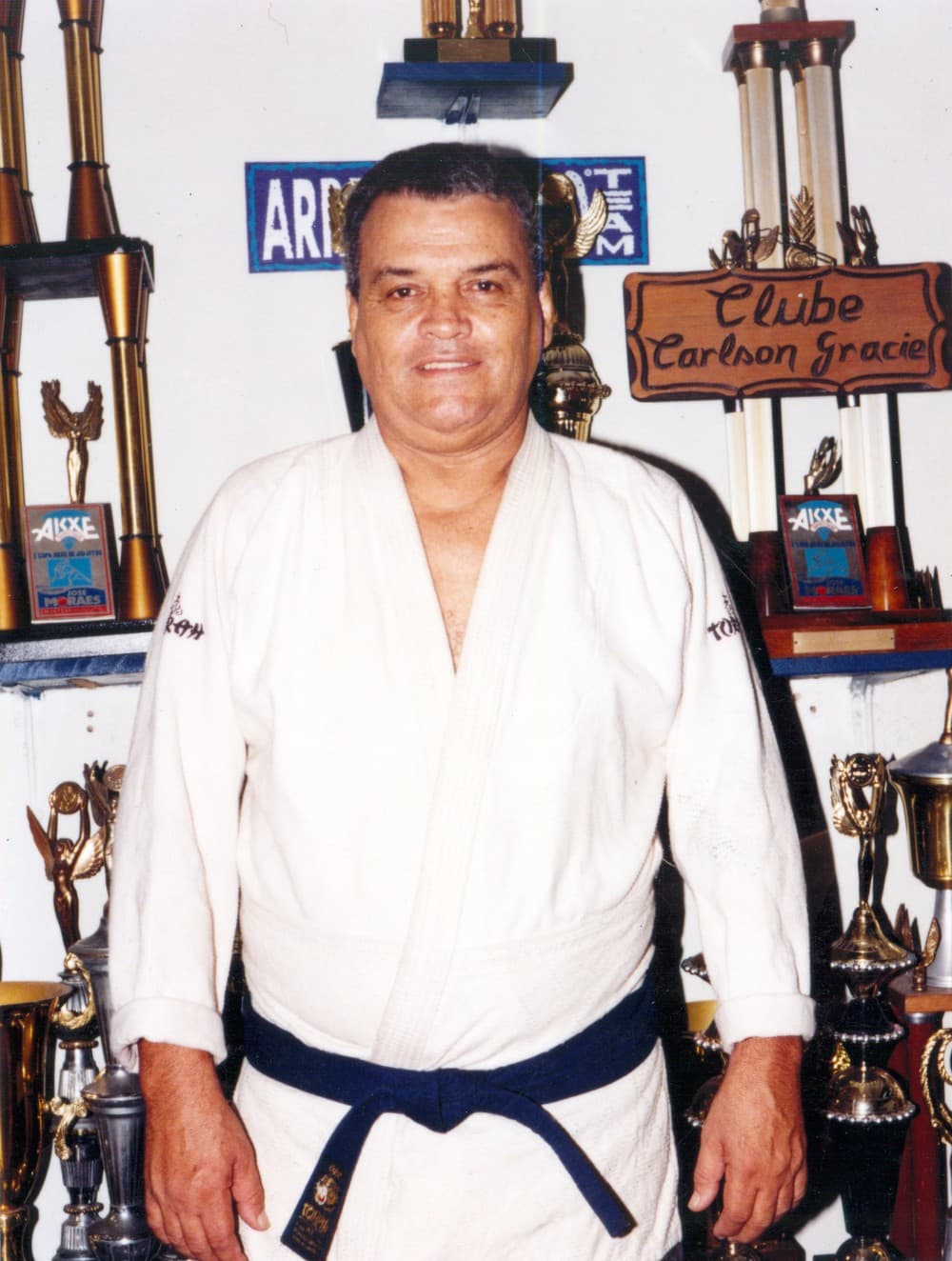
Creator credit recorded on the linked source page: FPS CORP · CC BY-SA 4.0
Carlson Gracie
Carlson Gracie taught generations at his Copacabana academy, shaping jiu-jitsu competitors and coaches before his death in 2006.
Biography
Sources for this profile
BJJ Heroes, “Carlson Gracie,” n.d.(opens in a new tab)
BJJ Heroes identifies Carlson Gracie as Carlos Gracie's son and places his birth in Rio de Janeiro in 1932.
Where in the source: Carlson Gracie Biography — birth sentence naming Rio de Janeiro and Carlos Gracie
Accessed:
BJJ Heroes describes Carlson Gracie as a leading vale tudo competitor during the 1950s and 1960s.
Where in the source: Carlson Gracie Biography — “top competitor in No Holds Barred/Vale Tudo”
Accessed:
BJJ Heroes reports that Carlson opened his academy to poorer students and at times waived fees in return for commitment and competition.
Where in the source: Carlson Gracie Biography — group classes, lower classes, and training without payment
Accessed:
ge, “15 anos sem Carlson Gracie: a história e o legado do maior formador de lutadores do mundo,” 31 January 2021.(opens in a new tab)
After retiring in 1970, Carlson opened an academy with Ivan Gomes in Copacabana, then another on Rua Figueiredo de Magalhães.
Where in the source: A mudança para treinador; Copacabana academy paragraphs.
Accessed:
After a team split, Murilo Bustamante, Zé Mário Sperry, Bebeo Duarte and Ricardo Libório founded Brazilian Top Team.
Where in the source: Team split and Brazilian Top Team paragraphs.
Accessed:
Carlson moved to Chicago in the early 2000s and died there on 1 February 2006.
Where in the source: Final Chicago and death paragraphs.
Accessed:
After Hélio Gracie lost to Waldemar Santana, Carlson challenged Santana in vale tudo.
Where in the source: Opening career narrative; Santana paragraphs.
Accessed:
American Top Team leader Marcus Silveira credited mentor Carlson with shaping his approach to training fighters.
Where in the source: MMA legacy section; Silveira statement.
Accessed:
ge, “Papo Cruzado: Sérgio Mallandro lembra trajetória na luta: ‘Fui o sexto aluno do Carlson Gracie’,” 24 February 2025.(opens in a new tab)
In a 2025 interview, former student Sérgio Mallandro recalled that students who lacked money could continue training at Carlson Gracie's academy after an initial payment.
Where in the source: Papo Cruzado — Mallandro's recollection of the academy's payment practice
Accessed:
'An interview with Carlson Gracie', UCLA-hosted Carlson Gracie Jiu-Jitsu archive, page last modified 21 May 1996.(opens in a new tab)
In a contemporary interview, Carlson said he shared his techniques with students, studied jiu-jitsu and free-style matches, and watched individuals to decide which part of their game needed work.
Where in the source: 1996 interview, question on coaching champions.
Accessed:
In that Los Angeles interview, Carlson described a plan to build a United States competition team modeled on his Brazilian team, entering both jiu-jitsu and free-style tournaments.
Where in the source: 1996 interview, opening Los Angeles questions.
Accessed:
Fighters Club Forum interview with Murilo Bustamante, Onzuka.com, 11 December 1999.(opens in a new tab)
In a December 1999 interview, Murilo Bustamante said he began training with Carlson Gracie as a child, that Carlson remained his instructor, and that team members assembled for hard sessions weekly and for intensive preparation before competitions.
Where in the source: Questions on background, lifelong instructor, training with Carlson and how often the team gathers, immediately after discussion of Heroes event
Accessed:
Can, 'Interview: Ricardo de la Riva on DLR Guard, Modern Guards & Carlson', Artemis BJJ, 27 November 2014.(opens in a new tab)
Ricardo de la Riva recalled that guard passing was a strong focus in Carlson Gracie's competition team; repeated attempts by older teammates to pass his guard pushed him to develop his own guard while Carlson observed and advised him.
Where in the source: First Artemis BJJ interview exchange on the de la Riva guard and team guard passing, before the question on flexibility
Accessed:
De la Riva said he assisted classes for girls and children as a blue belt at Carlson's academy and later led the whole class as a purple belt, learning an approach to teaching by watching Carlson.
Where in the source: Artemis BJJ interview question 'What was it like to teach at the Carlson academy during the 80s?'
Accessed:
GRACIEMAG, 'Ricardo de la Riva recounts creation of his guard, historic roll with Murilo Bustamante', 28 December 2016.(opens in a new tab)
De la Riva recalled Carlson stopping a multi-pair academy session so teammates could watch his sparring with Bustamante, and said teammates' passing attempts and feedback helped him refine the leg-hook guard he developed.
Where in the source: De la Riva's quoted recollection of training with Bustamante, '10 or 12 rolls', and teammates' feedback
Accessed:
Daniël Bertina, interview with Carlson Gracie Jr., BJJ Legends, January 2011.(opens in a new tab)
Carlson Gracie Jr. said his father preferred taking opponents down and fighting from the top; he contrasted that family preference with the strong guard players in their team, including de la Riva and Bustamante.
Where in the source: Carlson Jr. interview answers to 'playing the Top' and 'what does your school do different?'
Accessed:
Fábio Juppa and Gleidson Venga, ge, 'Em 1991, desafio entre jiu-jítsu e luta-livre colocou o vale-tudo na tevê em horário nobre', 21 March 2022.(opens in a new tab)
A ge reconstruction, including participants' recollections, places Carlson Gracie among the senior figures who organized a televised 1991 jiu-jitsu-versus-luta-livre challenge in Rio; he helped negotiate the matchups, while Wallid Ismail, Murilo Bustamante and Fábio Gurgel fought the three bouts.
Where in the source: Opening event reconstruction; Bustamante interview on Carlson and Marcelo Behring leading talks; 'Restaram três lutas' through three named pairings
Accessed:
Thomas Gerbasi, UFC, 'UFC Flashback: Murilo Bustamante', 23 January 2019.(opens in a new tab)
UFC records that Carlson Gracie awarded Murilo Bustamante his black belt and that Bustamante won the promotion's middleweight title against Dave Menne in January 2002, becoming its first Brazilian titleholder.
Where in the source: UFC Flashback: Murilo Bustamante — opening biography and 11 January 2002 title-bout account
Accessed:
Vinicius Cruz, 'At 80, Carlson Gracie lives', GRACIEMAG, August 2013.(opens in a new tab)
Carlson student Vinicius Cruz recalled distinct classes taught by Carlson Gracie Jr., Marcelo Alonso and Marcelo Saporito at the Copacabana academy, followed by open sparring among senior teammates, while Carlson Sr. observed, corrected positions and followed students at competitions.
Where in the source: Vinicius Cruz remembrance: paragraphs from 'I often saw my idols studying positions' through the daily class sequence and free practice at Figueiredo Magalhães
Accessed:
Gymdesk Originals, 'University Executive by Day, Jiu-Jitsu Professor by Night: Inside Chicago MMA', 28 May 2026.(opens in a new tab)
Chicago coach Misho Ceko recalled training with Carlson Gracie Sr. after earning his own black belt in 2004 and moving to Chicago; in one class Carlson stopped him to correct even how he tied his belt.
Where in the source: Gymdesk Originals transcript, Misho Ceko segment after 'I got a black belt from Ralph in 2004' and description of training with Carlson Sr. in Chicago
Accessed: