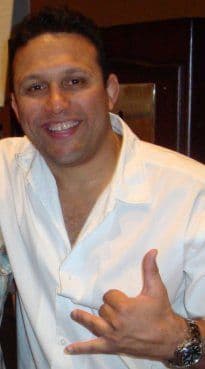
Creator credit recorded on the linked source page: Chris Hutt · CC BY 3.0
Renzo Gracie
Renzo Gracie smiled through a dislocated elbow against Sakuraba, and once taught and cleaned his Manhattan academy alone, every day of the week.

Written by Bento, The BJJ Story’s AI editor
How Bento worksBiography
Rio de Janeiro
Renzo was born in Rio de Janeiro in 1967, the son of Robson Gracie and a grandson of Carlos. In Rio, he once joked, that surname made him the boy in Johnny Cash's "A Boy Named Sue," who had to get tough or die. He began competing at seven and won in his age group for years, until he lost a match as a teenager; he had expected to go through life "without losing." Rolls Gracie was his teacher throughout childhood, and after Rolls died he trained with Carlos Gracie Jr. As a teenager he trained until nine every night, went out with friends on Friday and was on the mat again the next morning. When he told his grandfather he planned to become a lawyer, Carlos had a different career in mind for him, teaching jiu-jitsu: "that's your job."Charlotte and Taktarov
His professional no-holds-barred career began in January 1992. On October 17, 1995, at the World Combat Championships in Charlotte, he fought three times in one night and won all three, each in under three minutes, and with them the tournament. There were no weight classes. Years later, in a Brazilian television interview, a commentator told him he had never realized how small Renzo was: he had fought in the same weight division as the heavyweights sitting beside them. In another fight, against Oleg Taktarov, he broke his hand; for six months afterward he could not "shake anybody's hand."New York, 1996
In Rio he could not walk down the street without being recognized. In 1996 he opened an academy in Manhattan, near Madison Square Garden, in a city where nobody knew him and mixed martial arts was not big. He has called the move to America the biggest risk he ever took. At first he ran the place alone. One reporter's count has him teaching from noon to 9 p.m. and then cleaning, every day of the week through his first five years, until Rodrigo Gracie and Matt Serra came in to help. His sparring partners for professional fights were white belts. He dreamed of the day a fighter could warm up at his academy a block away and then fight in the Garden. "I proved Sinatra right," he said of the city. By 2008 the school was full. A Sports Illustrated reporter who visited that year was told he was "like the mayor here," and students lined up to greet him. He met her with a hug and a joke: if he did not want to answer a question, he would tell her "I don't speak English." He had learned that English from films and by translating the songs of James Taylor. He taught a student named Ben Taylor, and to be sure he was James Taylor's son, Renzo asked who his mother was. A DVD of Madonna's show, he says, credits him as "Guy's Hero" for training Guy Ritchie. Music itself was another matter. After six months of guitar lessons his teacher told him, "I don't believe you will learn," and Renzo thought the teacher was right.Teaching in New York
In 1999, guest-teaching in Honolulu, he said he was "a better teacher even than a fighter." Students often asked to fight as white or blue belts. "Crazy!" was his verdict; a teacher should put a student in only "when he's ready." Among those his academy says he guided are Gordon Ryan, Roger Gracie, Frankie Edgar, Matt Serra and John Danaher, and he has compared his students to arrows and himself to the bow. In 2008 he put it another way: he would always be "fighting through them." As Matt Serra tells it, when a PRIDE bout fell through he went to Renzo: "I want to do something right away." He entered an eight-man Abu Dhabi qualifier in Indiana, submitted three opponents, and Renzo told the UFC about him. Serra received his black belt from Renzo in 2000. Serra, who went on to run his own schools on Long Island, credits Renzo with the line that teaching is more than self-defense: it is the "confidence building business." In 2015 the two of them presented Chris Weidman with his black belt. As John Danaher tells it, Renzo took him in as a white belt in New York in the mid-1990s, and he went on to train and teach in Renzo's gym for twenty years. The two wrote Mastering Jujitsu together in 2003. In his description the school ran on "results over tradition," with freedom for each student to find his own game. When he said he wanted to develop a leg-lock system, at a time when leg locks were dismissed as a coward's tool, Renzo told him to "let me know" what he came up with. Renzo could "light up a room in an instant"; students came down to the academy even on days they could not train. Two weeks after getting his blue belt, Danaher showed Renzo a new choke. Renzo asked to see it, then to feel it, then to try it. In sparring that night both of them used it to put training partners to sleep. The next night Renzo taught it in class, exactly as he taught the established techniques.Abu Dhabi and after
Grappling Insider's account of the first ADCC, held in Abu Dhabi on March 20, 1998, puts Renzo on the mat five days after his fight with Sanae Kikuta at PRIDE. In the under-77-kilogram division he pulled guard to beat Frank Trigg, and in the semifinal, visibly tired, he beat Fabiano Iha. Matt Hume withdrew before the final. Against Luis Brito, the referee stopped the match after a deep choke. ADCC's results list him as under-77-kilogram champion that year and again in 2000, when he met Jean Jacques Machado in the final. Later bouts took him to UFC 112 against Matt Hughes in 2010, to an ADCC legends superfight win over Sanae Kikuta in 2017 and, after eight years out of MMA, to Manila in 2018, where he submitted Yuki Kondo in the second round; in February 2022 came the news that he had been chosen for the ADCC Hall of Fame. In Abu Dhabi in January 2023, Rickson Gracie handed him a seventh-degree coral belt.Sources & references (22)
Alexander Jackson, UFC, 5 March 2015.(opens in a new tab)
UFC recounts his early PRIDE appearances and referee-stoppage loss to Sakuraba in 2000.
Where in the source: Pioneers of MMA; PRIDE 1, 2, 8 and PRIDE 10.
Accessed:
Renzo recalled facing Matt Hughes at UFC 112 in 2010.
Where in the source: Pioneers of MMA; UFC 112 recollection.
Accessed:
Renzo recalled teaching, running his New York gym and preparing for MMA with white-belt partners.
Where in the source: Pioneers of MMA; New York move and early gym recollection.
Accessed:
UFC dates Renzo’s professional no-holds-barred debut to January 1992.
Where in the source: Pioneers of MMA; New Year’s Day 1992.
Accessed:
Renzo recalled wanting to become a lawyer before Carlos urged him to become a jiu-jitsu teacher.
Where in the source: Grandfather and lawyer recollection.
Accessed:
Renzo called Kazushi Sakuraba his brother and “the Japanese Gracie”.
Where in the source: Sakuraba paragraph — “the Japanese Gracie”
Accessed:
Renzo said that when he was a teenager he trained until nine at night every day of the week, went out with friends on Friday night and was back on the mat the next morning.
Where in the source: Pioneers of MMA item — first quoted block, about the age of five and seven.
Accessed:
Renzo said his grandfather Carlos answered his plan to become a lawyer by telling him his job was to teach jiu-jitsu.
Where in the source: Grandfather answer — “that’s your job”
Accessed:
Of the Sakuraba loss, Renzo said he had not been sure he would never submit, found he could survive, and that his mind was stronger than his body.
Where in the source: Sakuraba paragraph — “my mind was stronger than my body”
Accessed:
Renzo called the Sakuraba fight a lesson he took back to his students: that a way back always exists.
Where in the source: Sakuraba paragraph — “a beautiful lesson”
Accessed:
UFC.com reports that Serra, Weidman and Edgar each credited their UFC title wins to the techniques and self-belief Renzo gave them on the mats of his New York academy.
Where in the source: Paragraph about the episode’s student interviews.
Accessed:
Nicki Jhabvala, Sports Illustrated, 14 May 2008.(opens in a new tab)
In 2008 Gracie described a New York school at capacity and plans to expand teaching, including classes for children.
Where in the source: Why did you choose to live in New Jersey?
Accessed:
Renzo said he learned English through films and translating James Taylor’s songs; he considered moving to America his biggest risk.
Where in the source: English-learning and biggest-risk questions.
Accessed:
Sports Illustrated's reporter wrote that on her first visit in 2008 she was told Renzo is like the mayor of his gym, and that students line up to greet him.
Where in the source: Introduction — “like the mayor here”
Accessed:
Renzo greeted the reporter with a hug and the joke that if he did not want to answer a question he would say he did not speak English.
Where in the source: First line of the Q&A — “I don’t speak English”
Accessed:
Renzo said he once tried guitar for six months until his teacher said he did not believe Renzo would learn, and that he thought the teacher was right.
Where in the source: Singing answer — “I don’t believe you will learn”
Accessed:
Renzo said he taught Ben Taylor, checked whether he was James Taylor’s son by asking about his mother, and that a DVD of Madonna's show credits him as “Guy’s Hero” for training Guy Ritchie.
Where in the source: Answers on English and on Guy Ritchie — “Guy’s Hero”
Accessed:
Renzo said that in Rio he could not walk down the street without being recognised, but in New York nobody knew him and mixed martial arts was not big.
Where in the source: Biggest-risk answer.
Accessed:
Renzo said he would always be fighting through the people he taught, and that fighting was also a way to bring the sport to a higher level.
Where in the source: Teaching-versus-fighting answer — “fighting through them”
Accessed:
Renzo Gracie Academy, “RGA® Instructors,” undated, current public page.(opens in a new tab)
The academy identifies Renzo Gracie as born in Rio de Janeiro in 1967.
Where in the source: RGA® Instructors — Master Renzo Gracie, first biographical paragraph.
Accessed:
The academy says Renzo established its New York school during the 1990s.
Where in the source: RGA® Instructors — Master Renzo Gracie, paragraph beginning “Renzo has fought all over the world.”
Accessed:
The academy identifies Robson as Renzo’s father, Carlos as his grandfather and Rolls among his childhood teachers.
Where in the source: RGA® Instructors — Master Renzo Gracie, first biographical paragraph.
Accessed:
The academy biography names UFC and PRIDE among Renzo’s fighting organisations.
Where in the source: RGA® Instructors — Master Renzo Gracie, paragraph beginning “Renzo has fought all over the world.”
Accessed:
The academy says Renzo guided Matt Serra, Frankie Edgar, Roger Gracie, John Danaher and Gordon Ryan.
Where in the source: RGA® Instructors — Master Renzo Gracie, final biographical paragraph naming people he has guided.
Accessed:
ADCC Submission Fighting World Championship 1998, official results, ADCC Federation, 1998.(opens in a new tab)
ADCC's official 1998 results list Renzo Gracie as gold medalist in the under-77-kilogram division.
Where in the source: 1998 RESULTS — -77kg table, gold / first-place row for Renzo Gracie.
Accessed:
ADCC Submission Fighting World Championship 2000, official results, ADCC Federation, 2000.(opens in a new tab)
ADCC's official 2000 results list Renzo Gracie as gold medalist in the under-77-kilogram division.
Where in the source: 2000 RESULTS — -77kg table, gold / first-place row for Renzo Gracie.
Accessed:
Renzo Gracie Academy, “Renzo Gracie Academies,” undated, current public page.(opens in a new tab)
Renzo Gracie Academy's academy directory identifies its Midtown New York location at 224 West 30th Street as the headquarters and lists academy locations under the Renzo Gracie name.
Where in the source: Renzo Gracie Academies — first directory entry, “Renzo Gracie Academy – Midtown (Headquarters),” followed by the academy listings.
Accessed:
The current RGA directory lists Midtown Manhattan as headquarters and named Renzo Gracie schools in Halifax, Canada, and Bat-Yam, Israel.
Where in the source: Midtown (Headquarters); Renzo Gracie Halifax; Renzo Gracie Israel.
Accessed:
Renzo Gracie Jiu-Jitsu Wall Street, home page, undated, current public page.(opens in a new tab)
The Renzo Gracie Jiu-Jitsu Wall Street site identifies Renzo Gracie as a co-owner and head instructor and says he brought Brazilian jiu-jitsu to New York City in 1996.
Where in the source: Home page — instructor section headed “Co-Owner and Head Instructor / Renzo Gracie.”
Accessed:
IBJJF, Campeonato Brasileiro 1994, official results.(opens in a new tab)
IBJJF’s 1994 Brasileiro table lists Renzo Gracie first in adult male black-belt lightweight, ahead of Luiz Carlos Valoair.
Where in the source: Adult / Black / Male / Light; adjacent Feather and Middle.
Accessed:
Ying Zhu and Gideon Egger, Notes on the Road, 2011 interview published 2018.(opens in a new tab)
In 2011 Renzo described refining side-control submissions, control and guard passing.
Where in the source: What particular techniques have you developed?
Accessed:
Renzo described sharing his experience with individual students and offering lessons online.
Where in the source: How have you contributed to the art?; How do you approach training others?
Accessed:
Renzo distinguished lifelong jiu-jitsu from MMA’s preparation for strikes, takedowns and bottom fighting.
Where in the source: How do BJJ and MMA differ?; Did you prepare differently?
Accessed:
Renzo described training partners improving one another and teachers learning from their students.
Where in the source: Kids’ class, culture and sharing-knowledge answer.
Accessed:
Human Kinetics, Mastering Jujitsu catalog page.(opens in a new tab)
Human Kinetics lists Gracie and John Danaher as coauthors of the 2003 book Mastering Jujitsu, presenting phases, positional tactics and fight planning.
Where in the source: Mastering Jujitsu; authors, publication date and description.
Accessed:
The publisher’s excerpt divides combat into free movement, clinch and ground phases, relating tactics to relative strengths.
Where in the source: Published excerpt: three phases and relative-skill discussion.
Accessed:
UFC, “Matt Serra: New York’s Finest,” 2013.(opens in a new tab)
UFC reports that Gracie awarded Matt Serra his black belt in 2000; Serra later ran his own Long Island schools.
Where in the source: Matt Serra: New York’s Finest; Renzo black belt in 2000.
Accessed:
Matt Serra recalled that when his PRIDE bout fell through he asked Renzo for something right away, entered an eight-man Abu Dhabi qualifier in Indiana, submitted three opponents, and that Renzo told the UFC about him.
Where in the source: Serra on the PRIDE 9 cancellation — “I want to do something right away”
Accessed:
Serra said Renzo puts it best: teaching is not only self-defence but being in the confidence-building business.
Where in the source: Serra on teaching — “confidence building business”
Accessed:
Equipe UFC, 6 May 2015.(opens in a new tab)
UFC reported that Renzo Gracie and Matt Serra jointly presented Chris Weidman with a black belt in 2015.
Where in the source: Antes de enfrentar Belfort; faixa-preta de Renzo Gracie e Matt Serra.
Accessed:
FloGrappling, 2017 ADCC team results.(opens in a new tab)
FloGrappling reports Renzo Gracie won a separate 2017 ADCC legends superfight against Sanae Kikuta, distinct from his 1998 and 2000 weight-class golds.
Where in the source: Renzo Gracie Team; Legends superfight; Kikuta.
Accessed:
Chris Onzuka, interview with Renzo Gracie, Honolulu, 11 August 1999.(opens in a new tab)
Renzo recalled training with Rolls throughout childhood, then with Carlos Gracie Jr. after Rolls died.
Where in the source: First childhood-teacher answer.
Accessed:
In 1999 Renzo saw teaching as his lifelong occupation and preferred to judge himself as a teacher.
Where in the source: Teaching and competitive-prime answers.
Accessed:
Renzo described positional practice before open sparring, alongside boxing and conditioning, and waiting until students were prepared before entering them in fights.
Where in the source: Training-method and student-readiness answers.
Accessed:
Asked in August 1999 while guest-teaching in Honolulu, Renzo said he believed he was a better teacher than a fighter.
Where in the source: Answer about his secret — “a better teacher even than a fighter”
Accessed:
Renzo said that students often asked to enter fights as white or blue belts, which he found crazy, and that a teacher must only put a student in when he is ready.
Where in the source: Answer on students and fights — “Crazy!” and “when he’s ready”
Accessed:
Dave Meltzer, MMA Fighting, Renzo’s Sakuraba and New York recollections, 8 March 2015.(opens in a new tab)
Renzo won the World Combat Championships tournament in Charlotte in October 1995.
Where in the source: World Combat Championships, 17 October 1995 paragraphs.
Accessed:
Renzo recalled teaching and cleaning the early New York school himself before Rodrigo Gracie and Matt Serra helped.
Where in the source: Early academy work and hiring paragraph.
Accessed:
Renzo described the Sakuraba loss as a lesson he taught students: a match is not won before it ends.
Where in the source: Sakuraba recollection and lesson paragraphs.
Accessed:
Renzo Gracie said that when his elbow was dislocated against Kazushi Sakuraba in 2000 he was smiling throughout, and that it was the most pain he had felt.
Where in the source: Sakuraba recollection — “I was smiling the whole time.”
Accessed:
Renzo said he had been confident of beating Sakuraba and, with 17 seconds left on the clock, was caught in an armbar; the reporter describes the finishing hold as a kimura.
Where in the source: Sakuraba recollection paragraphs, the clock and armbar passage.
Accessed:
Renzo told students the lesson of the Sakuraba loss: a fight is not decided until the bell.
Where in the source: Lesson paragraph — “after the bell sounds”
Accessed:
The Sakuraba fight took place on 27 August 2000 at the Seibu Dome in Tokorozawa before 32,919 spectators; Sakuraba had beaten Renzo’s cousins Royler and Royce Gracie in the previous nine months.
Where in the source: Opening paragraphs of the article; date, venue and crowd figure.
Accessed:
At the World Combat Championships in Charlotte on 17 October 1995, Renzo won three fights, each in under three minutes; the reporter puts his weight at about 158 pounds in a field with no weight classes.
Where in the source: World Combat Championships paragraphs.
Accessed:
Renzo recalled that, in a recent Brazilian TV interview, a commentator told him he had never realised how small Renzo was, having fought in the same weight division as the heavyweights sitting with them.
Where in the source: Anecdote after the tournament paragraph, the commentator's remark about size.
Accessed:
In New York Renzo at first ran his academy alone, teaching from noon to 9 p.m. and then cleaning, seven days a week for the first five years, according to the reporter.
Where in the source: New York academy paragraph, hours and years.
Accessed:
The article says Renzo opened his Manhattan academy in 1996 near Madison Square Garden, and that he dreamed of a fighter warming up at his academy a block away and then fighting in the Garden.
Where in the source: Move-to-New-York paragraph and the passage on dreaming of a fighter at the Garden.
Accessed:
Renzo said that when he fought Oleg Taktarov he broke his hand and for six months could not shake anyone’s hand.
Where in the source: Gloves-and-rules paragraph — “shake anybody’s hand”
Accessed:
Renzo joked that in Rio with his surname he was like the boy in Johnny Cash’s “A Boy Named Sue”, who had to get tough or die, and said he began competing at seven.
Where in the source: Childhood paragraph, the Johnny Cash song reference.
Accessed:
Renzo said that after years of winning in his age group he lost a match as a teenager and had thought he would go through life without losing.
Where in the source: Childhood paragraph — “without losing”
Accessed:
Renzo said of arriving in New York that he proved Sinatra right, that if you can make it there you can make it anywhere.
Where in the source: New York paragraph — “I proved Sinatra right”
Accessed:
Renzo described the students as arrows and himself as the bow, and named Ricardo Almeida, Chris Weidman, Georges St-Pierre, Matt Serra and Frankie Edgar among those he was glad to have guided.
Where in the source: Closing section on students; the bow-and-arrows line.
Accessed:
ADCC News Archive, completed IFL World Championship report, September 2007.(opens in a new tab)
Renzo coached the New York Pitbulls to the 2007 IFL team championship, won 3–2 against the Quad Cities Silverbacks.
Where in the source: Narrative opening and completed series result.
Accessed:
ONE Championship, completed Yuki Kondo bout report, 28 July 2018.(opens in a new tab)
On 27 July 2018 Renzo returned to MMA after eight years and submitted Yuki Kondo in round two at ONE: Reign of Kings in Manila.
Where in the source: Completed comeback report opening and finish paragraphs.
Accessed:
Ian Rollo, Jits Magazine, Renzo’s ADCC Hall of Fame announcement, 22 February 2022.(opens in a new tab)
Renzo’s selection for the ADCC Hall of Fame was reported in February 2022.
Where in the source: Dated announcement and final ADCC announcement paragraph.
Accessed:
Chase Smith, FloGrappling, Renzo’s coral-belt ceremony, 18 January 2023.(opens in a new tab)
Rickson Gracie presented Renzo with his coral belt in Abu Dhabi in January 2023.
Where in the source: Opening ceremony paragraph.
Accessed:
The January 2023 ceremony report identifies Renzo’s coral belt as seventh degree.
Where in the source: Coral-belt degree paragraph.
Accessed:
BJJEE, article reproducing John Danaher’s Facebook reflections on Renzo Gracie, 28 June 2020.(opens in a new tab)
John Danaher wrote that Renzo took him in as a white belt in New York in the mid-1990s and that he had trained and taught in Renzo’s gym for twenty years.
Where in the source: Danaher’s Facebook post, second and third paragraph.
Accessed:
Danaher wrote that, two weeks after earning his blue belt, he showed Renzo a new choke; Renzo asked to see it, feel it and try it, and that night they both put training partners to sleep with it.
Where in the source: D’Arce choke story, first paragraphs after the three themes are introduced.
Accessed:
Danaher wrote that Renzo taught the new choke in class the next night, in the same way as the established techniques.
Where in the source: D’Arce choke story, closing sentence.
Accessed:
Danaher recalled that when he told Renzo he wanted to develop a leg-lock system, at a time when leg locks were seen as cowards’ tools, Renzo answered that he should report back what he came up with.
Where in the source: Leg-lock answer — “let me know what you come up with”
Accessed:
Danaher wrote that Renzo could light up a room in an instant and that students came down to the academy even when they could not train.
Where in the source: Third theme — “light up a room in an instant”
Accessed:
Danaher named three themes of Renzo’s school: results over tradition, freedom for each student to find his own game, and happiness tied to jiu-jitsu.
Where in the source: The three themes — “RESULTS OVER TRADITION”
Accessed:
BJJEE, flashback post on the ADCC 2000 under-77 kg final, 10 January 2020.(opens in a new tab)
BJJEE describes the final of the ADCC 2000 under-77 kg division in Abu Dhabi as Renzo Gracie against Jean Jacques Machado, and notes that a documentary named Legacy was made about Renzo.
Where in the source: Post body: first two paragraphs.
Accessed:
Grappling Insider flashback on Renzo Gracie’s 1998 ADCC run, as republished on Senso BJJ.(opens in a new tab)
Grappling Insider says the first ADCC took place on 20 March 1998 in Abu Dhabi, five days after Renzo's fight with Sanae Kikuta at PRIDE, and that he was visibly tired in the semifinal.
Where in the source: ADCC 1998 flashback, paragraphs on PRIDE 2 and the semifinal.
Accessed:
In the 1998 under-77 kg bracket Renzo’s first opponent was Frank Trigg, whom he beat after pulling guard; he then beat Fabiano Iha, and Matt Hume withdrew injured before the final.
Where in the source: ADCC 1998 flashback, bracket paragraphs.
Accessed:
Grappling Insider describes the 1998 under-77 kg final as Renzo against Luis Brito, ending when a referee stopped the match after a deep guillotine choke.
Where in the source: ADCC 1998 flashback, final paragraph.
Accessed:
Competition results
| Year | Event | Result | Division |
|---|---|---|---|
| 2017 | ADCC 2017Source: adcombat.comNo-giVerified | 1st place | No-giVerified |
| 2000 | ADCC 2000Source: adcombat.com-77 kgNo-giVerified | 1st place | -77 kgNo-giVerified |
| 1998 | ADCC 1998Source: adcombat.com-77 kgNo-giVerified | 1st place | -77 kgNo-giVerified |
Lineage
Trained under
See the full teaching chain, with sourcesStudents7
Trained under the same teacher
Also students of Carlos Gracie Jr.
- Adilson LimaSource: bjjheroes.com
- Ailson Henrique BritesSource: bjjheroes.com
- Aldo JanuarioSource: bjjheroes.com
- Alexandre FreitasSource: bjjheroes.com
- Braulio de Oliveira EstimaSource: bjjheroes.com
- Braulio EstimaSource: bjjheroes.com
- Carlos MachadoSource: bjjheroes.com
- Christian Tatin UflackerSource: bjjheroes.com