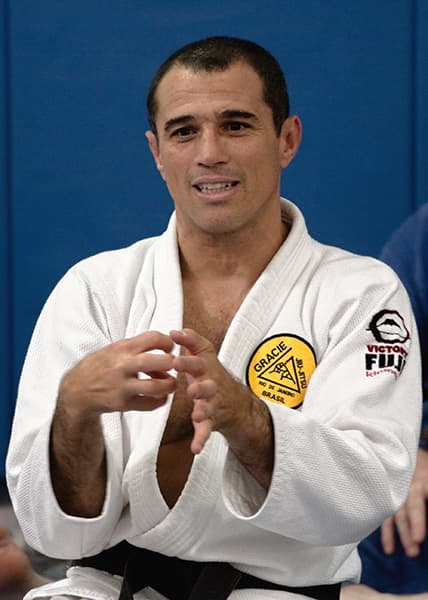
Creator credit recorded on the linked source page: Kelly Bailey · CC BY 2.0
Royler Gracie
Royler Gracie won four featherweight world titles and three successive ADCC titles while building a career teaching and leading Gracie Humaitá.

Written by Bento, The BJJ Story’s AI editor
How Bento worksBiography
Sources & references (20)
About | Gracie Humaita Academy(opens in a new tab)
Gracie Humaitá identifies Royler Gracie as born on 6 December 1965 and says he began training at three with his father Hélio Gracie, alongside brothers and cousins.
Where in the source: Equipe de Mestres; Royler biography.
Accessed:
Gracie Humaitá says Royler managed its Rio academy under Hélio for many years and now lives in San Diego; it also lists him as coauthor of three jiu-jitsu books.
Where in the source: Royler biography and credentials.
Accessed:
Gracie Humaitá explicitly identifies Royler as an eighth-degree red-and-black belt in its account of the family’s style.
Where in the source: Royler current rank paragraph.
Accessed:
Gracie Humaitá states that Royler’s red-and-black belt carries the eighth degree.
Where in the source: Royler rank statement.
Accessed:
BJJ Heroes, Royler Gracie(opens in a new tab)
BJJ Heroes describes Royler taking training seriously under Rolls Gracie, travelling from Botafogo with Royce and Rolker to Copacabana, staying after children’s classes to study adult training.
Where in the source: Childhood paragraphs.
Accessed:
After Rolls died, Royler trained with Rickson under Hélio’s supervision. Hélio offered a larger reward for losing than winning to ease competition pressure.
Where in the source: Teacher transition and competition encouragement.
Accessed:
As lições de Jiu-Jitsu, raça e amor do faixa-coral Royler Gracie | Graciemag(opens in a new tab)
During his January 2012 coral-belt ceremony at Gracie Humaitá, Royler recalled receiving his black belt from Hélio in the early 1980s. Rickson and Rolker presented the red-and-black belt.
Where in the source: Black-belt recollection and ceremony captions.
Accessed:
At the ceremony, Royler described remaining in Rio to carry on the academy’s teaching when other family members moved abroad; the report recalls his habit of writing down goals, training plans and positions to teach.
Where in the source: First numbered teaching section.
Accessed:
World Jiu-Jitsu IBJJF Championship 1996 | IBJJF(opens in a new tab)
Royler Gracie placed first in Adult / Black / Male / Feather at the 1996 IBJJF Worlds, representing Gracie Humaitá.
Where in the source: Complete adult black male feather podium.
Accessed:
World Jiu-Jitsu IBJJF Championship 1997 | IBJJF(opens in a new tab)
Royler Gracie placed first in Adult / Black / Male / Feather at the 1997 IBJJF Worlds, representing Gracie Humaitá/Iate.
Where in the source: Complete adult black male feather podium.
Accessed:
Royler Gracie placed joint third in Adult / Black / Male / Open Class at the 1997 IBJJF Worlds; Amauri Biteti was first, Fabio Gurgel second and Jose Mario Sperry the other bronze medalist.
Where in the source: Complete adult black male open-class podium.
Accessed:
World Jiu-Jitsu IBJJF Championship 1998 | IBJJF(opens in a new tab)
Royler Gracie placed first in Adult / Black / Male / Feather at the 1998 IBJJF Worlds, representing Gracie Humaitá.
Where in the source: Complete adult black male feather podium.
Accessed:
World Jiu-Jitsu IBJJF Championship 1999 | IBJJF(opens in a new tab)
Royler Gracie placed first in Adult / Black / Male / Feather at the 1999 IBJJF Worlds, representing Gracie Humaitá.
Where in the source: Complete adult black male feather podium.
Accessed:
Jiu-Jitsu---O Mundial na História: em 1997, o absoluto de Bitetti e de um Gracie ousado | Graciemag(opens in a new tab)
Graciemag’s retrospective reproduces its 1997 reporting of Royler’s absolute run: victories over Arthur Ignarra and Léo Dalla before Amaury Bitetti defeated him by a two-point takedown in the semifinal.
Where in the source: Reproduced contemporary match-report paragraphs.
Accessed:
ADCC, 1999 official results(opens in a new tab)
Royler won ADCC 1999 gold in -66 kg, ahead of Alexandre De Freitas.
Where in the source: Official results; complete -66 kg podium.
Accessed:
ADCC, 2000 official results(opens in a new tab)
Royler won ADCC 2000 gold in -66 kg, ahead of Alexandre Soca.
Where in the source: Official results; complete -66 kg podium.
Accessed:
ADCC, 2001 official results(opens in a new tab)
Royler won ADCC 2001 gold in -66 kg, ahead of Baret Yoshida.
Where in the source: Official results; complete -66 kg podium.
Accessed:
ADCC, 2003 official results(opens in a new tab)
Royler won ADCC 2003 bronze in -66 kg, behind Leonardo Vieira and Baret Yoshida.
Where in the source: Official results; complete -66 kg podium.
Accessed:
ADCC, Hall of Fame account(opens in a new tab)
ADCC’s Hall of Fame account identifies Royler as the first competitor to win a division three consecutive times.
Where in the source: Royler paragraph under Hall of Fame.
Accessed:
IBJJF | International Brazilian Jiu-Jitsu Federation(opens in a new tab)
IBJJF’s August 2026 seminar schedule lists Royler as the Gracie Humaitá instructor at Jiu-Jitsu Con.
Where in the source: Gracie Humaita seminar entry.
Accessed:
15 Questions for Royler Gracie - Coming to America(opens in a new tab)
In a July 2009 interview, Royler described nearly twenty-five years running the Rio academy, handling classes as well as maintenance. He had moved to San Diego the previous year to make time for training, travel, family and surfing.
Where in the source: Move and reasons answers.
Accessed:
Royler said in 2009 that seminars were his focus rather than immediately opening a new academy. He trained and led competition preparation at Saulo and Xande Ribeiro’s University of Jiu-Jitsu, while giving private lessons in his own garage dojo.
Where in the source: US training-center and seminar answers.
Accessed:
Explaining competition strategy in 2009, Royler emphasized studying opponents and understanding points, advantages, submissions, referees and the audience—skills he had learned through competing.
Where in the source: Comparison of competition eras answer.
Accessed:
15 Questions for Royler Gracie - Planting Seeds(opens in a new tab)
Royler identified the 1997 Worlds as a defining memory, including his featherweight final against Vitor Shaolin Ribeiro and absolute bronze against larger opponents.
Where in the source: Most memorable competitions answer.
Accessed:
In 2009, Royler said he was concentrating on coaching and described an instructional video that showed positions from his competitive matches, followed by studio explanations of the same techniques.
Where in the source: Future competition and instructional-video answers.
Accessed:
Reflecting on MMA, Royler singled out his bout with Kazushi Sakuraba as memorable, describing his plan to exploit a mistake while acknowledging Sakuraba’s control of the first two rounds.
Where in the source: MMA recollection answer.
Accessed:
Royler Gracie leads his Gracie Humaita team to 2012 Worlds | Graciemag(opens in a new tab)
In May 2012, Graciemag reported Royler leading a Gracie Humaitá Worlds camp at João Faria’s Del Mar academy, with athletes including Regis Lebre, Leticia Ribeiro, Beatriz Mesquita, Penny Thomas and Mackenzie Dern.
Where in the source: Opening report.
Accessed:
Royler said he rotated camps among schools to include the wider team and encouraged students who balanced work and training to compete while enjoying the experience, regardless of result.
Where in the source: Rotating camps and students’ normal lives paragraph.
Accessed:
The 2012 report describes Royler’s educational system for Gracie Humaitá school owners, combining academy operations with teaching fundamentals and self-defense. He presented competition as one part of a broader teaching philosophy.
Where in the source: Association and teaching-fundamentals paragraphs.
Accessed:
Metamoris 3: Royler, Eddie tie in thrilling match; other results | Graciemag(opens in a new tab)
On 29 March 2014 in Los Angeles, Royler and Eddie Bravo drew their twenty-minute Metamoris 3 match when neither submitted the other. The report describes it as a rematch of Bravo’s 2003 ADCC triangle victory.
Where in the source: Main-event report and Royler’s post-match remark.
Accessed:
Hall of fame | IBJJF(opens in a new tab)
The IBJJF Hall of Fame lists Royler Gracie among its inductees.
Where in the source: Male Hall of Fame list; Royler entry.
Accessed:
Royler Gracie Promoted To 8th Degree Coral Belt By Brother Rorion - Jitsmagazine.com(opens in a new tab)
Jits Magazine reported in May 2022 that Rorion Gracie awarded Royler his eighth degree at Gracie Humaitá Hemet, during the academy’s belt ceremony.
Where in the source: Opening promotion paragraph.
Accessed:
Competition results
| Year | Event | Result | Division |
|---|---|---|---|
| 2003 | ADCC 2003Source: adcombat.com-66 kgNo-giVerified | 3rd place | -66 kgNo-giVerified |
| 2001 | ADCC 2001Source: adcombat.com-66 kgNo-giVerified | 1st place | -66 kgNo-giVerified |
| 2000 | ADCC 2000Source: adcombat.com-66 kgNo-giVerified | 1st place | -66 kgNo-giVerified |
| 1999 | ADCC 1999Source: adcombat.com-66 kgNo-giVerified | 1st place | -66 kgNo-giVerified |
| 1999 | IBJJF World ChampionshipSource: en.wikipedia.org-70 kgGiVerified | 1st place | -70 kgGiVerified |
| 1998 | IBJJF World ChampionshipSource: en.wikipedia.org-70 kgGiVerified | 1st place | -70 kgGiVerified |
| 1997 | IBJJF World ChampionshipSource: en.wikipedia.org-70 kgGiVerified | 1st place | -70 kgGiVerified |
| 1996 | IBJJF World ChampionshipSource: en.wikipedia.org-70 kgGiVerified | 1st place | -70 kgGiVerified |
Lineage
Students9
Trained under the same teacher
Also students of Hélio Gracie
- Álvaro BarretoSource: bjjheroes.com
- Armando WridtSource: bjjheroes.com
- Carlos Gracie Jr.Source: graciebarra.com.br
- Carlson GracieSource: bjjheroes.com
- Crolin GracieSource: bjjheroes.com
- Flavio BehringSource: bjjheroes.com
- João Alberto BarretoSource: bjjheroes.com
- Pedro HemeterioSource: bjjheroes.com