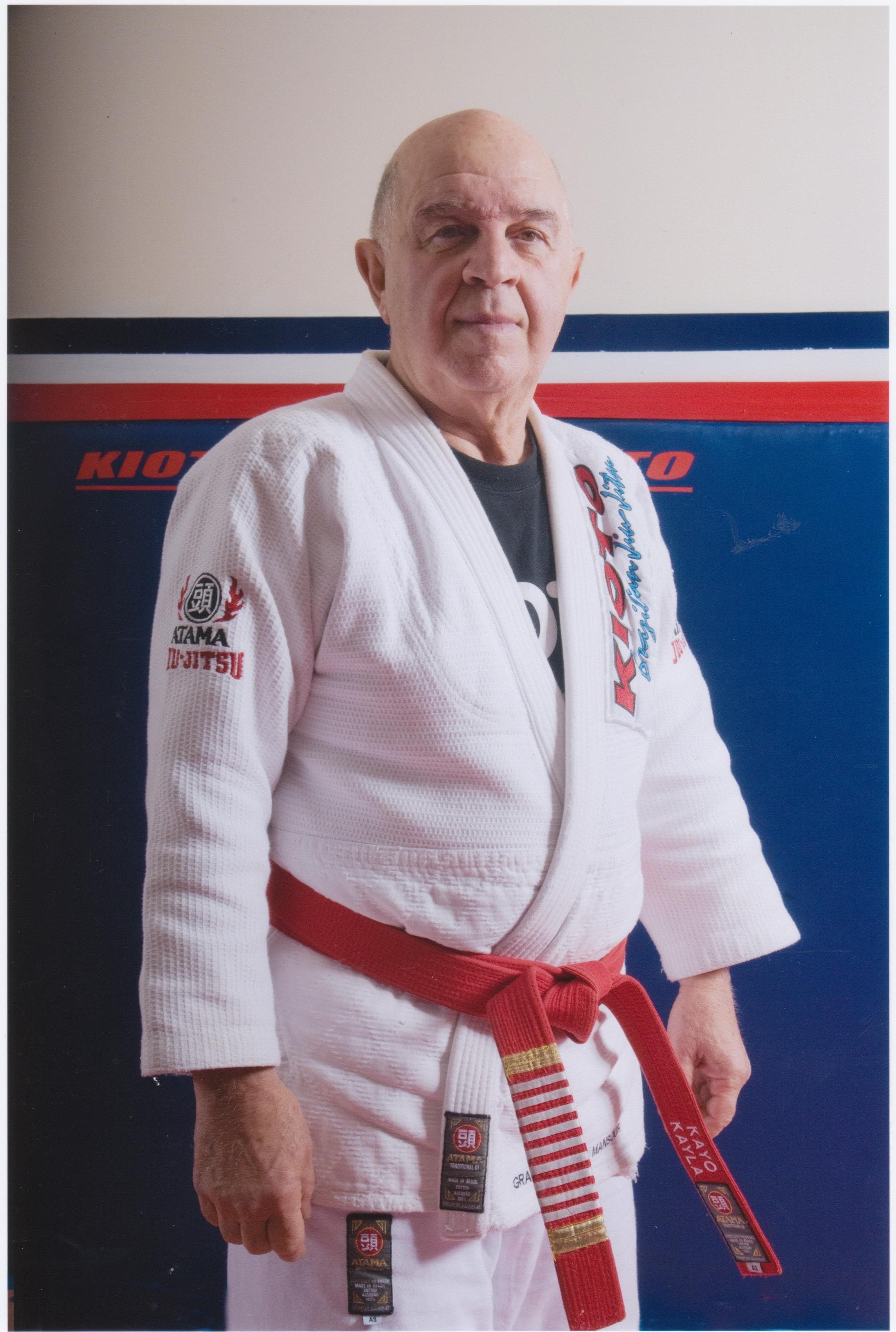
Creator credit recorded on the linked source page: Gmastermansor · CC BY-SA 3.0
Francisco Mansor
Chico Mansor, a ninth-degree red belt taught by Hélio Gracie, founded Rio's Kioto academy in 1965 and recalls a meeting that listed the sweeps for scoring.

Written by Bento, The BJJ Story’s AI editor
How Bento worksBiography
Sources & references (5)
GracieMag, “Homenagem surpresa a Chico Mansor ilumina parte valiosa da história do BJJ,” 3 December 2024.(opens in a new tab)
On 2 December 2024 a surprise tribute was held for Francisco Mansor, a red belt, at the Kioto academy in Rio de Janeiro, which the report says he founded in 1965; masters including Fernando Pinduka attended.
Where in the source: Opening paragraph; ordrett anker: “fundou em 1965”
Accessed:
GracieMag gives the pronunciation of his surname as Mansur and notes that he is called Chico.
Where in the source: Second paragraph, parenthetical “pronuncia-se Mansur”
Accessed:
In the report's account, Mansor came to Helio Gracie's academy in Rio de Janeiro, Helio welcomed him, and Mansor later called Helio a second father who redirected his aggression into jiu-jitsu training.
Where in the source: Paragraph on his first visit to Helio Gracie’s academy; quote “segundo pai”
Accessed:
The report says Mansor took part in several well-known vale-tudo fights and then became one of the most loyal followers of the Gracie family; it gives no fight count.
Where in the source: Paragraph on the vale-tudo fights; ordrett anker: “célebres combates”
Accessed:
GracieMag reports that Mansor, on reading Carlos Gracie’s 1948 book Introdução ao Jiu-Jitsu, saw the value of systematizing instruction for small children and shy students.
Where in the source: Paragraph on the 1948 book
Accessed:
Mansor recalls the first federation tournament in 1964, where straw mats were borrowed from each teacher, marked with the academy name and returned afterward in his pickup truck.
Where in the source: Quoted recollection on the first tournament; ordrett anker: “primeiro torneio, em 1964”
Accessed:
Mansor recalls meeting at João Alberto Barreto's academy in Copacabana with Hélio, Carlos, Carlson and Robson Gracie, Hélio Vígio and Barreto to settle scoring, and says they catalogued only seven known sweeps, against about 150 in Kioto's system today.
Where in the source: Quoted recollection on the meeting at Barreto’s academy; ordrett anker: “sete raspagens”
Accessed:
Mansor says he retired from the police in 1999 and moved to the United States, where after three difficult years he taught police and local security forces self-defense; the report says he still gives seminars in Brazil and abroad.
Where in the source: Quoted paragraph on retirement and the move to the United States, and the paragraph after it; ordrett anker: “Me aposentei da polícia”
Accessed:
Guarçoni, B. P. R. M., “Critérios de Escolha e Opiniões de Academias de Jiu-Jitsu,” PUC-Rio undergraduate final project (Business Administration), November 2021, section 2.2 “Linhagem Mansor.”(opens in a new tab)
A PUC-Rio undergraduate final project names Francisco José Mansor, known as Chico, as a student of Hélio Gracie and one of the few non-Gracie students graduated to ninth-degree red belt by Hélio.
Where in the source: Printed p. 4, section 2.2, first paragraph
Accessed:
The project says Mansor later founded his own academy in 1965, Kioto, in the Tijuca district of Rio de Janeiro on Rua Jurupari.
Where in the source: Printed p. 4, section 2.2, second paragraph; ordrett anker: “bairro da Tijuca”
Accessed:
According to the project, Mansor moved to the United States and left Kioto in the charge of his nephew Álvaro Mansor and Kraus Mansor; Álvaro left in 2008 and co-founded the Soul Fighters academy.
Where in the source: Printed p. 4, section 2.2 end, and section 2.3 first sentence
Accessed:
Ninth-degree red belt, as recorded by the PUC-Rio project.
Where in the source: Printed p. 4, section 2.2; ordrett anker: “Faixa Vermelha Nono Grau”
Accessed:
Ninth degree, as recorded by the PUC-Rio project.
Where in the source: Printed p. 4, section 2.2; ordrett anker: “Nono Grau”
Accessed:
Kioto Brazilian Jiu-Jitsu, “History,” academy website, read 21 October 2026.(opens in a new tab)
Kioto's history page says the academy was founded in 1965 by Francisco Mansor and that Hélio Gracie began teaching him in Rio de Janeiro.
Where in the source: HISTORY, Foundation and Helio Gracie paragraphs
Accessed:
Kioto Brazilian Jiu-Jitsu, “Grande Mestre Mansor,” academy website, read 21 October 2026.(opens in a new tab)
Kioto's master profile says he was born in Palma, Minas Gerais, moved to Rio de Janeiro in 1953, and there became a student and friend of Hélio Gracie.
Where in the source: Perfil, first paragraph; ordrett anker: “Mudou-se para o RJ em 1953”
Accessed:
Kioto says that during the 1960s he researched the history of jiu-jitsu and gathered a small group to organize it as a sport, creating the first jiu-jitsu federation of Guanabara state in 1963, which became FJJ-Rio in 1967.
Where in the source: Perfil, second paragraph
Accessed:
Kioto says that Mansor, Carlos Couto and Robson Gracie created the CBJJ in 1993 and that the IBJJF originated from it later.
Where in the source: Perfil, third paragraph
Accessed:
Kioto says Mansor lived in the United States from 1999 to 2019, working as a police consultant and lecturer.
Where in the source: Perfil, fourth paragraph
Accessed:
The Pajaronian (Watsonville), Juan Reyes, seminar report, 11 March 2022.(opens in a new tab)
In March 2022 the Pajaronian reported that Mansor, founder of Academia Kioto, gave a seminar at the Claudio França jiu-jitsu school in Watsonville, California, to about 30 students and instructors.
Where in the source: Opening paragraphs
Accessed:
The same report lists him as president of the Masters Council and Ethics Committee and vice president of the Technical Department of the Rio de Janeiro State Jiu-Jitsu Federation.
Where in the source: Paragraph beginning “Mansor is currently serving”
Accessed:
The report says he is a law graduate of Estácio de Sá University and spent 35 years with the Rio de Janeiro civil police, including as an instructor of self-defense at the police academy.
Where in the source: Paragraph beginning “A graduate of Estacio de Sa University”
Accessed:
The report says he was inducted into the Budo International Hall of Fame and that his Rio academy is known for one of the city's largest youth programs; it names Alvaro Mansor, Augusto Tanquinho Mendes, Carlos Henrique, Joe Moreira and Claudio França as former students.
Where in the source: Paragraphs beginning “Mansor was inducted” and “Mansor is known for having”
Accessed:
Lineage
No teaching connections are shown on this page.
Open lineage