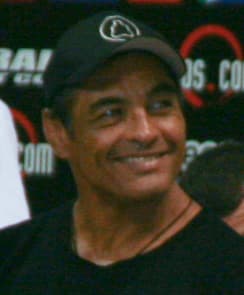
Creator credit recorded on the linked source page: Zekerags · Public domain
Rickson Gracie
Rickson Gracie is a Brazilian ninth-degree red belt whose teaching on connection, breathing and self-defense reaches students through seminars and courses.
Biography
Sources for this profile
Rickson Gracie Jiu-Jitsu, “About Rickson,” n.d.(opens in a new tab)
Rickson Gracie's official biography identifies him as Hélio Gracie's third son, says he entered competition at six, began teaching at fifteen, and received a black belt from his father at eighteen.
Where in the source: About Rickson — opening two paragraphs
Accessed:
Rickson Gracie's official biography says that he moved to the United States in 1989 to help his brother Rorion establish a jiu-jitsu academy in Torrance, California.
Where in the source: About Rickson — paragraph beginning “Rickson Gracie moved to America in 1989”
Accessed:
Sherdog, “Rickson Gracie,” n.d.(opens in a new tab)
Sherdog's professional fight record lists 11 wins and no losses for Rickson Gracie, with two KO/TKO wins and nine submission wins.
Where in the source: Rickson Gracie — record summary and FIGHT HISTORY - PRO
Accessed:
Sherdog lists three wins at Vale Tudo Japan 1994 and three wins at Vale Tudo Japan 1995, including the 1995 win over Yuki Nakai.
Where in the source: FIGHT HISTORY - PRO — VTJ 1994 and VTJ 1995 entries
Accessed:
Sherdog lists submission wins over Nobuhiko Takada at Pride 1 (1997) and Pride 4 (1998), followed by a 2000 technical-submission win over Masakatsu Funaki.
Where in the source: FIGHT HISTORY - PRO — 2000, 1998, and 1997 entries
Accessed:
Graciemag, “Zulu,” undated; accessed 2026-10-04(opens in a new tab)
A Graciemag account dates Rickson Gracie’s first vale-tudo fight with Rei Zulu to 25 April 1980 in Brasília and says Rickson won by rear-naked choke.
Where in the source: Zulu — 1980 bout paragraphs
Accessed:
The same account describes a 1984 rematch at Maracanãzinho in which Rickson moved from closed guard to Zulu’s back and submitted him again.
Where in the source: Zulu — 1984 rematch paragraph
Accessed:
Ana Ban, Folha de S.Paulo, 2 July 1995(opens in a new tab)
A contemporary Folha profile reported in July 1995 that Rickson had lived in Los Angeles for six years and taught students there.
Where in the source: Rickson a força vem aí — opening
Accessed:
The 1995 Folha profile says Rickson helped train his brother Royce.
Where in the source: “Um monstro” — Royce paragraph
Accessed:
Jordan Breen, Sherdog, 29 October 2009(opens in a new tab)
Sherdog’s 2009 retrospective presents Rickson’s 1994 and 1995 Vale Tudo Japan victories as part of the groundwork for the rise of mixed martial arts in Japan; that is the author’s historical assessment.
Where in the source: Opening history paragraphs
Accessed:
The Part-Time Grappler, Rickson Gracie interview, 5 November 2014(opens in a new tab)
In a July 2014 interview, Rickson said he had traveled internationally teaching progressive seminars on fundamentals including weight distribution, leverage and the subtleties of body control.
Where in the source: Role and mission questions
Accessed:
Rickson described founding the Jiu-Jitsu Global Federation to share teaching beyond his in-person seminars, with service to practitioners and instructors as his stated mission.
Where in the source: JJGF role and mission questions
Accessed:
Rickson Gracie Academy, “Visible vs. invisible jiu-jitsu,” undated; accessed 2026-10-04(opens in a new tab)
Rickson describes “invisible jiu-jitsu” as subtle weight distribution and relaxation that reduce effort and increase control, rather than as a separate martial art.
Where in the source: Visible vs. invisible jiu-jitsu — answer
Accessed:
Rickson Gracie Academy, “How do you control your opponent’s movement?,” undated; accessed 2026-10-04(opens in a new tab)
Rickson’s academy explains his concept of connection as controlling an opponent’s movement through balance and the direction of their force, not merely holding a grip.
Where in the source: How do you control your opponent’s movement?
Accessed:
Rickson Gracie Academy, “Rickson Gracie explains his breathing philosophy (part 1),” undated; accessed 2026-10-04(opens in a new tab)
His academy says Rickson learned diaphragmatic breathing from Orlando Cani in the early 1980s and later discussed its importance in an instructional interview.
Where in the source: Rickson Gracie explains his breathing philosophy (part 1)
Accessed:
Rickson Gracie Academy, “Rickson Gracie’s No. 1 tip for beginners in BJJ,” undated; accessed 2026-10-04(opens in a new tab)
Rickson advises beginners to prioritize relaxed movement, breathing, timing and questions over winning early training rounds.
Where in the source: Rickson Gracie’s No. 1 tip for beginners
Accessed:
Rickson Gracie Academy, “Fundamentals,” accessed 2026-10-04(opens in a new tab)
Rickson Academy’s Fundamentals course lists lessons on base and breathing, connection, hip movement, stand-up work and guard passing.
Where in the source: Fundamentals — classes 1–7
Accessed:
Rickson Gracie Academy, “Rickson on bringing his dad’s vision of self-defense to life,” undated; accessed 2026-10-04(opens in a new tab)
Rickson Academy says its Self.Defense.Unit online course preceded the academy platform and was intended to bring Hélio Gracie’s self-defense curriculum to a broad modern audience.
Where in the source: Rickson on bringing his dad’s vision — opening
Accessed:
Rickson says self-defense should introduce jiu-jitsu to students who may never want to compete, rather than limiting instruction to sport skills.
Where in the source: Rickson on bringing his dad’s vision — answer
Accessed:
Rickson Gracie Academy, “Does a blue-belt qualify to teach BJJ?,” undated; accessed 2026-10-04(opens in a new tab)
Rickson says a blue belt can share limited knowledge with family or friends while continuing to seek more qualified instruction.
Where in the source: Does a blue-belt qualify to teach BJJ?
Accessed:
Graciemag Newsroom, 7 July 2017(opens in a new tab)
Graciemag reported that Rickson accepted a red belt at a July 2017 seminar after an initial objection about the usual time-in-rank requirement.
Where in the source: Video: Rickson Gracie promoted to red-belt
Accessed:
The same 2017 ceremony report says the awarded rank was ninth degree and that Rickson ultimately accepted the red-belt title.
Where in the source: Video: Rickson Gracie promoted to red-belt
Accessed:
FloGrappling, 7 July 2017(opens in a new tab)
FloGrappling independently reported Rickson’s July 2017 red-belt ceremony and identified Rorion Gracie as leading the promotion.
Where in the source: Rickson Gracie Promoted to Red Belt — opening
Accessed: