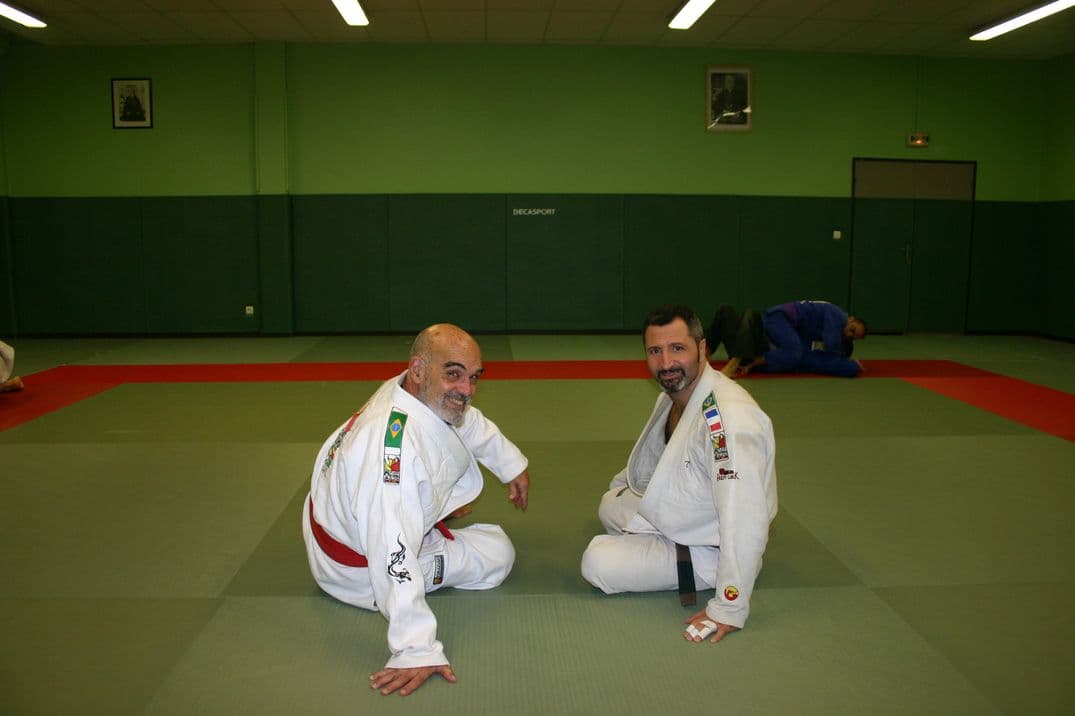
Creator credit recorded on the linked source page: Balthazar31 · Public domain (copyright-holder release)
Flavio Behring
Flavio Behring's story runs from early training sessions at Hélio Gracie's home to a 1963 jiu-jitsu demonstration trip with João Alberto Barreto.
Biography
Sources for this profile
Associação Behring, ‘A jornada do nosso Jiu-Jitsu,’ undated, retrieved 2026-09-12.(opens in a new tab)
Projeto Behring's history page gives Flávio Behring's birth date as November 21, 1937.
Where in the source: Timeline — ‘1937 / Nasce Flávio Behring’ and the advanced-question card asking for his birth date.
Accessed:
Projeto Behring's timeline says Behring began training jiu-jitsu at ten, encouraged by his father, and was already an instructor at seventeen.
Where in the source: Timeline — ‘1937 / Nasce Flávio Behring,’ immediately after the stated birth date.
Accessed:
The same association history says that, after becoming a black belt, Behring trained with João Alberto Barreto.
Where in the source: Timeline — ‘1950–60 / Faixa preta e nova geração.’
Accessed:
Projeto Behring's history says João Alberto Barreto conferred the title of Grand Master on Behring in 2006 and describes it as recognized by CBJJ.
Where in the source: Timeline — ‘2006 / Grande Mestre.’
Accessed:
Projeto Behring's history says Hugo Ribeiro asked Behring in 2014 to formally link an unaffiliated dojo to his teaching banner; it says Behring agreed and the project began.
Where in the source: Timeline — ‘2014 / Nasce o Projeto Behring.’
Accessed:
GracieMag, ‘A voz do mestre: para Flavio Behring, o bom professor ensina, não se exibe,’ 2022; interview originally published in GRACIEMAG #216.(opens in a new tab)
In a GracieMag interview, Behring recalled beginning jiu-jitsu in 1947, at ten, with his first training sessions at Hélio Gracie's home on Flamengo beach in Rio de Janeiro.
Where in the source: Interview opening — answer to ‘O senhor treina desde 1947. Foi amor à primeira vista, mestre?’
Accessed:
In the same interview, Behring said that at thirteen he began training at the Gracie academy on Avenida Rio Branco under João Alberto Barreto, whom he described as an important teacher of self-defense.
Where in the source: Interview section headed ‘Quando Helio Gracie apareceu na escola…’.
Accessed:
GracieMag, ‘Dicas do mestre: as lições do faixa-vermelha João Alberto Barreto,’ 2019.(opens in a new tab)
In a GracieMag interview, João Alberto Barreto said that he and Flavio Behring went to the United States in 1963 to give jiu-jitsu demonstrations for American police and military audiences.
Where in the source: Interview question on the 1963 and 1966 trips — Barreto's answer beginning ‘Em 1963 fui com o Flavio Behring aos Estados Unidos.’
Accessed:
GracieMag, ‘Grande Mestre Flavio Behring: Ser julgado pela cor da faixa no Jiu-Jitsu é errado,’ 2017.(opens in a new tab)
In 2017, Behring told GracieMag that he had tied on a white belt symbolically during his seventieth year in jiu-jitsu, while explaining it as a reminder of continual learning; he said he had returned to using a red belt.
Where in the source: Article opening and Behring quotation beginning ‘O principal objetivo da faixa-branca foi simbólico.’
Accessed: