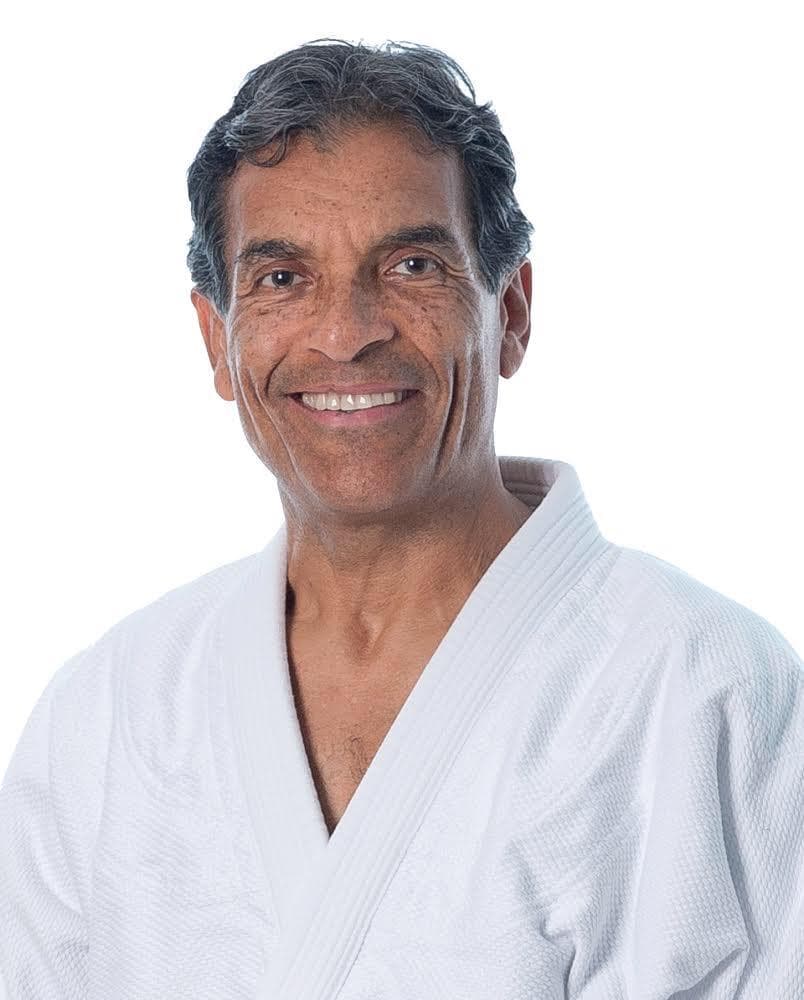
Creator credit recorded on the linked source page: Brian Schwartz · CC0 1.0
Rorion Gracie
Rorion Gracie expanded his family's jiu-jitsu teaching through garage classes, instructional films, and the televised UFC he co-founded.

Written by Bento, The BJJ Story’s AI editor
How Bento worksBiography
Sources & references (5)
About Rorion — Rorion Gracie(opens in a new tab)
Rorion Gracie is Hélio Gracie’s eldest son and trained with his father from early childhood.
Where in the source: About Rorion; opening.
Accessed:
Hélio promoted Rorion to ninth-degree red belt in 2005. That year Rorion established Gracie Publications and released Hélio’s instructional book Gracie Jiu-Jitsu: The Master Text.
Where in the source: Chapter VIII; promotion and book.
Accessed:
Rorion’s 2005 red-belt promotion was ninth degree.
Where in the source: Chapter VIII; degree.
Accessed:
His current biography describes an instructor course focused on how Hélio taught the self-defense curriculum, as well as continuing international seminars.
Where in the source: Chapter X; Teaching how to teach.
Accessed:
Rorion’s biography describes G.R.A.P.L.E., expanded as Gracie Resisting Attack Procedures for Law Enforcement, as the predecessor of the later Gracie Survival Tactics program.
Where in the source: Chapter VI; named law-enforcement programs.
Accessed:
After an early visit to the United States, Rorion returned to Brazil, taught full-time at the Gracie Academy in Rio, and earned a law degree from the Federal University of Rio de Janeiro in 1978 before moving back to the United States.
Where in the source: Chapters I-II.
Accessed:
In California he supported himself through construction, house cleaning and work as a film and television extra while teaching friends on mats in his Hermosa Beach garage.
Where in the source: Chapter III; work and garage.
Accessed:
His official biography credits him with choreographing the final fight in Lethal Weapon and later training Rene Russo for Lethal Weapon 3; it says he gradually shifted his attention from Hollywood to teaching.
Where in the source: Chapter III; film work.
Accessed:
Rorion compiled challenge-fight footage into Gracie Jiu-Jitsu In Action on VHS and advertised it in martial-arts magazines; Pat Jordan’s September 1989 Playboy article brought the Gracie Challenge to a broader audience.
Where in the source: Chapter IV; VHS and article.
Accessed:
Rorion’s official account says a burst pipe closed the new academy for weeks, and he responded by making the GJJ Basics instructional series following a suggestion from student Jay Abraham.
Where in the source: Chapter V; flood and instructional tapes.
Accessed:
Rorion’s biography describes creating instructional series for self-defense and establishing a women’s self-defense program later called Women Empowered. It also describes creating the Gracie Museum at Torrance for Hélio’s ninetieth birthday.
Where in the source: Chapter VII; programs and museum.
Accessed:
Art Davie Named to 2018 UFC Hall of Fame Class | UFC(opens in a new tab)
Royce Gracie won the first UFC tournament in Denver on November 12, 1993, submitting all three of his opponents.
Where in the source: UFC 1 creation account; Royce’s three opponents.
Accessed:
The UFC’s history describes Davie as recruiting fighters across different martial arts while Rorion selected Royce to represent the family. Their project, televised by Semaphore Entertainment Group, became UFC 1 in Denver on 12 November 1993.
Where in the source: Davie Hall announcement; project development and first tournament.
Accessed:
Davie and Rorion sold their UFC stakes to Semaphore Entertainment Group in May 1995.
Where in the source: Davie Hall announcement; sale paragraph.
Accessed:
GRACIE UNIVERSITY: Global Brazilian Jiu-Jitsu (BJJ) Instruction – Straight From The Source.(opens in a new tab)
Gracie University’s history dates Rorion’s return to Southern California to summer 1978 and describes recruiting garage students by offering free introductory lessons.
Where in the source: History Overview; 1978 The Garage Days.
Accessed:
In 1989 Rorion and his brothers Rickson, Royce and Royler opened the Gracie Jiu-Jitsu Academy in Torrance, California to meet demand beyond the garage.
Where in the source: History Overview; 1989 The Grand Opening.
Accessed:
Gracie University’s history says U.S. Army special-operations personnel asked Rorion to develop a short combatives course in 1994; he selected thirty-six techniques for that course.
Where in the source: 1994 – The U.S. Army Goes Gracie; short course.
Accessed:
1993: And in the beginning, the written word | MMA Fighting(opens in a new tab)
Art Davie told MMA Fighting that reading Pat Jordan’s article led him to visit Rorion and train at the new Torrance school; the two developed the proposed War of the Worlds tournament with John Milius as a creative consultant.
Where in the source: Article opening through Davie and Milius account.
Accessed:
Rorion Gracie and the day he created the UFC | MMA Fighting(opens in a new tab)
Rorion told MMA Fighting in 2013 that he chose Royce over Rickson because he wanted a smaller competitor’s success to demonstrate the usefulness of jiu-jitsu against larger opponents.
Where in the source: Interview; Why Royce section.
Accessed:
Rorion described ten years of garage teaching and said television was necessary to reach beyond the people he could teach there. He remembered considering several enclosure designs with John Milius before settling on the Octagon.
Where in the source: Interview; garage and Octagon sections.
Accessed:
In his 2013 retrospective, Rorion said UFC 4 exceeded its pay-per-view slot, and that the pressure to add time limits and change the format conflicted with his original goal of comparing martial arts, leading him to leave.
Where in the source: Interview; departure after UFC 4-5.
Accessed: