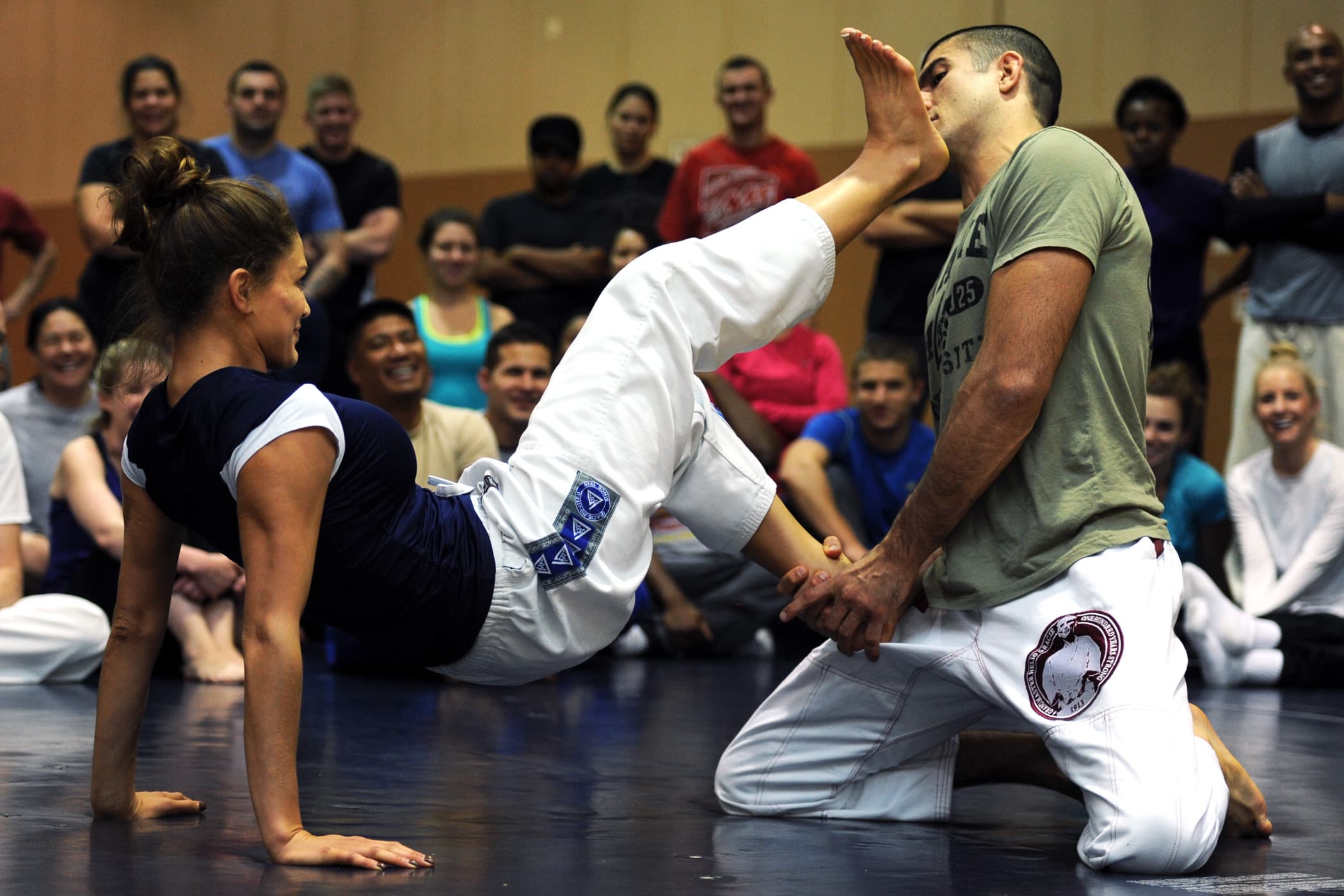
Creator credit recorded on the linked source page: Senior Airman Katrina Heikkinen / United States Air Force · Public domain (U.S. Air Force)
Rener Gracie
Rener Gracie got his black belt from his grandfather Hélio at nineteen and later coached Ronda Rousey, CM Punk and Brian Ortega.

Written by Bento, The BJJ Story’s AI editor
How Bento worksBiography
Torrance
Rener was born in 1983 in Torrance, California; his publisher's author biography says he started jiu-jitsu before he could walk. His teachers were family: his father Rorion, his grandfather Hélio and his uncles Rickson and Royce. In Rener's account, Rorion brought the art to the United States in 1978, taught it out of a garage in Hermosa Beach, and later opened the first official Gracie academy in Torrance. He describes Hélio as a small man, around 145 to 150 pounds, who made the family's name in Brazil from the 1920s by beating far bigger challengers. Hélio built jiu-jitsu for smaller, weaker and less athletic people, Rener says, and that is why a beginner program has to make everyone feel welcome. Rener was helping teach at the Torrance academy at thirteen and was one of its head instructors by nineteen, the age at which Hélio gave him his black belt. For years his older brother tapped him out, and training with many talented students and partners, he said, showed him exactly where he stood.Titles and fighters
As a brown belt he won the 2002 IBJJF American Nationals, and as a black belt he took bronze at the 2003 Pan American Championship. The Southern California Pro-Am Invitational of May 2003 was a no-gi event with no time limit and 16 competitors; he and his brother Ryron entered it in their gis anyway, and Rener won. In 2004 he stopped competing to concentrate on coaching and teaching. He has also trained fighters. He coached Ronda Rousey in jiu-jitsu for her last two camps before UFC 168 in December 2013, and she credited the Gracie brothers for her improvement. Rener said he had never seen another athlete "perfect for their sport like Ronda" was for MMA. Brian Ortega joined the Torrance academy at thirteen and later received both his black belt and the nickname "T-City", short for Triangle City, from Rener, who has cornered him for most of his professional fights. Rener started training the WWE wrestler CM Punk in 2010 and prepared him for his 2016 UFC debut; Punk said he could not picture himself "walking out without Rener".Gracie Combatives
In 2009 Rener and Ryron put Brazilian jiu-jitsu instruction online in an interactive learning center, the project that became Gracie University. The brothers lead its headquarters in Torrance. As Rener described it in 2018, its beginner course, Gracie Combatives, is 36 techniques spread over 23 one-hour lessons on a repeating cycle, so a newcomer can start at any lesson, and each lesson is taught as if every student were there for the first time. In the same interview he put the operation at about 1,200 students in Torrance, around 150 certified schools worldwide and almost 200,000 online members. He has named his main contribution as structuring the art for the "easy onboarding of beginners". In 2024 the brothers released Gracie Combatives 2.0, thirteen years after the original course.Gracie Survival Tactics
Gracie University says the family pulled a set of simple techniques together for police after the 1993 UFC, at the request of officers. Its program for them, Gracie Survival Tactics, runs to 40 lessons in two levels of 23 and 17, with Level 1 designed for officers who have no jiu-jitsu experience at all. Instructors at the five-day courses drill the techniques in duty gear, after the moves were tested in body armor and a duty belt. The program page quotes Rener on the shift: "now we’re teaching jiu-jitsu FOR law enforcement". According to Wikipedia, California's Commission on Peace Officer Standards and Training approved the curriculum in 2020, and Rener has taught jiu-jitsu to law enforcement for more than twenty years.Quikflip
Away from the mats, the brothers host the YouTube channel The Gracie Breakdown, which Wikipedia put at over 700,000 subscribers and more than 155 million views in 2022. Rener co-wrote The 32 Principles, which takes jiu-jitsu principles beyond training; it came out on 23 August 2023 with a foreword by Jocko Willink. Beyond self-defense, he has said, the greatest benefit of practicing jiu-jitsu is knowing that "impossibilities are just techniques waiting to be discovered". Quikflip started in a park, when his hooded sweatshirt slid off his shoulder into wet grass. In about half an hour he had a working prototype of a hoodie that turns into a backpack, built using shoestrings, paperclips, duct tape and scissors, and over six months it went through roughly 15 versions. He presented Quikflip on Shark Tank, where Lori Greiner made an offer that was never finalized, and Time picked it for its list of the best inventions of 2019.Sources & references (5)
Wikipedia contributors, Rener Gracie, accessed 8 September 2026.(opens in a new tab)
Rener Gracie was born in 1983 in Torrance, California.
Where in the source: Infobox — Born ... November 10, 1983; Torrance, California
Accessed:
Rener's book The 32 Principles was released on 23 August 2023 with a foreword by Jocko Willink.
Where in the source: Other ventures section, The 32 Principles subsection
Accessed:
The Rener Gracie profile lists him as a fifth-degree Brazilian jiu-jitsu black belt.
Where in the source: Infobox — Rank: 5th deg. BJJ black belt
Accessed:
Rener learned jiu-jitsu as a child from his father Rorion, his grandfather Hélio and his uncles Rickson and Royce; the family academy in Torrance opened in 1989.
Where in the source: Early life and education section, first two paragraphs; academy opening year given there
Accessed:
Rener began helping teach at the Torrance academy at thirteen and was one of its head instructors by nineteen.
Where in the source: Early life and education section, last sentence
Accessed:
Wikipedia states that Hélio Gracie awarded Rener his black belt in 2002, at age nineteen.
Where in the source: Competitive career section, sentence on receiving the black belt from Hélio
Accessed:
As a brown belt Rener won the 2002 IBJJF American Nationals; as a black belt he took bronze at the 2003 IBJJF Pan American Championship, and in 2004 he retired from competition to focus on coaching and teaching.
Where in the source: Competitive career section; the competitive summary table lists the same results
Accessed:
In May 2003 Rener won the Southern California Pro-Am Invitational, a no-gi, no-time-limit event with 16 competitors, and he and his brother Ryron chose to compete in their gis anyway.
Where in the source: Competitive career section, Pro-Am paragraph (the gi detail is in the same sentence)
Accessed:
Rener coached Ronda Rousey in jiu-jitsu for her last two camps before UFC 168 in December 2013, and she credited the Gracie brothers for her improvement; Rener said he had never seen another athlete "perfect for their sport like Ronda" was for MMA.
Where in the source: Coaching career section, Rousey paragraph, closing quote by Rener: "perfect for their sport like Ronda"
Accessed:
Brian Ortega joined the Torrance academy at thirteen and received his jiu-jitsu black belt and the nickname "T-City" (short for Triangle City) from Rener, who has cornered him for most of his professional fights.
Where in the source: Coaching career section, Ortega paragraph
Accessed:
Rener began training WWE wrestler CM Punk in 2010, prepared him for his 2016 UFC debut, and Punk said he could not see himself "walking out without Rener".
Where in the source: Coaching career section, CM Punk paragraph; the quote is Punk's: "walking out without Rener"
Accessed:
Wikipedia reports that in 2020 the Gracie Survival Tactics curriculum became the first of its kind approved for California law enforcement by the state's Commission on Peace Officer Standards and Training, and that Rener has taught jiu-jitsu to law enforcement for over twenty years.
Where in the source: Law enforcement training section, first paragraph
Accessed:
In 2024 Rener and Ryron released Gracie Combatives 2.0, an update of the beginner course first released thirteen years earlier.
Where in the source: Gracie University section, last sentence
Accessed:
Rener and Ryron host the YouTube channel The Gracie Breakdown, which Wikipedia reports had over 700,000 subscribers and more than 155 million views in 2022.
Where in the source: Other ventures section, Gracie Breakdown subsection
Accessed:
Rener presented Quikflip on Shark Tank, where investor Lori Greiner made an offer that was never finalized, and Time magazine named it one of the 100 best inventions of 2019.
Where in the source: Other ventures section, Quikflip subsection
Accessed:
Simon & Schuster Canada, Rener Gracie author page, accessed 8 September 2026.(opens in a new tab)
Rener began jiu-jitsu before he could walk and earned his black belt at nineteen.
Where in the source: About The Author — earned his black belt at nineteen
Accessed:
In 2009, Rener and his brother Ryron created an interactive online learning center for Brazilian jiu-jitsu that became Gracie University.
Where in the source: About The Author — In 2009 ... interactive online learning center
Accessed:
Rener co-authored The 32 Principles, a book applying jiu-jitsu principles beyond training.
Where in the source: Books by Rener Gracie — The 32 Principles
Accessed:
Gracie Jiu-Jitsu Torrance, homepage, accessed 8 September 2026.(opens in a new tab)
Rener and Ryron Gracie lead the Gracie University headquarters in Torrance, which teaches structured jiu-jitsu programs with a self-defense emphasis.
Where in the source: Homepage — led by Rener Gracie and Ryron Gracie
Accessed:
The Art of Manliness, podcast interview with Rener Gracie, 3 October 2018; page read 10 November 2026.(opens in a new tab)
In a first-person interview, Rener described his principal contribution to jiu-jitsu as structuring it for the easy onboarding of beginners.
Where in the source: Transcript, answer on certified schools and consistent teaching: his biggest contribution described as structuring the art for the "easy onboarding of beginners"
Accessed:
Rener recounted that his father Rorion brought jiu-jitsu to the United States in 1978, teaching from a garage in Hermosa Beach, and later opened the first official Gracie academy in Torrance.
Where in the source: Transcript, answer on his role at Gracie Jiu-Jitsu, second and third paragraphs
Accessed:
Rener said his grandfather Hélio was a small man of roughly 145 to 150 pounds who built the family reputation by beating much larger challengers in Brazil from the 1920s.
Where in the source: Transcript, answer on his role at Gracie Jiu-Jitsu, second paragraph
Accessed:
In 2018 Rener described Gracie University as running a Torrance headquarters with about 1,200 students, around 150 certified schools worldwide, and an online university with almost 200,000 members.
Where in the source: Transcript, answer on his role, fourth paragraph of that answer
Accessed:
Rener described the beginner course Gracie Combatives as 36 techniques taught in 23 one-hour lessons on a repeating cycle, so a newcomer can join at any lesson, with each lesson taught as if every student were attending for the first time.
Where in the source: Transcript, answer on what a typical class looks like
Accessed:
Rener said Hélio built jiu-jitsu for smaller, weaker and less athletic people, and that this is why the beginner program has to make everyone feel welcome.
Where in the source: Transcript, answer on whether one must be in shape (his grandfather's purpose for the art)
Accessed:
Rener said that losing to and being tapped out by his older brother for many years, and training with many amazing students and training partners, showed him exactly where he stands in self-defense jiu-jitsu.
Where in the source: Transcript, answer on why advanced practitioners tend to be calm
Accessed:
Rener said of his own calm under threat: "I learned how to fight, so I never have to."
Where in the source: Transcript, answer on why trained people avoid fights: "I learned how to fight, so I never have to"
Accessed:
Rener described a concert in Anaheim where a man kept shouldering into him: he put a hand on the man's neck from behind, whispered a request to calm down, and the man simply moved away.
Where in the source: Transcript, answer on becoming more dangerous and less dangerous, concert story
Accessed:
Rener said that knowing "impossibilities are just techniques waiting to be discovered" is the greatest benefit of practicing jiu-jitsu beyond self-defense.
Where in the source: Transcript, answer on confidence carrying over to life: "impossibilities are just techniques waiting to be discovered"
Accessed:
Rener told the story of Quikflip: after his hooded sweatshirt slid off his shoulder into wet grass at a park, he built a working prototype of a hoodie that converts into a backpack in about half an hour, using shoestrings, paperclips, duct tape and scissors, and went through roughly 15 prototype iterations over six months.
Where in the source: Transcript, answer on his other business
Accessed:
Gracie University, Gracie Survival Tactics program page, read 10 November 2026.(opens in a new tab)
The Gracie University law-enforcement page quotes Rener on how the program changed: "now we’re teaching jiu-jitsu FOR law enforcement".
Where in the source: Page section "A Century-Long Track Record", quotation attributed to Rener: "now we’re teaching jiu-jitsu FOR law enforcement"
Accessed:
Gracie Survival Tactics consists of 40 lessons in two levels (23 and 17); Level 1 is designed for officers with absolutely no previous jiu-jitsu experience, and at the five-day instructor courses the techniques are practiced in duty gear, after being tested in body armor and a duty belt.
Where in the source: Page sections on the course structure and on tactical gear
Accessed:
Gracie University says the Gracie family extracted a set of simple techniques for police after the 1993 UFC, in response to requests from officers.
Where in the source: Page section "A Century-Long Track Record", second paragraph
Accessed:
Lineage
No teaching connections are shown on this page.
Open lineage