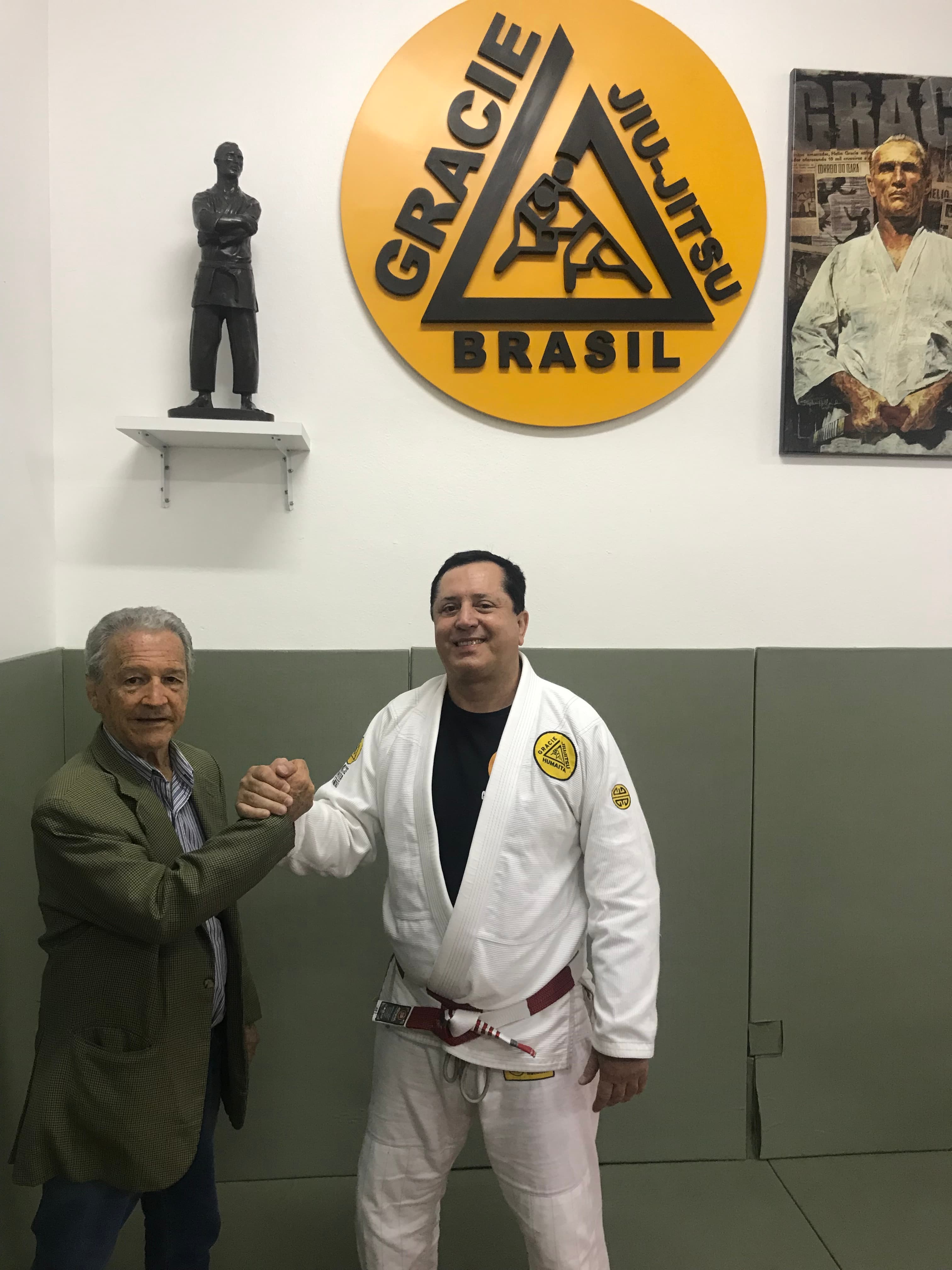
Creator credit recorded on the linked source page: Renangracie · CC BY-SA 4.0
Robson Gracie
Robson Gracie taught relatives and other pupils, led Rio’s jiu-jitsu federation and brought vale-tudo to television through Heróis do Ringue.

Written by Bento, The BJJ Story’s AI editor
How Bento worksBiography
Sources & references (9)
Graciemag, “Robson Gracie,” biographical profile.(opens in a new tab)
Carlos Robson Gracie was born on 16 January 1935 and was Carlos Gracie’s second son.
Where in the source: Opening biographical paragraph, “Nascido em 16 de janeiro de 1935”.
Accessed:
The family profile recalls Robson as a mischievous child who climbed the household curtains and regarded his uncle Hélio as a second father.
Where in the source: Opening paragraph, childhood and Hélio sentences.
Accessed:
His nephew Marco Gracie Imperial remembered a basic lesson from Robson on defending against a slap as an unforgettable introduction to self-defense.
Where in the source: Opening paragraph, Marco Gracie Imperial’s recollection.
Accessed:
Graciemag’s family photographs identify Renzo, Charles, Ralph, Ryan and Robson Jr. among Robson’s notable pupils.
Where in the source: Photograph caption beginning “Robson teve pupilos notáveis”.
Accessed:
The Graciemag profile places Robson’s vale-tudo debut in April 1957, when he defeated capoeirista Artur Emídio by submission.
Where in the source: Paragraph beginning “A estreia de Robson Gracie no vale-tudo”.
Accessed:
Robson became president of the Rio de Janeiro Jiu-Jitsu Federation in the 1980s.
Where in the source: Paragraph beginning “A notoriedade como especialista”.
Accessed:
In 1999 Robson revived and hosted Heróis do Ringue on CNT, drawing on the television program that had first aired in 1959; the profile remembers his distinctive on-air catchphrases.
Where in the source: Paragraph beginning “Em 1999, o faixa-vermelha”.
Accessed:
Robson explicitly credited the thousands of followers of Carlos and Hélio, beyond the Gracie family itself, with keeping their art alive.
Where in the source: Final quotation beginning “Não fossem os milhares de seguidores”.
Accessed:
Jogo Corpo Fechado, “MESTRE ARTUR EMIDIO,” historical article citing Diário Carioca.(opens in a new tab)
Jogo Corpo Fechado dates the Artur Emídio–Robson Gracie bout to 13 April 1957 and, citing Diário Carioca, describes an early takedown followed by a choke from behind in a four-minute bout.
Where in the source: Artur Emídio article, paragraph beginning “Artur Emídio and Robson Gracie were the protagonists”.
Accessed:
Combate.com, “Morre aos 88 anos Robson Gracie, lenda do jiu-jítsu,” 29 April 2023.(opens in a new tab)
Combate’s obituary reports that Robson later also defeated Valdo Santana, Valdemar Santana’s brother.
Where in the source: Second biographical paragraph following the Artur Emídio debut.
Accessed:
Robson’s martial-arts reputation led to work as Leonel Brizola’s bodyguard when Brizola was a federal deputy for Guanabara.
Where in the source: Political involvement paragraph beginning “Robson também teve notório envolvimento na política”.
Accessed:
According to Combate’s obituary, Robson was detained for 64 days and tortured after the 1964 military coup, and was released following Hélio’s intervention.
Where in the source: Political involvement paragraph, 1964 coup and release sentences.
Accessed:
During Brizola’s first term as governor of Rio de Janeiro in the 1980s, Robson headed SUDERJ, the state sports authority.
Where in the source: Paragraph beginning “Mais tarde, na década de 1980”.
Accessed:
Combate credits Robson’s SUDERJ period with helping bring vale-tudo events back to Rio, including the Rickson Gracie–Rei Zulu rematch at Maracanãzinho.
Where in the source: 1980s SUDERJ paragraph, “promoveu o retorno dos eventos de Vale-Tudo”.
Accessed:
Combate’s obituary identifies Robson as a red belt during his lifetime.
Where in the source: Paragraph beginning “Em vida, Robson recebeu a faixa vermelha”.
Accessed:
Combate’s obituary specifies Robson’s ninth degree.
Where in the source: Same red-belt paragraph, “nono ... grau”.
Accessed:
UOL Esporte/Ag. Fight, federation leadership report, 25 August 2023; historical succession paragraph only.(opens in a new tab)
The historical background in UOL’s August 2023 federation report says Kenya Gracie took over the presidency in 2019 after Robson’s long tenure.
Where in the source: Subheading “Entenda o caso”, paragraph beginning “Por muitos anos”; only the first two historical sentences.
Accessed:
Federação de Jiu-Jitsu do Rio de Janeiro, “Diretoria FJJRio,” current officers page.(opens in a new tab)
The federation’s current officers page lists Kenya Gracie as president.
Where in the source: Diretoria FJJRio, Kenya Gracie / Presidente card.
Accessed:
Graciemag Newsroom, “A voz do mestre: o faixa-vermelha Robson Gracie e o poder do Jiu-Jitsu,” 28 April 2023; retrospective excerpts from issue 191.(opens in a new tab)
In interviews excerpted by Graciemag from issue 191, Robson described jiu-jitsu as a spiritual art and spoke of his father Carlos as a visionary.
Where in the source: Section “A essência do Jiu-Jitsu”.
Accessed:
Graciemag Newsroom, “A melhor lição que mestre Robson aprendeu com o pai, Carlos Gracie,” 20 January 2026; recounting a 2015 gathering.(opens in a new tab)
A January 2026 Graciemag retrospective recalls Robson attending Luiz Carlos “Manimal”’s year-end academy celebration in Copacabana in 2015, where his address helped rekindle photographer and purple belt Clever Barbosa’s enthusiasm for training.
Where in the source: Opening four paragraphs, “Em idos de 2015” through “A chama se reacendeu”.
Accessed:
At that 2015 gathering, Robson drew on childhood fascination with King Arthur and recounted a story about his father encouraging a fighter to persevere against apparently doubled obstacles.
Where in the source: Speech paragraphs, King Arthur and Carlos’s corner anecdote.
Accessed:
Redação Graciemag, interview with Vitor Terra, 5 August 2019.(opens in a new tab)
Vitor Terra’s 2019 interview identifies Robson among the Gracie teachers he learned from, and explains that Terra named the training area of his new Copacabana dojo after Robson.
Where in the source: First interview answer, “batizamos a área de treinos”; next question naming Robson and Royler.
Accessed:
Diego Ribas, “Kyra Gracie anuncia a morte do avô Robson Gracie aos 88 anos,” Ag. Fight, 28 April 2023.(opens in a new tab)
Robson Gracie died on 28 April 2023 at the age of 88, as announced by his granddaughter Kyra and reported that day by Ag. Fight.
Where in the source: Opening report paragraph, “Robson Gracie faleceu nesta sexta-feira (28)”.
Accessed:
Lineage
Students3
Trained under the same teacher
Also students of Carlos Gracie
- Carlos MachadoSource: machadomethodcarrollton.com
- Carlson GracieSource: bjjheroes.com
- Gastão Gracie FilhoSource: bjjheroes.com
- George GracieSource: bjjheroes.com
- Hélio GracieSource: bjjheroes.com
- Reyson GracieSource: bjjheroes.com
- Rilion GracieSource: bjjheroes.com
- Rolls GracieSource: sensobjj.com