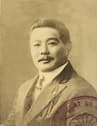
Creator credit recorded on the linked source page: Unknown photographer · Public domain (PD-Japan-oldphoto)
Mitsuyo Maeda
Mitsuyo Maeda (1878–1941) was a Japanese Kodokan judoka who taught in Belém, where Carlos Gracie was among his students.
Biography
Sources for this profile
National Diet Library, Undefeated Conde Koma who challenged the Amazon, 100 Years of Japanese Emigration to Brasil.(opens in a new tab)
Aomori farming family; Tokyo 1896.
Where in the source: Life-history paragraph near the beginning.
Accessed:
Kodokan 1897; third dan 1901; traveled with Tomita to America; Brazil 1914, Belém 1915.
Where in the source: Early-career and journey paragraphs: “He first”; “Thereafter”.
Accessed:
From 1922: settlement-company work and government liaison.
Where in the source: “Afterwards” (settlement-company paragraph).
Accessed:
Adapted to wrestlers’ rules and refusal of jackets.
Where in the source: Overseas-challenge paragraph.
Accessed:
Fed settlers; helped with employment; died 1941 without revisiting Japan.
Where in the source: Closing two biographical paragraphs.
Accessed:
Matthias Röhrig Assunção, Ringue ou academia? A emergência dos estilos modernos da capoeira e seu contexto global, História, Ciências, Saúde – Manguinhos 21(1), 135–150 (2014), DOI 10.1590/S0104-59702014005000002.(opens in a new tab)
Maeda, known as Conde Koma, taught in Belém in the 1910s. Carlos Gracie was among his students and later developed his own jiu-jitsu style.
Where in the source: Body discussion of Belém, paragraph anchored by “Quando o já mencionado Mitsuyo Maeda” and the next paragraph.
Accessed:
José Cairus, Modernization, nationalism and the elite: the Genesis of Brazilian jiu-jitsu, 1905–1920, Tempo e Argumento 3(2), 100–121 (2011), DOI 10.5965/2175180303022011100.(opens in a new tab)
Early 1916: advertised Teatro Moderno lessons for children and adults.
Where in the source: Footnote 74 and associated paragraph.
Accessed:
Jacyntho Ferro, Maeda’s chief instructor, also taught Carlos Gracie.
Where in the source: Footnote 86 and associated apprenticeship paragraph.
Accessed:
1915: troupe appeared at Bar Paraense with singers and dancers.
Where in the source: Footnote 64 and associated paragraph.
Accessed:
July 1920: defeated Victorio Segato by armbar.
Where in the source: Footnote 91 and associated theatre paragraph.
Accessed:
July 1922: returned to Belém; Ferro met him.
Where in the source: Footnote 93 and associated return paragraph.
Accessed:
Portuguese 1935 manual: his Kodokan judo differed from broader jiu-jitsu.
Where in the source: Footnotes 98–100 and associated manual discussion.
Accessed:
Riqueldi Straub Lise and André Mendes Capraro, Primórdios do jiu-jitsu e dos confrontos intermodalidades no Brasil: contestando uma memória consolidada, Revista Brasileira de Ciências do Esporte 40(3) (2018), DOI 10.1016/j.rbce.2018.03.003.(opens in a new tab)
Maeda's troupe performed at Rio de Janeiro's Teatro Carlos Gomes in 1915, combining demonstrations, bouts among troupe members and challenges to spectators.
Where in the source: Section “Konde Koma no Brasil”, paragraphs citing O Imparcial of March 12, 1915, and the May 1915 theater reports.
Accessed:
Japanese jiu-jitsu demonstrations were reported in Rio in 1908, before Maeda's arrival: the performers included Sada Miyako and M. Kakiora.
Where in the source: Section “O jiu-jitsu antes de Koma”, opening paragraph citing O Século, December 25, 1908, page 2.
Accessed:
National Diet Library, Development of the Amazon, 100 Years of Japanese Emigration to Brasil, section 4.2.(opens in a new tab)
Amazonian states sought settlers after the rubber economy declined. Maeda's standing in Pará helped connect Japanese settlement initiatives with the state government.
Where in the source: “Development of the Amazon”: subsections “Amazon Kudari” and “Gratuitous grant of land to foreign countries by the State Government”.
Accessed:
International Judo Federation, From Martial Art to Olympic Sport – Part 3, historical text by Michel Brousse with Nicolas Messner.(opens in a new tab)
The International Judo Federation places Maeda among judo's early international promoters, tracing a professional route through Europe and the Americas before Brazil.
Where in the source: Part 3, section “THE INVENTION OF JUDO IN THE WEST”, Maeda paragraph beside the Boston 1905 photograph.
Accessed:
National Diet Library Authorities, 前田, 光世, 1878–1941, authority identifier 00477831.(opens in a new tab)
The National Diet Library authority record gives 1878 as Mitsuyo Maeda's birth year.
Where in the source: Authority record 00477831, “生年” field.
Accessed:
The National Diet Library authority record gives 1941 as Mitsuyo Maeda's death year.
Where in the source: Authority record 00477831, “没年” field.
Accessed:
Maeda and Satake: what the sources establish
Mitsuyo Maeda and Soshihiro Satake were fellow performers. Estado do Pará reported their bout of 4 August 1921 two days later. This documents a shared appearance; it does not establish that Maeda taught Satake.
Lineage
Students2
Historical teacher attribution; extent and duration remain uncertain.