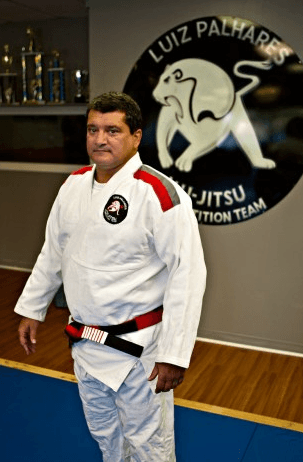
Creator credit recorded on the linked source page: FloridaFaye · CC BY-SA 3.0
Luiz Palhares
By his own account a student of Rolls and Rickson Gracie, Luiz Palhares moved to the US in 1999, founded a Jacksonville academy and taught soldiers and police.

Written by Bento, The BJJ Story’s AI editor
How Bento worksBiography
Sources & references (3)
BJJEE, interview with Luiz Palhares, 6 November 2012 (his own account).(opens in a new tab)
In a 2012 interview with BJJ Eastern Europe, Luiz Palhares said he began training Brazilian jiu-jitsu in Rio de Janeiro in 1977, aged 18, under Rolls Gracie, and kept training with him until Rolls died in a hang-gliding accident in 1982. He then continued under Rolls's brother Rickson Gracie.
Where in the source: Interview, answer 1, second sentence onward (training start, Rolls's death, move to Rickson).
Accessed:
Palhares said that after about seven years of training he received his black belt in 1984 from Rickson Gracie, together with Hélio Gracie. He also said that, as a competitor, he had trained alongside Rolls and Rickson, who competed at the same tournaments as he did.
Where in the source: Interview, answer 1 (black belt, 1984) and answer 6 (instructors as co-competitors and team mates).
Accessed:
Palhares said in 2012 that he was born in Rio de Janeiro in 1959.
Where in the source: Interview, answer 1, first sentence (birth place and year).
Accessed:
Palhares said he was asked in 1999, as a 6th degree black belt, to move from Brazil to the United States to teach at Rickson Gracie's academy in Los Angeles. After almost eight years there he opened his own school, Jacksonville Gracie Jiu Jitsu, in Jacksonville, Florida, in 2007, where he was still living in 2012.
Where in the source: Interview, answer 1, paragraph beginning with the 1999 move (Los Angeles, then Jacksonville in 2007).
Accessed:
Palhares said that as a competitor he won the Rio de Janeiro championships several times, was Brazilian national champion in the senior heavyweight division and the open class in 1998, took 3rd place at the Masters and Seniors International in 2002, and won Pan American titles in the senior super heavyweight division and the open class in 2000, 2003 and 2004.
Where in the source: Interview, answer 1, paragraph beginning "As a competitor" (Rio titles, 1998, 2000-2004).
Accessed:
Palhares said he is a certified Army combatives instructor and had started a continuing jiu-jitsu-based combatives training programme inside the US Navy SEALs compound at Dam Neck, Virginia Beach. In 2010 the 3rd Battalion, 20th Special Forces Group (Airborne) invited him to run a five-month programme at Camp Blanding before its deployment to Afghanistan, and he also teaches the Jacksonville Sheriff's Office.
Where in the source: Interview, answer 1, paragraph on military and law-enforcement training (Dam Neck, 2010 Camp Blanding, Jacksonville Sheriff's Office).
Accessed:
Palhares said that in 2006 he released two instructional DVDs, on closed guard attacks and on progressing from white to blue belt, and that since 2008 he has run the BJJ Grand Prix website and, with the Florida National Guard, two tournaments a year at the National Guard Armory in Jacksonville: the JAX BJJ Open in spring and the Sunshine State BJJ Open in autumn.
Where in the source: Interview, answer 1, final paragraph (DVDs, BJJ Grand Prix, JAX BJJ Open, Sunshine State BJJ Open).
Accessed:
Palhares said his student Paulo Rigon spent nearly a year in Albania in 2010 and, with Rezart Spahia, opened an academy at the Tirana MMA Center; Palhares was invited to the October 2011 opening, appeared on national news there, and was invited to teach with Albanian special forces. He announced a Tirana seminar for 24-25 November 2012 and said he wanted to help build a jiu-jitsu association in Eastern Europe.
Where in the source: Interview, answers 4 and 13 (Albania opening 2011, Tirana seminar dates) and answer 3 (Eastern Europe goal).
Accessed:
Asked what he learned from Hélio, Rolls and Rickson Gracie, Palhares said there was no single lesson: he likened jiu-jitsu to chess, and said their biggest lesson was that they were never satisfied with their own game. From Hélio he said he learned that a choke is the most effective submission. He said he started training because his younger brother began first and he was too competitive to wait.
Where in the source: Interview, answers 2 (why he started) and 6 (lessons from the Gracies).
Accessed:
In the same interview Palhares argued that sport jiu-jitsu was drifting from its self-defence roots, citing time limits and the points system, and said the art's main purpose is to let a smaller, weaker person defend against a bigger one. He added that he would like to see Metamoris-style submission-only events held without a time limit.
Where in the source: Interview, answers 11 and 12 (sport development; Metamoris).
Accessed:
Jacksonville Gracie Jiu-Jitsu, "Master Luiz Palhares" academy biography, read 21 October 2026.(opens in a new tab)
Jacksonville Gracie Jiu-Jitsu's biography says Palhares was born in Rio de Janeiro in 1959, received his black belt in 1984 from Rickson Gracie alongside Hélio Gracie, and was promoted in 2018 to 8th degree white-and-red (coral) belt by Carlos Robson Gracie, president of the Jiu-Jitsu Federation of Rio de Janeiro.
Where in the source: About page, "Master Luiz Palhares" biography, first three paragraphs (birth, black belt, 2018 promotion).
Accessed:
The academy's biography describes Palhares as holding the rank of 8th degree white-and-red (coral) belt.
Where in the source: Page headline and biography paragraph on the 2018 promotion.
Accessed:
The academy's biography gives Palhares's current degree as 8th, awarded in 2018.
Where in the source: Biography paragraph on the 2018 promotion by Carlos Robson Gracie.
Accessed:
Jacksonville Gracie Jiu-Jitsu says Palhares founded the academy in 2007 after nearly eight years teaching at Rickson Gracie's academy in Los Angeles, and that he continues to lead it. The page names his son Pedro Palhares as a black belt promoted by him in 2014 and says the two lead the academy together.
Where in the source: "Bringing Gracie Jiu-Jitsu to the United States" section; "Professor Pedro Palhares" section, paragraphs on the 2014 black belt and the father-and-son team.
Accessed:
The academy's page lists Jacksonville Gracie Jiu-Jitsu as Palhares's current school; it also lists a number of black belts who it says trained under him.
Where in the source: Black belt staff section; the short entries stating "black belt under Luiz Palhares".
Accessed:
A caption on the academy's page, written in the voice of a Kentucky Army National Guard combatives programme (author unknown), says Palhares was its team coach at the first All-Army combatives tournament at Fort Benning, Georgia, in 2005, after he and another instructor held a preparation seminar in Louisville.
Where in the source: Caption near the bottom of the page about the beginning of the KY Army National Guard combatives programme (2005 seminar, Fort Benning tournament).
Accessed:
BJJEE, seminar report by Ivan Miroslavov Dimitrov, 6 December 2012.(opens in a new tab)
A participant's report published by BJJ Eastern Europe says Palhares taught a seminar in Sofia, Bulgaria, on 1 December 2012, after two days of training with the host group, with more than twenty-five people attending. The report describes him as a direct student of Rolls and then Rickson Gracie who teaches US military and law-enforcement officers.
Where in the source: Report by Ivan Miroslavov Dimitrov, 6 December 2012; opening paragraphs and the attendance sentence.
Accessed: