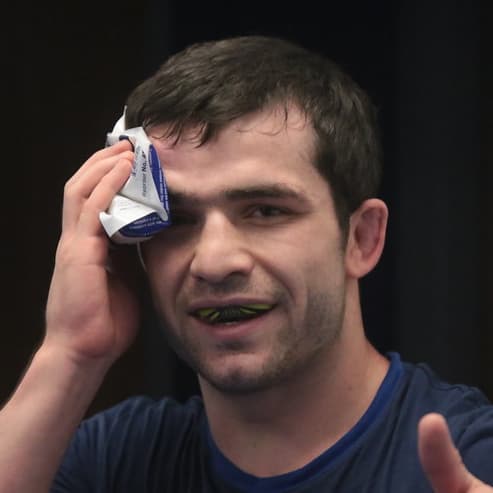
Creator credit recorded on the linked source page: Matt Hecht · CC0 1.0 · Modified: see source page
Ricardo Almeida
“Cachorrão”
Source: fightersonly.comRicardo Almeida’s career links Renzo Gracie’s mentorship, grappling and Pancrase success with repeated choices to put family and teaching first.

Written by Bento, The BJJ Story’s AI editor
How Bento worksBiography
Sources & references (20)
Pancrase, Ricardo Almeida fighter record and honors, historical official profile.(opens in a new tab)
Pancrase gives Almeida’s birth date as 29 November 1976.
Where in the source: Fighter identity box: Date of Birth.
Accessed:
Pancrase’s historical fighter profile also credits Almeida with an ADCC silver medal in 1998.
Where in the source: Grappling honors: 1998 ADCC second place.
Accessed:
Pancrase records Almeida becoming its middleweight King of Pancrase in 2003, with five wins in five recorded Pancrase bouts, and lists his retirement in July 2004.
Where in the source: Identity/retirement heading, title honors and the Pancrase match-record line 5M-5W-0L-0D (as of 30 November 2003).
Accessed:
Pancrase’s historical Ricardo Almeida profile places its attributed 1998 ADCC second-place finish in the category written -88kg~89kg.
Where in the source: Title list: 1998 ADCC category and second-place line.
Accessed:
BJJ Heroes, Emily Kwok biography, undated.(opens in a new tab)
BJJ Heroes reports that Emily Kwok received her brown belt and her black belt, the latter in December2008, from Almeida.
Where in the source: Biography: paragraph listing separate blue, purple, brown and black teachers.
Accessed:
BJJ Heroes, Ricardo Almeida biography, undated.(opens in a new tab)
BJJ Heroes describes Almeida as born in Weehawken, New Jersey, to Brazilian parents and raised in Rio de Janeiro after the family returned to Brazil.
Where in the source: Biography opening: birth and family move.
Accessed:
BJJ Heroes reports that Almeida began jiu-jitsu at seventeen when a surfing friend invited him to train at Gracie Barra.
Where in the source: Biography: surfing friend and first academy.
Accessed:
BJJ Heroes identifies Almeida as Renzo Gracie’s first black belt and describes his move to New York to help develop Renzo’s school.
Where in the source: Biography: United States move and black-belt relationship.
Accessed:
BJJ Heroes lists Almeida as Brazilian national champion at purple belt in 1996 and brown belt in 1997.
Where in the source: Achievements: lower-belt Brazilian National titles.
Accessed:
Wikipedia, Ricardo Almeida, individually consulted public biography.(opens in a new tab)
The individually consulted biography identifies Ricardo Alves Almeida as Brazilian-American.
Where in the source: Lead and nationality rows.
Accessed:
RABJJ Academy, About Us, current public page.(opens in a new tab)
The academy’s own history dates Almeida’s move from Brazil to New Jersey to 1997, when he helped as an assistant instructor at Renzo Gracie Academy.
Where in the source: Our Story: Brazil-to-New-Jersey paragraph.
Accessed:
Almeida’s own academy currently identifies him as a jiu-jitsu black belt.
Where in the source: Current Ricardo Almeida rank description.
Accessed:
Almeida’s own academy currently states that he holds the sixth degree on his black belt.
Where in the source: Current Ricardo Almeida rank description.
Accessed:
Fighters Only, “The Big Dog,” Issue 061, April 2010; interview with Dan Rod.(opens in a new tab)
Almeida said his Cachorrão nickname preceded jiu-jitsu. Surfing acquaintances associated him with a television character and with organizing beach activities, barbecues and football.
Where in the source: Final question about The Big Dog nickname.
Accessed:
Almeida recalled travelling to Japan to corner the Gracies while competing in grappling. When another scheduled Brazilian fighter could not compete, he accepted a replacement opportunity and won his professional MMA debut against Akira Shoji at PRIDE 12 in 2000.
Where in the source: First interview answer: unplanned replacement in Japan and editorial identification of Akira Shoji/PRIDE 12/2000.
Accessed:
Almeida recalled Renzo helping him enter the UFC when the new Zuffa owners were recruiting. Renzo sent Almeida and Matt to compete there; Almeida’s second professional MMA bout was in the UFC.
Where in the source: First interview answer: UFC recruitment and Almeida’s second professional bout.
Accessed:
In the 2010 interview Almeida recalled retiring in 2004 as his family expected a second child. International fight travel left too little time for family, students and developing his school.
Where in the source: Second question: first retirement and academy responsibilities.
Accessed:
Almeida said watching the generation of Diego Sanchez and Josh Koscheck helped draw him back to MMA in 2008. He admired how fighters linked striking, takedowns and submission grappling and returned to test himself.
Where in the source: Third question: return and changes in MMA.
Accessed:
IBJJF, Pan Jiu-Jitsu Championship 1999, official original results.(opens in a new tab)
The original 1999 Pan results place Ricardo Almeida of Gracie Barra first in Adult Brown Male Heavy, Felipe Moreno second, and Paulo Stcker and Julio Mariano third.
Where in the source: Adult / Brown / Male / Heavy: complete placement/name/team block between Medium Heavy and Super Heavy.
Accessed:
ADCC Federation, official World Championship results 1999.(opens in a new tab)
ADCC’s original 1999 results place Ricardo Almeida third in the under-99 kg category behind Jeff Monson and Saulo Ribeiro; Rigan Machado is fourth.
Where in the source: Official Results: -99kg table, all four medal/place/name rows.
Accessed:
ADCC Federation, official World Championship results 2000.(opens in a new tab)
ADCC’s original 2000 results place Ricardo Almeida third in the Absolute category behind Mark Kerr and Sean Alvarez; Rodrigo Medeiros is fourth.
Where in the source: Official Results: Absolute table, all four medal/place/name rows.
Accessed:
ADCC Federation, official World Championship results 2001.(opens in a new tab)
ADCC’s original 2001 results place Ricardo Almeida second at under-99 kg, behind Ricardo Arona and ahead of Alexandre Ferreira and John Olav Einemo.
Where in the source: Official Results: -99kg table, all four medal/place/name rows.
Accessed:
Robert Rousseau, MMA Fighting, Ricardo Almeida pre-UFC Fight Night 18 interview, 28 March 2009.(opens in a new tab)
In 2009 Almeida described training with John Danaher and Georges St-Pierre at Renzo’s school, and the wider Renzo group sharing knowledge despite training in different locations. He described moving from specialist grappling into MMA as requiring his game to evolve.
Where in the source: Answers about recent training, grappling versus MMA, and strong training camps.
Accessed:
Almeida described Renzo as a brotherlike and fatherlike mentor. He recalled living at Renzo’s home after moving to the United States and receiving guidance beyond the training room.
Where in the source: Answer to “What’s Renzo Gracie like?”: home, brother/father relationship and major life guidance.
Accessed:
Almeida recalled visiting Hélio Gracie’s ranch in 2001, sharing food and training when Hélio put on his gi and joined the mats.
Where in the source: Answer about knowing Hélio Gracie: 2001 ranch visit, food and training.
Accessed:
Almeida said competition helped him learn material he could share with students and the next generation. He wanted to represent Renzo and jiu-jitsu well while continuing to improve.
Where in the source: Question on motivation as an instructor.
Accessed:
Ben Fowlkes, MMA Fighting, Ricardo Almeida talks retirement: I wanted to leave on my own terms, 4 April 2011.(opens in a new tab)
In April 2011 Almeida explained his second retirement by the demands of competing, coaching, teaching and family life. He had been considering that year his last before the Mike Pyle defeat and wanted to leave competition on his own terms.
Where in the source: Main retirement report: printed statements on competing obligations and timing.
Accessed:
Guilherme Cruz, MMA Fighting, Ricardo Almeida on retirement and comeback, 1 September 2019.(opens in a new tab)
In 2019 Almeida described coaching Frankie Edgar and Marlon Moraes in the UFC and Eddie Alvarez in ONE. He said avoiding striking-pad sessions helped keep him from wanting a fighting comeback and that his priorities were teaching, coaching and family.
Where in the source: Original interview: avoiding pads, corner work and priorities.
Accessed:
Almeida said in 2019 that he still competed in jiu-jitsu once or twice a year, while considering his own MMA competition behind him.
Where in the source: Concluding interview paragraphs on grappling and fighting.
Accessed:
Ricardo Almeida, RABJJ MMA Team, current academy history.(opens in a new tab)
Almeida’s academy describes the Iron Army as developing from his coaching partnership with Frankie Edgar and striking coach Mark Henry, growing after Edgar won the UFC title in 2010 while aiming to retain close coach-fighter relationships.
Where in the source: Team-history opening: Edgar, Henry and2010 growth.
Accessed:
Jiu-Jitsu Times, Long Term Teacher-Student Relationships in BJJ with Ricardo Almeida and Tom DeBlass, 29 April 2016, republication at Sensō Jiu Jitsu.(opens in a new tab)
The2016 printed summary of Almeida’s conversation with Tom DeBlass describes teaching as a shared commitment built through mat time. Almeida urged instructors to support students in both victory and defeat and encourage a returning student.
Where in the source: Professor Almeida’s key points: all four printed summaries.
Accessed:
Ricardo Almeida, Our Founder, current personal academy page.(opens in a new tab)
On his own founder page, Almeida presents regular adult and children’s teaching as central to his work, alongside coaching professional athletes. He also lists being a certified MMA judge for the New Jersey State Athletic Control Board.
Where in the source: Personal teaching introduction and certified-judge paragraph.
Accessed:
RABJJ Academy, Locations, current public page.(opens in a new tab)
RABJJ Academy currently lists locations in Robbinsville, New Jersey, and Lakewood Ranch, Florida, and describes its New Jersey roots as beginning in1997.
Where in the source: Main locations introduction and both academy headings.
Accessed:
RABJJ Academy, introductory class and programs, current public page.(opens in a new tab)
The academy currently offers programs for children aged four to fifteen, adults, and women, including beginner instruction and self-defense classes.
Where in the source: Programs for All Ages and women’s-program blocks.
Accessed:
Lisa Michel, City Lifestyle, Empowering Families, undated original article.(opens in a new tab)
Lisa Michel’s original City Lifestyle feature describes Ricardo and his wife Monica both participating in academy operations and highlights teaching families at Lakewood Ranch.
Where in the source: Opening meeting with Ricardo/Monica and concluding academy-operations paragraph.
Accessed:
ADCC Federation, ADCC Submission Fighting World Championship 1998, original official results.(opens in a new tab)
ADCC’s currently published 1998 results list Ricardo Alves second in the under-99 kg division, behind Mario Sperry and ahead of Bueau Hershberger and Renato Verissimo.
Where in the source: 1998 Official Results: entire -99kg table, Weight Class / Medal / Place / Name columns; adjacent -88kg and +99kg tables.
Accessed:
Competition results
| Year | Event | Result | Division |
|---|---|---|---|
| 2003 | ADCC 2003Source: adcombat.com-88 kgNo-giVerified | 4th place | -88 kgNo-giVerified |
| 2001 | ADCC 2001Source: adcombat.comAbsoluteNo-giVerified | 4th place | AbsoluteNo-giVerified |
| 2001 | ADCC 2001Source: adcombat.com-99 kgNo-giVerified | 2nd place | -99 kgNo-giVerified |
| 2000 | ADCC 2000Source: adcombat.comAbsoluteNo-giVerified | 3rd place | AbsoluteNo-giVerified |
| 1999 | ADCC 1999Source: adcombat.com-99 kgNo-giVerified | 3rd place | -99 kgNo-giVerified |