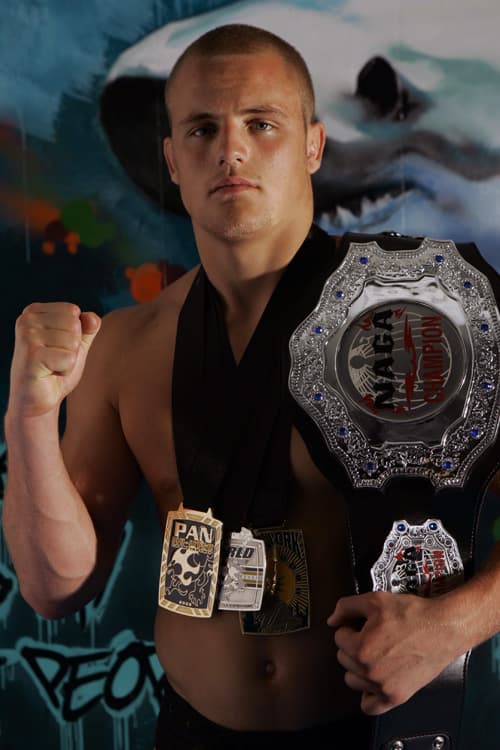
Creator credit recorded on the linked source page: Haraldur Dean Nelson · CC BY-SA 3.0
Gunnar Nelson
“Gunni”
Source: nelson.isAn Icelandic karate champion who had never grappled, Gunnar Nelson was a Renzo Gracie black belt within four years and fourth in the ADCC absolute.
Biography
Sources for this profile
nelson.is (Gunnar Nelson's official site), 'About Gunnar', undated page, read 2026-09-13.(opens in a new tab)
Gunnar Lúðvík Nelson, known as Gunni, was born on 28 July 1988 in Akureyri in northern Iceland and has lived in Reykjavík almost all his life since early childhood.
Where in the source: Section 'ABOUT GUNNAR NELSON', INFO block ('DOB: July 28 1988') and the opening paragraph, which names Akureyri and Reykjavík.
Accessed:
Nelson's nickname is Gunni, a short form of Gunnar, and his own site describes him as an Icelandic professional MMA and BJJ fighter who fights out of the Reykjavík club Mjölnir.
Where in the source: INFO block rows 'Nickname: Gunni', 'From: Reykjavik Iceland', 'Club: Mjölnir'.
Accessed:
Nelson fights and teaches out of Mjölnir in Reykjavík, Iceland, which his own site names as his home club.
Where in the source: Paragraph beginning 'Gunnar fights out of his local Icelandic MMA club MJÖLNIR in Reykjavik'.
Accessed:
Nelson played football and ice hockey as a child, started Gōjū-ryū karate at 13 in the autumn of 2001, won the Icelandic juvenile kumite championship in 2003 and again in 2004 and 2005, took a medal in every karate tournament he entered between 2003 and 2005, and was named Iceland's most promising up-and-coming karate talent of 2005 at the age of 16.
Where in the source: Section 'ABOUT GUNNAR NELSON', the childhood paragraph; anchor 'he started training Goju-Ryu karate'.
Accessed:
- Conflicting accounts
Nelson began training MMA and BJJ alongside his karate in 2005 and in 2006 dropped karate to concentrate on MMA and BJJ.
Where in the source: Section 'MMA AND BJJ CAREER', first two sentences.
Accessed:
Nelson's own site dates his belts precisely: blue on 25 April 2006, purple on 3 June 2007 and brown on 28 June 2008, and states he has been a BJJ black belt under Renzo Gracie since 30 September 2009.
Where in the source: Section 'MMA AND BJJ CAREER', sentence listing the three dated belts and the following sentence on the black belt.
Accessed:
Nelson's father Haraldur Dean Nelson, known as Halli, was born in 1965 in Keflavík and is Gunnar's manager; his mother Guðrún Hulda Gunnarsdóttir Nelson was born in 1966 in Ólafsfjörður; he has one sister, María Dögg Nelson, born 1992 in Reykjavík; and the family name comes from his paternal grandfather, who was from the United States. His site also states that he trains with John Kavanagh's team in Dublin while Kavanagh also teaches at Mjölnir in Iceland, and that he trains with Renzo Gracie and John Danaher in New York and in Manchester with Karl Tanswell.
Where in the source: Section 'ABOUT GUNNAR NELSON', first paragraph (family) and second paragraph (training bases and coaches).
Accessed:
Nelson had his first mixed martial arts fight in May 2007 in Copenhagen, Denmark. His own site records it as his first full contact fight of any kind, against a much more experienced Danish opponent regarded at the time as one of the best up-and-coming fighters in Denmark, and states that the Danish judges ruled the bout a draw.
Where in the source: Section 'MMA AND BJJ CAREER', the paragraph anchored on 'his first full contact fight ever'.
Accessed:
Nelson’s own site states that he has been signed to the UFC as from July 2012.
Where in the source: Section 'MMA AND BJJ CAREER', the sentence 'As from July 2012 Gunnar is signed for the UFC.' (followed on the page by 'For more info see his Record page.').
Accessed:
Wikipedia, 'Gunnar Nelson (fighter)', read 2026-09-13.(opens in a new tab)
Gunnar Lúðvík Nelson is an Icelandic professional mixed martial artist and Brazilian jiu-jitsu black belt, born 28 July 1988 in Akureyri, Iceland.
Where in the source: Infobox rows 'Born' and 'Nickname'; lead sentence anchored on 'is an Icelandic professional mixed martial artist'.
Accessed:
Kavanagh had awarded Nelson his brown belt by 2008 but, not having held a black belt for more than six years at the time, could not promote him to black belt under IBJJF rules, so Nelson went to the Renzo Gracie Academy in New York to advance his rank.
Where in the source: Section 'Brazilian Jiu-Jitsu', the sentence anchored on 'progressed far enough for Kavanagh' and the IBJJF clause that follows.
Accessed:
Wikipedia's grappling record table gives Nelson 14 matches, 8 wins and 6 losses, and dates the ADCC absolute losses to Vinny Magalhães and Alexandre Ribeiro to 27 September 2009 in Barcelona, the -88 kg loss to James Brasco to 26 September 2009, and the 2011 ADCC matches to 24-25 September 2011 in Nottingham; it also records a guillotine win over Bjarni Kristjánsson and an armbar win over Brynjólfur Ingvarsson in the Mjolnir Open absolute in Reykjavík on 3 September 2011, a rear-naked-choke win over Mike Russell at a Health & Fitness Expo superfight in Reykjavík on 20 November 2010, and a win over Ronnie Mikvenski plus a points loss to Azunna Anyanwu in the Grapplers Quest Beast of the East absolute in Caldwell, New Jersey on 20 March 2010.
Where in the source: Section 'Grappling record'; table header Result / Rec. / Opponent / Method / Event / Division / Date / Location.
Accessed:
Wikipedia’s medal record box and its grappling honours list credit Nelson with 2009 IBJJF silver in brown belt middleweight at the World Jiu-Jitsu Championship, gold in brown belt middleweight at the Pan American Championship in gi, and gold in black belt middleweight plus silver in black belt absolute at the Pan American No-Gi Championship, and also list him as a one-time NAGA middleweight champion.
Where in the source: Medal record box under the infobox, and section 'Championships and accomplishments' > 'Grappling'.
Accessed:
Wikipedia states that Nelson is an instructor at his home club Mjölnir and divides his time between there, SBG Ireland, the Renzo Gracie Academy and SBG Mainline in Manchester.
Where in the source: Section 'Brazilian Jiu-Jitsu', final paragraph beginning 'Today, Gunnar is an instructor in his home club Mjolnir'.
Accessed:
- Conflicting accounts
Wikipedia records that Nelson’s first MMA bout was in May 2007 in Copenhagen against the Danish fighter John Olesen and was ruled a draw, that he added five more wins over the following 16 months, fighting in Ireland, the United Kingdom and Denmark, and that he then took a break from the sport for almost two years, returning at BAMMA 2 in February 2010 with a first-round submission win over Sam Elsdon.
Where in the source: Section 'Mixed martial arts career' > 'Early career', first two paragraphs; anchor 'before taking a break from the sport for almost two years'.
Accessed:
BJJ Heroes, 'Gunnar Nelson', read 2026-09-13.(opens in a new tab)
BJJ Heroes lists Nelson's team affiliation as Mjölnir – SBG/Renzo Gracie and his lineage as Mitsuyo Maeda > Carlos Gracie > Helio Gracie > Carlos Gracie Jr > Renzo Gracie > Gunnar Nelson.
Where in the source: Section 'Gunnar Nelson Jiu Jitsu', rows 'Lineage:' and 'Team/Association:'.
Accessed:
BJJ Heroes writes that Nelson grew up with ice hockey and football before moving to Gōjū-ryū karate, and that by 16 he had won three national juvenile kumite tournaments and was regarded as one of the country's leading up-and-coming karateka.
Where in the source: Section 'Gunnar Nelson Biography', first paragraph; anchor '3 national juvenile kumite tournaments'.
Accessed:
BJJ Heroes writes that Nelson’s drive took him on repeated trips abroad for training, and that frequent travel to the United Kingdom brought him to Matt Thornton, the source of his blue and purple belts, and to John Kavanagh, who promoted him to brown.
Where in the source: Section 'Gunnar Nelson Biography', second paragraph; anchor 'frequent travels to the United Kingdom'.
Accessed:
BJJ Heroes writes that repeated visits to New York brought Nelson into Renzo Gracie’s circle, that training there with high-level practitioners lifted his game, that his largest tournament victories — at the New York Open and at the Pan American in both gi and no-gi — came while he was under Renzo’s guidance, and that Renzo awarded his black belt on 30 September 2009.
Where in the source: Section 'Gunnar Nelson Biography', third paragraph; anchor 'It was also Renzo who awarded'.
Accessed:
The profile's opening paragraph ranks Nelson among Europe's strongest grapplers, credits his fourth place in the 2009 ADCC open-weight bracket with making his name in the sport, and counts him among the youngest Europeans ever given a jiu-jitsu black belt, at 21 and four years into training.
Where in the source: Opening paragraph of the profile.
Accessed:
BJJ Heroes' black-belt fight history for Nelson records, for ADCC 2009: a referee-decision loss to James Brasco at 88 kg in round one, a points win over Jeff Monson in the absolute round one, a rear-naked-choke win over David Avellan in the absolute quarter-final, a kneebar loss to Alexandre Ribeiro in the absolute semi-final and a 3-0 points loss to Vinny Magalhaes in the absolute third-place match; and for ADCC 2011: a 5-0 points win over Marko Helen at 88 kg round one, a points win over Bruno Frazatto in the absolute round one, a 3-0 loss to Andre Galvao in the 88 kg quarter-final and a 2-0 loss to Alexandre Ribeiro in the absolute quarter-final.
Where in the source: Table 'GUNNAR NELSON FIGHT HISTORY', columns Opponent / W-L / Method / Competition / Weight / Stage / Year; note above it that the record covers black-belt division matches only.
Accessed:
nelson.is, 'Gunnar a black belt under Renzo', 30 September 2009, read 2026-09-13.(opens in a new tab)
Renzo Gracie awarded Nelson his Brazilian jiu-jitsu black belt on 30 September 2009, after Nelson had trained at the Renzo Gracie Academy in New York for almost a year, and the promotion followed his fourth place in the absolute division at ADCC 2009 in Barcelona.
Where in the source: News item 'GUNNAR A BLACK BELT UNDER RENZO', dated Sep 30, 2009; opening sentence and the closing sentence linking the belt to his ADCC run.
Accessed:
At the time of his black belt Nelson had been doing Brazilian jiu-jitsu for less than four years and had no grappling experience before that.
Where in the source: News item of Sep 30, 2009; the sentence anchored on 'This has been a amazing ride' (the source's own wording).
Accessed:
Nelson received his blue belt in April 2006 and his purple belt in June 2007 under Matt Thornton of SBGi, with help from John Kavanagh and Karl Tanswell, and his brown belt under John Kavanagh of SBG Ireland in June 2008; shortly after the brown belt he went to New York to train at the Renzo Gracie Academy.
Where in the source: News item of Sep 30, 2009; the belt sentences, anchored on 'both under Matt Thornton SBGi' and the brown-belt sentence that follows.
Accessed:
Nelson's own site reported that the Renzo Gracie Academy's website said he demonstrated amazing ability in all areas of Brazilian jiu-jitsu and was a calibre of grappler the academy was proud to have represent it.
Where in the source: News item of Sep 30, 2009; the sentence anchored on 'demonstrate amazing ability in all areas'.
Accessed:
UFC.com, Jordan Newmark, 'A Visit with Gunnar Nelson in Iceland', 10 January 2013, read 2026-09-13.(opens in a new tab)
Nelson has said that he began in Okinawa Gōjū-ryū and that about two years in, or less, he narrowed his training to kumite, free fighting, training it with a group who did only that; the club kept some kata work, which he came to appreciate, but as a boy with a lot of energy he found it hard to be still and do things in one prescribed way, and felt far freer when he was free sparring.
Where in the source: Quote beginning 'I started off with Okinawa Goju-Ryu,' remembers Nelson — the paragraph that ends with free sparring.
Accessed:
At 17 Nelson was introduced to submission grappling when Jón Viðar Arnþórsson — a friend, coach and member of Iceland's national kumite team — asked him whether he wanted to roll; after several minutes of being put into unfamiliar locks and holds, Nelson had eyes only for the new art.
Where in the source: Paragraph beginning 'At 17, Nelson was introduced to submission grappling' — names Jon Vidar Arnthorsson and the invitation to roll.
Accessed:
Nelson has said he got his black belt in four years — a year and a half of it unstable, then very stable training every day — and that he never rushed himself, always staying relaxed, because it is not the years but the hours spent on the mat thinking about it and working on it.
Where in the source: Quote beginning 'I guess I got my black belt in four years,' tells Nelson — through 'I do believe I have a lot of hours in it.'
Accessed:
Nelson has explained how he approached his ADCC 2009 win over Jeff Monson: Monson was much bigger and stronger but would not be as fast or able to handle as many scrambles, and would want to grab hold and slow the match down and use his strength, so Nelson's plan was to keep it open, force quick scrambles, make Monson move and react, and escape whenever he got a grip so that the effort tired him; he added that he would have liked to finish, that he was able to do most of what he wanted, and that he stayed safe without working as much offence as he would have liked.
Where in the source: Nelson's quote on the Monson match, from 'I'd say, I would have an idea' through the end of that paragraph.
Accessed:
After taking up submission grappling, Nelson's coaching escalated quickly, from Ireland's first BJJ black belt John Kavanagh to Renzo Gracie and John Danaher in New York and former UFC champion BJ Penn in Hawaii, among others, and he rose to the top of the BJJ ranks winning gold and silver medals at IBJJF Pan American and World championships.
Where in the source: Paragraph beginning 'From there, the escalation of coaching was immediate'.
Accessed:
Nelson has described Mjölnir's origin in his own words: at first there were karate people and jiu-jitsu people, who came together and became Mjölnir; since then a boxing gym joined and brought its material in, which helped everyone; and he brought a lot of wrestling into the gym himself, which the members picked up. His stated idea is that it is all grappling, split into different sports but the same thing, so you work your grappling on the feet, on the ground, your guard passes and your takedowns.
Where in the source: Nelson's quote on the gym's origin, from 'At first, there were karate guys' through 'It's just martial arts.'
Accessed:
At the time of the visit in late 2012 Mjölnir had more than 800 members, its walls carried newspaper clippings, trophies, belts and markers of Nelson's accomplishments alongside old Viking proverbs about fighting to the last breath, and its second floor was a former theatre rehearsal room refitted with jiu-jitsu mats and a cage, where Kavanagh taught gi BJJ while Jón Viðar Arnþórsson ran a Viking conditioning class on the ground floor.
Where in the source: Paragraph beginning 'Nowadays, Nelson's massive home gym, Mjolnir, which boasts 800+ members'.
Accessed:
Nelson has said that his thinking about the sport has always put self-defence first, and that when people ask why he finishes opponents early he answers that this is self-defence: the longer he spends in there with an opponent, the more time he gives him to work him out and beat him. He contrasted training, where you give a lot up because you are playing, with competition, where you push and do not leave the outcome to the judges or spend more time in there than you need.
Where in the source: Quote beginning 'I do push for finishes,' explains Nelson — through the end of that paragraph.
Accessed:
- Conflicting accounts
UFC.com writes that in 2007 Nelson did not so much decide to try MMA as tackle it, taking five fights within eight months, and that to prepare for the new sport he trained with John Kavanagh at his Straight Blast Gym in Dublin; it adds that Kavanagh’s own competition experience in MMA, BJJ, kickboxing and submission wrestling was what early on shaped Nelson’s mindset for jiu-jitsu as well as for fighting.
Where in the source: Paragraph anchored on 'as much as he tackled it', and the sentences that follow on Dublin and on Kavanagh's own competition background.
Accessed:
The42.ie, Paul Dollery, 'The Icelandic teenager who became one of Ireland's favourite fighting sons', 22 September 2016, quoting John Kavanagh, 'Win or Learn'.(opens in a new tab)
- Conflicting accounts
John Kavanagh has written that when he travelled to Iceland for a seminar in 2005 he had been told about Nelson before leaving Dublin, that Nelson had very high-level karate and, although grappling was still new to him, was taking to it easily; Nelson asked him for a private lesson on arrival and his potential was evident when they rolled. Just over a year later Nelson came to Dublin to train with Kavanagh at Straight Blast Gym, then based in an industrial estate in Rathcoole, the first of many visits.
Where in the source: Opening two paragraphs; block quote attributed to Kavanagh's autobiography 'Win or Learn', anchored on 'like a duck to water'.
Accessed:
- Conflicting accounts
nelson.is, 'Gunnar takes 4th place in absolute at ADCC 2009', 29 September 2009, read by the reviewer in the in-app browser.(opens in a new tab)
At ADCC 2009 in Barcelona Nelson lost his -88 kg opening match to James Brasco on a judges' decision after double overtime, then in the absolute division beat Jeff Monson on points in double overtime and David Avellan by rear naked choke, lost the semi-final to Alexandre 'Xande' Ribeiro by kneebar near the end of the match, and lost the third-place match to Vinicius 'Vinny' Magalhães on a takedown scored in the last seconds of overtime, finishing fourth.
Where in the source: News item 'Gunnar takes 4th place in absolute at ADCC 2009', the round-by-round report covering the Saturday -88 kg match and the Sunday absolute bracket.
Accessed:
Nelson came into the ADCC 2009 absolute division as the lightest man in it, weighing 83 kg in his clothes and shoes, and was drawn against the heaviest man in the bracket, Jeff Monson, a former ADCC champion who had already taken third place in the +99 kg division at the same event.
Where in the source: Report dated Sep 29, 2009; the sentence anchored on 'weighted in 83kg in his clothes and shoes'.
Accessed:
nelson.is, 'Brazilian Jiu Jitsu and Grappling record', read 2026-09-13.(opens in a new tab)
Nelson's own competition record lists, in 2009: first place in men's brown belt middleweight at the Pan Jiu-Jitsu Championship in Carson, California on 29 March; first in men's brown belt middleweight and third in brown belt open weight at the New York International Open on 18 April; second in men's brown belt middleweight at the World Jiu-Jitsu Championship on 6 June; fourth in men's absolute at ADCC in Barcelona on 27 September; first in men's black belt medium heavyweight and second, by coin toss, in black belt open weight at the Pan No-Gi Championship on 3 October; second in men's black belt -88 kg at the Scandinavian Open in Stockholm on 18 October; and first in both open weight and -81 kg at the Icelandic Brazilian Jiu Jitsu Championship in Reykjavík on 8 November.
Where in the source: Page 'BRAZILIAN JIU JITSU AND GRAPPLING RECORD', the year block headed 2009, read top to bottom.
Accessed:
Before his 2009 season Nelson's record already ran through several countries: first place in men's advanced no-gi at the Hawaiian Open on 1 June 2008; first in men's advanced no-gi -80 kg at the Great Britain Grappling Open National Championship on 14 September 2008; first in men's no-gi expert middleweight and second in men's gi brown and black cruiserweight at the North American Grappling Championship in New Jersey on 8 November 2008; and, in 2007, first in both absolute and purple belt at the Irish BJJ Open on 20 October.
Where in the source: Page 'BRAZILIAN JIU JITSU AND GRAPPLING RECORD', year blocks 2008 and 2007.
Accessed:
Nelson won the Mjölnir Open repeatedly at home: both open weight and -74 kg no-gi in March 2006 (second in open weight, first in -74 kg), both titles at the club's gi tournament in November 2006, both open weight and -81 kg in May 2007, both open weight and -88 kg in February 2010, September 2011 and March 2012. He also won both open weight and his weight class at the Icelandic Brazilian Jiu Jitsu Championship in 2009 and 2010.
Where in the source: Page 'BRAZILIAN JIU JITSU AND GRAPPLING RECORD', year blocks 2006, 2007, 2010, 2011, 2012 (Mjölnir Open lines) and 2009-2010 (Icelandic championship lines).
Accessed:
On 20 November 2010 Nelson beat the English black belt Michael Russell by rear naked choke after 4 minutes 8 seconds in a no-gi grappling match at -77 kg under ADCC rules, in the main event of the Iceland Health and Fitness Expo in Reykjavík; the same year's entry for 20 March records a win in the men's 179 lb no-gi class at Grapplers Quest Beast of the East, New Jersey.
Where in the source: Page 'BRAZILIAN JIU JITSU AND GRAPPLING RECORD', year block 2010, the 20 November and 20 March entries.
Accessed:
nelson.is, 'Gunnar the first Icelandic BJJ Champion', 27 October 2008, read 2026-09-13.(opens in a new tab)
Nelson took three gold medals at the first Icelandic Brazilian jiu-jitsu championship, held on 26 October 2008: his weight class, the open weight class and the team event. His club Mjölnir - SBG Iceland won the most medals of the four BJJ clubs in Iceland, and Nelson had about ten matches at the championship and won them all without conceding a single point.
Where in the source: News item 'GUNNAR THE FIRST ICELANDIC BJJ CHAMPION', dated Oct 27, 2008; whole item, four sentences.
Accessed:
Wikipedia (Icelandic), 'Mjölnir (íþróttafélag)', read 2026-09-13.(opens in a new tab)
The Icelandic Wikipedia article on Mjölnir states that the club was founded in 2005 and specialises in combat sports, that it used a hall at Mýrargata 2-8 until 2011, when the building gave way to a hotel and the club moved to Seljavegur 2, that it holds the annual combat sports tournament Mjölnir Open, and that in 2009 Mjölnir members won the most medals at the Icelandic championship in Brazilian jiu-jitsu.
Where in the source: Whole article body, one paragraph; anchor 'var stofnað 2005'.
Accessed:
Vísir, Stefán Ó. Jónsson, 'Jón Viðar gengur sáttur frá Mjölni', 17 February 2020, read 2026-09-13.(opens in a new tab)
Jón Viðar Arnþórsson is one of the founders of Mjölnir and was long its chairman, stepping down from that role in August 2017; in 2020 he was selling his 14.71 per cent holding in Mjölnir MMA ehf., which placed him among the five largest owners.
Where in the source: Opening paragraphs; anchors 'einn stofnenda Mjölnis' and 'Hann var lengi formaður félagsins'.
Accessed:
MMAViking.com, Pétur Marinó Jónsson, 'MMA in Iceland Beyond Gunnar Nelson', 24 January 2014, read 2026-09-13.(opens in a new tab)
In January 2014 MMAViking reported that Iceland had only two clubs that could be called MMA clubs, that Mjölnir was by far the biggest with over 1,200 members and one of the best facilities in Europe, that there had always been a strong emphasis on BJJ in the gym but that the emphasis shifted from BJJ to MMA after John Kavanagh was hired as the gym’s head coach in the summer of 2012 — Kavanagh no longer held that post at the time of writing but still coached there occasionally — and that its competition team had been developed under John Kavanagh, Jón Viðar Arnþórsson as chairman, Gunnar Nelson and Árni Ísaksson, with Nelson’s father Haraldur Dean Nelson — his manager and the gym’s chief executive — arranging fights for the young team.
Where in the source: Sections 'Gyms & The Development of MMA' and the paragraph beginning 'A strong competition team was developed under the tutelage of John Kavanagh'.
Accessed:
UFC.com, Kevin Schuster, 'Gunnar Nelson | Back Like He Never Left', 20 March 2025, read 2026-09-13.(opens in a new tab)
In March 2025 UFC.com reported that Nelson, as a coach at Mjölnir, enjoys spending longer periods teaching and learning from his students, and quoted him saying that time off lets him work on new things and take his game to the next level, that it can be hard to improve while staying busy and always in the shark tank, and that because he coaches a good deal he gets to go deeper into techniques and situations, which he finds improves his own game a lot. He added that the game is evolving, that you can learn something from anyone, beginner or not, and that he has a good mind for picking up what works for him.
Where in the source: Paragraph beginning 'As a coach at Mjölnir, he enjoys spending longer periods of time teaching', and the two quoted paragraphs that follow.
Accessed:
Sunnlenska.is, 'Gunnar Nelson heimsótti Berserki BJJ', 5 June 2024, read 2026-09-13.(opens in a new tab)
When the Brazilian jiu-jitsu club Berserkir BJJ in Selfoss turned one year old in June 2024, Gunnar Nelson and Halldór Logi Valsson — a coach at Mjölnir and one of Iceland's best competitors in the sport — visited for the anniversary, led technique sessions for the group and then rolled with the club's members.
Where in the source: Whole article, four sentences, dated 5 June 2024; anchors 'Berserkir BJJ á Selfossi varð eins árs' and 'stýrðu tækniæfingum'.
Accessed:
Bloody Elbow, Ben Kohn, 'BJJ Oversimplified - Gunnar Nelson's top game tactics', 19 April 2023, read 2026-09-13.(opens in a new tab)
A technical breakdown of Nelson's top game identifies three recurring tools: weight distribution, where he drops his weight across the chest to cover as much surface as possible, posts a foot and drives forward to extend an arm; frames and posts, which he uses to own the space over an opponent's upper body, limiting the responses available and creating room to strike and posture; and a leg hook inside the opponent's leg from half guard, which kills hip mobility and cuts the energy he has to spend on control, letting one action feed the next.
Where in the source: Sections 'Gunnar Nelson's effective weight distribution', 'Gunnar Nelson's frames and posts' and 'Gunnar Nelson's leg hook'.
Accessed:
Competition results
| Year | Event | Result | Division |
|---|---|---|---|
| 2009 | ADCC 2009Source: adcombat.comAbsoluteNo-giVerified | 4th place | AbsoluteNo-giVerified |
Lineage
No teaching connections are shown on this page.
Open lineage