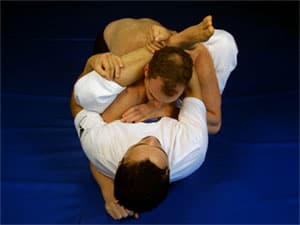
Creator credit recorded on the linked source page: Phil192 · Public domain
Eddie Bravo
Eddie Bravo turned no-gi experiments into 10th Planet’s teaching system and built the submission-only Eddie Bravo Invitational.

Written by Bento, The BJJ Story’s AI editor
How Bento worksBiography
Sources & references (14)
Todd Blackett, 'Eddie Bravo Promoted To Fourth Degree BJJ Black Belt,' Jitsmagazine.com, 20 October 2023.(opens in a new tab)
A 20 October 2023 report says Eddie Bravo was promoted to fourth-degree Brazilian jiu-jitsu black belt by Jean Jacques Machado.
Where in the source: Opening promotion description and the recent official Instagram announcement, in the report dated 20 October 2023.
Accessed:
The same 20 October 2023 report says Jean Jacques Machado promoted Eddie Bravo to the fourth degree on his Brazilian jiu-jitsu black belt.
Where in the source: Opening two paragraphs — report of the fourth-degree promotion by Jean Jacques Machado.
Accessed:
Bravo received his black belt and opened his first no-gi 10th Planet school after returning from ADCC 2003.
Where in the source: Third biographical paragraph.
Accessed:
The 2023 promotion report also identifies Bravo’s women’s grappling promotion Medusa alongside EBI and Combat Jiu-Jitsu.
Where in the source: Promotional career paragraph.
Accessed:
Adisa Banjoko, 'Eddie Bravo: Formless Wisdom Pt. 1,' Fast Company, 10 September 2008.(opens in a new tab)
In 2008 Bravo described receiving his black belt from Jean Jacques Machado and opening an exclusively no-gi school.
Where in the source: Interview Q&A on Machado, opening the school and dropping the gi
Accessed:
Bravo said defeating Royler at ADCC 2003 enabled him to open a school in Los Angeles.
Where in the source: Interview Q&A on the Royler bout and subsequent Los Angeles school opening
Accessed:
Bravo moved to Hollywood in 1991 pursuing music, practiced karate, then began jiu-jitsu in 1994 after watching Royce Gracie.
Where in the source: Early music and karate/UFC questions.
Accessed:
Teaching offered a fallback career while Bravo pursued music and expected The Man Show to end.
Where in the source: Writing career, ADCC and school-opening answers.
Accessed:
Friday no-gi training under Machado made Bravo want an entire week of practice without the gi.
Where in the source: Machado and dropping-the-gi answer.
Accessed:
Eddie Bravo, 'MTS 101 & 102 are now LIVE!,' 10th Planet Jiu Jitsu, 4 March 2016.(opens in a new tab)
A 2016 post signed by Eddie on the official 10th Planet Jiu Jitsu site describes Mastering the System as an online instructional series for the association's unorthodox no-gi Brazilian jiu-jitsu style, filmed at its downtown Los Angeles headquarters.
Where in the source: MTS 101 & 102, 4 March 2016 — signed introductory description.
Accessed:
In March 2016 Bravo credited Sean Applegate with a leg-lock counter and Sergio Hernandez with rubber-side-control material he was incorporating.
Where in the source: MTS 101/102 signed paragraph.
Accessed:
Bravo’s 2015 announcements describe repeated warm-up flows, including a Cummings-derived leg-lock escape, and training linked attacks from back control.
Where in the source: MTS 98, 96 and 95 descriptions.
Accessed:
Marcelo Alonso, ADCC 2003 retrospective, Portal do Vale Tudo, 22 August 2024.(opens in a new tab)
At ADCC 2003 in São Paulo, Eddie Bravo submitted Royler Gracie with a triangle in the under-66 kg division.
Where in the source: HÉLIO GRACIE; Royler/Eddie paragraphs
Accessed:
Bravo then lost 15–0 to eventual under-66 kg champion Leonardo Vieira; the published podium names Vieira, Baret Yoshida and Royler Gracie.
Where in the source: Leozinho vinga Royler; RESULTADOS, Até 66kg; neighbor Até 77kg
Accessed:
Jits Magazine, ADCC 2003 Bravo–Royler match retrospective.(opens in a new tab)
A retrospective match breakdown describes Bravo using lockdown and guard recovery before finishing Royler with a triangle in the 2003 ADCC quarterfinal.
Where in the source: ADCC 2003; match breakdown
Accessed:
Bryan Tucker, Metamoris 3 results, MMA Fighting, 29 March 2014.(opens in a new tab)
The 2014 Metamoris 3 rematch between Eddie Bravo and Royler Gracie was declared a draw.
Where in the source: Main card, Bravo–Gracie result
Accessed:
Luke Thomas, interview with Eddie Bravo, MMA Fighting, 26 March 2014.(opens in a new tab)
In a 2014 interview, Bravo said his 2003 game already included the twister, lockdown and electric chair while his rubber guard was still developing.
Where in the source: Development Q&A, 2003 techniques
Accessed:
Bravo described his no-gi approach as emphasizing clinches, underhooks, overhooks and head control instead of clothing grips.
Where in the source: Gi/no-gi comparison Q&A
Accessed:
Before the 2014 rematch, Bravo described successive counters and positional links as the growth of his system, comparing it to expanding creative tools.
Where in the source: Development question and Pro Tools analogy.
Accessed:
Bravo credited Machado and several training partners with refining his leg-lock defence for the 2014 Royler rematch.
Where in the source: Rematch preparation and leg-lock questions.
Accessed:
Luke Thomas, interview with Eddie Cummings, MMA Fighting, 28 August 2015.(opens in a new tab)
EBI winner Eddie Cummings credited Bravo with organizing the truck and back attacks into a coherent positional system, rather than inventing each individual move.
Where in the source: Cummings on coherent systems and truck
Accessed:
After winning EBI 4, Eddie Cummings praised its overtime format in a 2015 interview for deciding matches through grappling exchanges.
Where in the source: Cummings on event formats and overtime
Accessed:
Victory Belt Publishing, Advanced Rubber Guard catalogue page.(opens in a new tab)
Victory Belt published Bravo and Glen Cordoza's Advanced Rubber Guard, presenting developments in rubber guard plus half, butterfly and X-guard material.
Where in the source: Title/byline; book description
Accessed:
10th Planet Jiu Jitsu, Locations and certified-instructor notice, current public directory.(opens in a new tab)
The 10th Planet locations page identifies a Los Angeles headquarters and a network of independently operated locations with certified instructors teaching the system.
Where in the source: Locations; certified-instructor notice
Accessed:
C.J. Tuttle, Eddie Bravo interview before EBI 3, Sherdog, 19 March 2015.(opens in a new tab)
By March 2015 Bravo had founded the Eddie Bravo Invitational; its third event followed two earlier tournaments, with bonuses offered for submissions in regulation.
Where in the source: EBI 3 preview; founder and incentive paragraphs
Accessed:
For EBI 3, Bravo reduced the adult programme to one sixteen-person bracket and added teenage superfights to shorten the show.
Where in the source: Format changes near the interview conclusion.
Accessed:
Arun Subramanian, Eddie Bravo retrospective, Jiu Jitsu Brotherhood, 8 July 2018.(opens in a new tab)
A 2018 grappling retrospective describes EBI as no-gi and submission-only, with overtime from dominant positions resolving matches without a draw.
Where in the source: EBI section
Accessed:
Bravo was born Edgar Cano in California in 1970; Bravo was his stepfather’s surname.
Where in the source: Opening biographical paragraph.
Accessed:
FloGrappling, “Combat Jiu-Jitsu: What’s The Verdict?”, 7 March 2017.(opens in a new tab)
At EBI 11 in Los Angeles in March 2017, Bravo introduced Combat Jiu-Jitsu: grappling with open-handed ground strikes; Nick Honstein won its four-man bantamweight tournament.
Where in the source: Event introduction, ground-strike explanation and four-man tournament paragraphs.
Accessed:
Dave Meyer, Ageless Warrior Lab, Eddie Bravo interview EP 52, 1 September 2026; printed transcript.(opens in a new tab)
Bravo recalled Machado supporting experiments, teaching classmates counters, then helping him develop answers to those counters.
Where in the source: Printed transcript 46:59–53:42.
Accessed:
Bravo recalled organising written flows with Todd White and testing their drills in sparring.
Where in the source: Printed transcript 46:59–53:42, Todd White subsection.
Accessed:
Revisiting Royler’s 2003 finish, Bravo credited guard recovery and Machado’s overhook sequence rather than a completed rubber-guard attack.
Where in the source: Printed transcript 40:18–41:55.
Accessed:
Bravo connected his mixing of musical styles to borrowing useful ideas across grappling disciplines.
Where in the source: Printed transcript 1:46:11–1:48:10.
Accessed:
Bravo chose familiar back-control and armbar starts for EBI overtime instead of his distinctive positions.
Where in the source: Printed transcript 1:22:40–1:24:00.
Accessed: