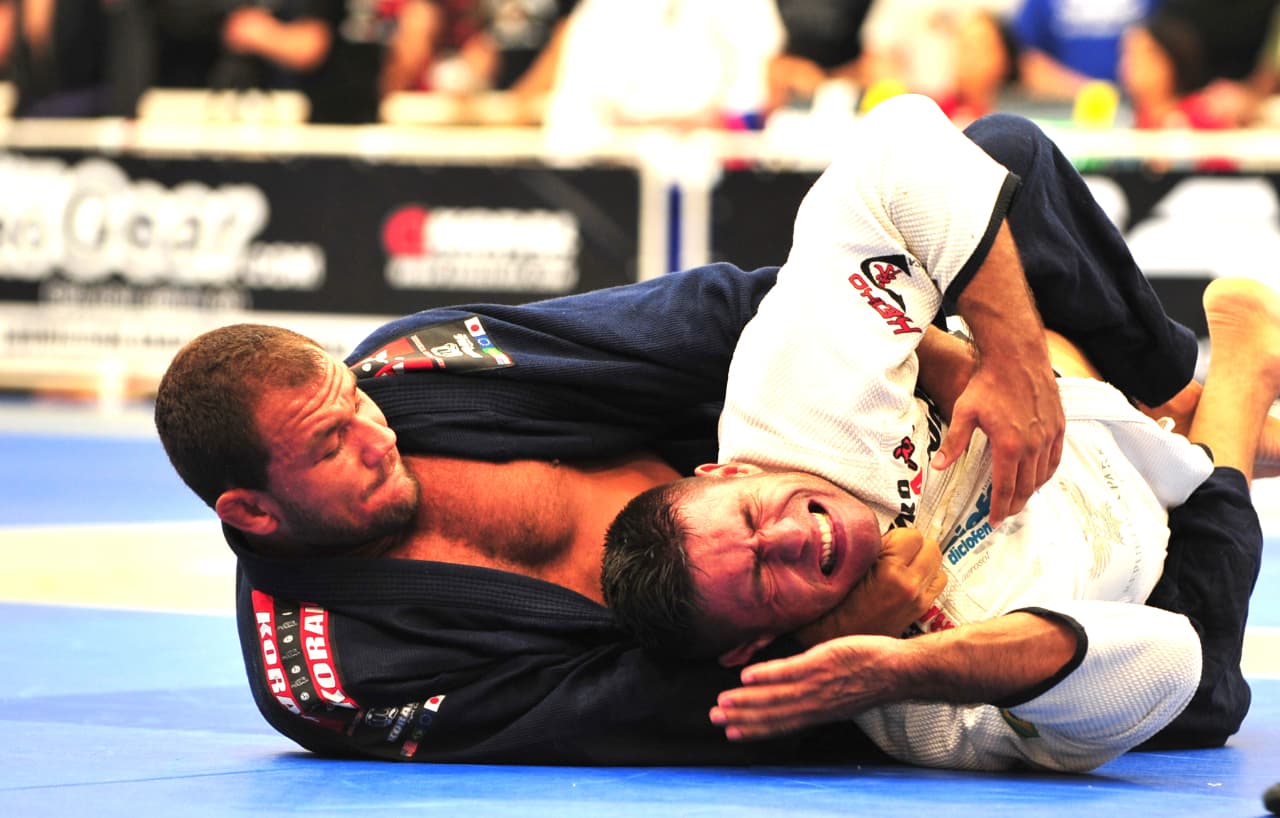
Creator credit recorded on the linked source page: © John Lamonica · CC BY-SA 3.0
Roberto "Cyborg" Abreu
Roberto “Cyborg” Abreu won ADCC open-class gold in 2013 and built Fight Sports, bringing competition experience into his work as a teacher.

Written by Bento, The BJJ Story’s AI editor
How Bento worksBiography
Sources & references (12)
Graciemag’s road trip with Roberto ‘Cyborg’ Abreu | Graciemag(opens in a new tab)
Graciemag’s account identifies Luiz Cláudio Isaías as an early instructor in Campo Grande and Francisco “Toco” Albuquerque as the teacher guiding Abreu through his intermediate development and 2004 black belt. Abreu recalled approximately day-long bus journeys to Rio to compete, sometimes arriving too late to eat before heading to the Tijuca Tennis Club.
Where in the source: The power of regeneration; teacher history and purple-belt bus journeys.
Accessed:
Abreu told Graciemag that founding his own academy while still a purple belt required teaching himself through successes and mistakes. He linked the development of his techniques and teaching methods to that process of building the school, supported by his parents and students.
Where in the source: Autodidacticism paragraph and Abreu’s following explanation.
Accessed:
During the trip through Mato Grosso do Sul and the Pantanal, Abreu explained that his upbringing around nature shaped his sense of movement, reflexes and willingness to try things. He brought the reporting team to the region because he considered it essential to understanding his inspiration as a martial artist.
Where in the source: Upbringing amid nature and reason for the Pantanal visit.
Accessed:
After losing to Buchecha in the 2013 ADCC weight division, Abreu beat him in the open class. Reflecting on the title, he emphasized the mental state needed to compete under pressure; looking back on that year, he described turning his academy into a close community as his most important accomplishment.
Where in the source: Opening ADCC reflection and The best year of my life section.
Accessed:
In Graciemag’s road-trip interview, Abreu recalled a rollover accident in which wreckage crushed his left arm, doctors warning that its movement might not return, and subsequently resuming training. The report links the nickname “Cyborg” to his recovery.
Where in the source: The power of regeneration section.
Accessed:
ADCC World Championship 2009(opens in a new tab)
Roberto Abreu won silver in the +99kg division at the 2009 ADCC World Championship in Barcelona.
Where in the source: Full +99kg table.
Accessed:
ADCC World Championship 2013(opens in a new tab)
At the 2013 ADCC World Championship in Beijing, Roberto Abreu won Absolute gold and +99kg bronze.
Where in the source: Full Absolute and +99kg tables.
Accessed:
ADCC - Cyborg wins open class | Graciemag(opens in a new tab)
Abreu defeated Keenan Cornelius in the semifinal and Marcus “Buchecha” Almeida 10–0 in the final to win the 2013 ADCC open class.
Where in the source: Contemporaneous October 20 report; opening result paragraphs.
Accessed:
Revelação da faixa-preta na Jiu-Jitsu Expo, aluno de Cyborg dá fórmula para vitória no GP | Graciemag(opens in a new tab)
Ricardo Rezende described Abreu’s coaching at the 2013 World Jiu-Jitsu Expo black-belt grand prix. After Rezende lost to James Puopolo early and met him again in the final, Abreu reminded him of his own ADCC reversal against Buchecha and encouraged him to attack. Rezende credited that encouragement with increasing his confidence before he submitted Puopolo and won the tournament.
Where in the source: Rezende interview; final question about the main lesson from winning the GP.
Accessed:
IBJJF | International Brazilian Jiu-Jitsu Federation(opens in a new tab)
Abreu won the 2019 IBJJF No-Gi Heavyweight Grand Prix with victories over Victor Hugo, Lucas Barbosa and João Gabriel Rocha. In a later IBJJF interview he recalled the event as a demanding format he enjoyed and wanted to enter again.
Where in the source: Opening and 2019 Grand Prix paragraph.
Accessed:
Speaking before the November 2022 Grand Prix, Abreu said he had entered that year’s Pans at short notice to support his students. He described gi and no-gi as complementary and said the ambitions of younger athletes helped keep him motivated: training remained his routine regardless of a tournament’s result.
Where in the source: Pan-entry answer and gi/no-gi and longevity questions.
Accessed:
IBJJF | International Brazilian Jiu-Jitsu Federation(opens in a new tab)
Abreu won the 2022 Pan Championship ultra-heavyweight title with victories over Wildermar Souza, Wallace Costa, Davi Cabral and Gutemberg Pereira, fourteen years after his first Pan title in 2008.
Where in the source: 2022 Pan Champion Roberto Cyborg Wants Another GP Title section; full Cyborg paragraph.
Accessed:
Confira os campeões do ADCC 2024 | Graciemag(opens in a new tab)
At ADCC 2024 in Las Vegas, Abreu took silver in the men’s open class and bronze at under 99 kilograms. The contemporary report describes Kaynan Duarte submitting him in the open-class final and Abreu defeating Michael Pixley in the weight-division bronze match.
Where in the source: Event/date; full men’s Absolute podium; -99kg podium and preceding bronze-match paragraph.
Accessed:
Roberto "Cyborg" Abreu Promoted To 5th Degree Brazilian Jiu-Jitsu Black Belt(opens in a new tab)
A December 18, 2023 report records Roberto “Cyborg” Abreu’s promotion to fifth-degree BJJ black belt by Alexandre Pimentel.
Where in the source: Opening promotion paragraphs and publication date.
Accessed:
Stubbs, Tribune, 2018.(opens in a new tab)
Abreu taught a two-day clinic at a Bahamas academy’s opening in 2018.
Where in the source: Opening; clinic.
Accessed:
BJJ Heroes, Roberto Cyborg Abreu(opens in a new tab)
Roberto de Abreu Filho, known as “Cyborg”, was born in Campo Grande on 20 December 1980.
Where in the source: Full name; opening biography.
Accessed:
Abreu began at Claudionor Cardoso’s gym and trained at Nova Geração with Francisco “Toco” Albuquerque, who awarded him his black belt in December 2004.
Where in the source: Biography; Cardoso and Albuquerque.
Accessed:
A smaller friend’s repeated submissions introduced the teenage Abreu to jiu-jitsu; he followed the friend to Cardoso’s gym.
Where in the source: First-contact paragraphs.
Accessed:
Micael Sergi, BJJ Legends interview with Roberto Cyborg Abreu(opens in a new tab)
Abreu said his tornado guard began as a blue-belt half-guard sweep developed through experimentation and flexibility.
Where in the source: Tornado-guard answer.
Accessed:
After opening Fight Sports in Campo Grande as a purple belt in 2002, Abreu trained mostly with smaller white belts. Giving them room to move helped him develop a looser game emphasizing mobility, balance and speed.
Where in the source: School and smaller-students answer.
Accessed:
In 2010 Abreu described a Miami Beach training camp hosting visiting grapplers, MMA coaching at Legacyfit and a partnership with Pablo Popovitch.
Where in the source: Miami schools and Avengers answers.
Accessed:
Competition results
| Year | Event | Result | Division |
|---|---|---|---|
| 2024 | ADCC 2024Source: adcombat.comAbsoluteNo-giVerified | 2nd place | AbsoluteNo-giVerified |
| 2024 | ADCC 2024Source: adcombat.com-99 kgNo-giVerified | 3rd place | -99 kgNo-giVerified |
| 2022 | ADCC 2022Source: adcombat.comAbsoluteNo-giVerified | 4th place | AbsoluteNo-giVerified |
| 2019 | ADCC 2019Source: adcombat.com+99 kgNo-giVerified | 4th place | +99 kgNo-giVerified |
| 2017 | ADCC 2017Source: adcombat.com+99 kgNo-giVerified | 3rd place | +99 kgNo-giVerified |
| 2013 | ADCC 2013Source: adcombat.com+99 kgNo-giVerified | 3rd place | +99 kgNo-giVerified |
| 2013 | ADCC 2013Source: adcombat.comAbsoluteNo-giVerified | 1st place | AbsoluteNo-giVerified |
| 2011 | ADCC 2011Source: adcombat.com+99 kgNo-giVerified | 3rd place | +99 kgNo-giVerified |
| 2009 | ADCC 2009Source: adcombat.com+99 kgNo-giVerified | 2nd place | +99 kgNo-giVerified |