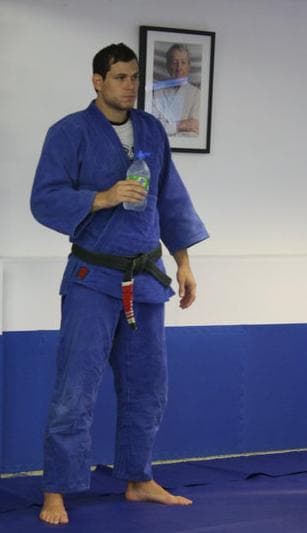
Creator credit recorded on the linked source page: Iwtbf42 · CC BY-SA 3.0
Roger Gracie
Roger Gracie built ten black belt world titles through pressure and precision, while his London academy made those details teachable.
Biography
In 2010, after Roger Gracie became the first man to win three black belt world titles in the open division, fellow champion Tarsis Humphreys had a practical question. How did he keep improving in London, away from many of Gracie Barra's strongest black belts? His answer included his students. He trained through successive partners until fatigue made the rounds competitive, and deliberately started in positions from which he might have to concede. Losing in the academy could prepare him to escape in a championship.
Roger finished his competitive career with ten IBJJF world titles at black belt and championship victories in both ADCC grappling and mixed martial arts (MMA). His best-known weapon was a progression opponents could recognize: get on top, work past the legs, settle into mount, then choke. The difficulty was stopping him between those steps. His route to that level ran through teenage uncertainty, repeated defeats in major finals, and a teaching life he built across the Atlantic.
Choosing the work
Roger Gracie Gomes was born on September 26, 1981, and grew up in Rio de Janeiro, the son of Reila Gracie and jiu-jitsu practitioner Mauricio Gomes. The family name came through his mother, Carlos Gracie's daughter. In a 2011 interview, he distinguished his childhood from that of relatives raised inside their fathers' academies: Mauricio did not run a school during those years. Roger played ball as well as training, and remembered deciding in his teens to make jiu-jitsu his life. The choice coexisted with a familiar family pressure. Relatives and family friends continually wanted to know whether he was training enough.
A stay with uncle Rilion in Florianópolis brought morning runs, a changed diet and daily training with cousin Rolles. Feeling the improvement made Roger want to continue. At Rio's 1999 World Championship qualifier, though, three sweeps—reversals from underneath to the top—gave him a 6–0 lead before a foot attack beat him. Years later, he remained annoyed. His mentors included Carlos Gracie Jr, his Gracie Barra teacher, Rilion and Renzo Gracie.
At Gracie Barra, better partners gave him repeated opportunities to develop his defense. Recalling his blue belt years, Roger described conceding through successive failed adjustments before finding a head position that helped him resist a choke. He presented his escapes as the product of such trial and error. His competition results advanced through the belts: world gold at blue in 2000, purple in 2001, and both weight and open divisions at brown in 2002.
London offered contacts Roger had made while visiting his father and helping him teach. When Mauricio returned to Brazil, Roger was approaching black belt; those contacts could help him open an academy. By Fighters Only's February 2007 issue, his Ladbroke Grove school had operated for about three years.
Nicholas Brooks remembered arriving on its opening day in February 2004 and finding a man painting the wall. The man told him a class would begin soon, put down the roller, and changed into his training uniform: it was Roger. Brooks later ran Mill Hill BJJ and helped support Roger's academy in Split when Roger could not visit. The relationships formed in London would carry the teaching beyond the original school.
Opponents who could stop him
At the 2003 Worlds, Roger placed second to Márcio “Pé de Pano” Cruz in the black belt open division, where competitors face one another without a weight limit. The following year's final brought him up against Ronaldo “Jacaré” Souza.
The 2004 final showed how narrow the distance could be between threatening the finish and winning. Jacaré took Roger's back and established a points lead. Roger escaped and recovered his guard, using his legs to control Jacaré from underneath, then caught the left arm in an armbar. Jacaré resisted and continued despite injuring the elbow. The remaining time ran out with him still ahead. In the interview recalled by reporter Marcelo Dunlop, Jacaré insisted that he had escaped the hold and argued that Roger's later attempts to take him down had been less dangerous than returning to guard would have been.
In May 2005, Roger won both the under-99-kilogram and open divisions at ADCC, the major submission-grappling competition fought without the gi, the jacket and trousers used in traditional jiu-jitsu. Jacaré took silver in the open division. Roger later remembered the physical cost of the tournament as much as the results. Alexandre “Cacareco” Ferreira was particularly difficult to finish: after 30 minutes, Ferreira did not return to continue. Roger described being sore for more than a week.
Jacaré beat him again in the 2005 Worlds open final, and Xande Ribeiro soon presented another problem. Before the 2006 Pan, Xande and his brother Saulo studied recordings of Roger's matches and identified openings in his standing game. Xande used that preparation to win their weight-division final. Later at the same event, Roger caught him in a triangle choke, using his legs around the neck and one arm, in the open final. The two camps gave different explanations for the reversal: Roger emphasized being properly warmed up for the second match; Saulo pointed to Xande's demanding earlier rounds and fatigue. Neither result made the rivalry a settled matter.
Roger won the world open title in 2007, alongside gold in his weight division, and beat John Olav Einemo in that year's ADCC superfight. In 2008, Xande won the world open title, repeating his victory over Roger in the 2006 final. Their 2008 match was level after Xande's takedown and Roger's sweep; another takedown in the closing stages gave Xande a 4–2 victory. Roger still won his weight class. A season could end with a world championship and an unresolved problem in the same weekend.
Getting to the finish
The two finals at the 2009 Worlds show both the resistance Roger met and the control he could establish. Ricardo “Demente” Abreu swept him to take the lead in the super-heavyweight final and threatened to reach his back. Roger recovered top position, moved beyond Abreu's legs into mount, sitting astride his torso, and finished with an Ezekiel choke using his own sleeve. Against Rômulo Barral in the open final, he passed the guard, mounted, and finished with a cross-collar choke. Different starts led to the same dominant position.
Barral knew Roger needed only a small opening. He tried to deny it, yet Roger immobilized his hips and advanced. Abreu described having no comfortable space to begin his game. Knowing the destination did not provide room to resist.
Roger later resisted describing this simply as “basic” jiu-jitsu. His preferred explanation was progression. Underneath, he wanted to reverse the position; on top, to pass the opponent's guard; beyond the legs, to reach mount or the back and finish. He distinguished that purpose from becoming absorbed in a position for its own sake. It was his account of how he organized a fight, rather than a claim that all other styles were invalid.
His third world open title came in 2010, after Barral withdrew from the final. Barral had injured his knee in his weight-division final against Tarsis Humphreys and could not face Roger.
A different kind of fight
After his 2006 MMA debut against Ron Waterman, Roger explained how punches changed familiar positions: starting slowly could invite a knockout. Renzo Gracie helped him prepare specifically for MMA.
Before his Strikeforce debut in 2010, Roger described the ambition as becoming a better fighter rather than pursuing a particular belt. He acknowledged the pressure created by recent family defeats, but said he could not let those results dictate his own concentration or approach. The name remained part of the circumstances; his next fight still had to be his own.
His London academy also brought him into an exchange with Georges St-Pierre. Visiting in 2010, the UFC champion found the grappling difficult enough to stay and learn. Roger subsequently helped St-Pierre prepare for fights; St-Pierre traveled to London to assist Roger before his January 2011 bout with Trevor Prangley. The relationship gave both men work to do in the other's specialty.
MMA produced a different record from his jiu-jitsu career. He lost to “King Mo” Lawal and, in his only UFC appearance, Tim Kennedy. At ONE Championship, he returned to light heavyweight and eventually submitted Michał Pasternak in May 2016 to win the title. That became his final MMA bout.
One last return
Roger's final jiu-jitsu contest brought him back to Marcus “Buchecha” Almeida, with whom he had drawn in 2012. By their July 2017 rematch in Rio, each man had won ten world titles. Roger resisted Buchecha's early takedown attempts, controlled his left sleeve, and worked onto his back to finish with a choke. Roger said he had intended to let the opening minutes develop before imposing his attack. Buchecha identified his own turning movement and Roger's grip as decisive. The submission came at 6:52, and Roger retired from jiu-jitsu competition.
He announced his MMA retirement that October. He said the sport no longer gave him enough motivation to dedicate his life to training, and money alone would not sustain that commitment. He left with eight wins and two losses.
Making the details teachable
At a 2015 seminar in Fullerton, California, Roger showed how bringing his arm nearer the partner's armpit increased arm-lock pressure. For the mounted choke, his free arm and then his head supported his position before the second hand entered the collar. Students could practice what held the attack together.
Former students were also carrying the work into their own schools. In a 2012 interview, Nic Gregoriades, a black belt under Roger, described teaching at the Budokwai and sometimes at Roger's academy, alongside founding the Jiu-Jitsu Brotherhood. He credited the early kindness of Roger and Mauricio with helping shape his life and friendships through the sport. At the time, he was working on a specific Roger guard pass while developing his own teaching.
By 2019, Roger was describing a different purpose for the same discipline: developing his school and opening others. His focus had moved from preparing himself for the next contest to the work of the academy.
Sources for this profile
Graciemag, Champions query, Roger responds, 13 July 2010(opens in a new tab)
In 2010, Tarsis Humphreys asked how Roger improved in London without Gracie Barra's leading black belts. Roger described focused practice, successive student partners until tired, and deliberately difficult starting positions: conceding in training could help him escape in competition.
Where in the source: Humphreys question and Roger's answer — «students»; «danger positions».
Accessed:
Roger became the first three-time champion of the black-belt open division at the 2010 Worlds.
Where in the source: Opening championship context — «three-time absolute world champion».
Accessed:
Roger Gracie Academy, Roger Gracie biography, undated(opens in a new tab)
Roger's academy records ten IBJJF world titles in 2004–2010 and three open-weight titles.
Where in the source: Biography — «A member of both»; championship paragraph.
Accessed:
BJJ Heroes, Roger Gracie, undated(opens in a new tab)
Roger Gracie Gomes was born on 26 September 1981; his parents are Mauricio Gomes and Reila Gracie, whose father was Carlos Gracie.
Where in the source: Biographical section — «September 26, 1981».
Accessed:
BJJ Heroes identifies Roger Gracie Academy among Roger's affiliations.
Where in the source: Affiliation entry — «Team/Affiliation».
Accessed:
His colored-belt World Championship golds were blue in 2000, purple in 2001, and both weight and open categories at brown in 2002.
Where in the source: Colored-belt achievements; asterisk legend — «Weight and absolute».
Accessed:
Jack Encarnacao, Sherdog, The Unlikely Heir, 27 January 2011(opens in a new tab)
Roger recalled Rio childhood with ball games/training, no paternal academy, choosing jiu-jitsu as a teenager, and repeated family questions about training.
Where in the source: Opening Roger interview — «my own decision»; subsequent family-pressure answer.
Accessed:
In 2010 St-Pierre stayed to learn after demanding training at Roger's London academy. They exchanged fight preparation; St-Pierre helped Roger for Prangley, January 2011.
Where in the source: St-Pierre visit and preparation exchange — «A heady exchange».
Accessed:
ADCC Federation, ADCC Submission Fighting World Championship 2005, official results; event 28 May 2005(opens in a new tab)
At ADCC in May 2005, Roger won -99kg and Absolute. Alexandre Ferreira took -99kg silver; Ronaldo Souza took Absolute silver.
Where in the source: 2005 RESULTS — «Weight Class / Medal / Place / Name»; -99kg and Absolute tables.
Accessed:
Graciemag, Roger Gracie, o tricampeão insatisfeito, 8 June 2010; retrospective originally published after Worlds 2009(opens in a new tab)
Florianópolis: uncle Rilion's runs/diet changes and daily training with cousin Rolles encouraged Roger. Rio's 1999 qualifier: three sweeps, 6–0, footlock defeat still frustrating. Mentors: teacher Carlos Jr, Rilion, Renzo.
Where in the source: Retrospective development passages — «Eu estava gordinho»; «em 1999».
Accessed:
Barral: small openings, immobilized hips; Abreu: no space for his game.
Where in the source: Opponent accounts — «travar o quadril».
Accessed:
Ezekiel uses the attacker's own gi sleeve.
Where in the source: Choke description — «própria manga».
Accessed:
Graciemag Newsroom, Roger Gracie seminar at Gracie Barra Fullerton, 13 August 2015(opens in a new tab)
At blue belt in Gracie Barra, failed escapes against stronger partners taught Roger better head-and-chin positioning against rear chokes.
Where in the source: Seminar report, items 3–4 — «trial and error».
Accessed:
The 2015 report records ten black-belt world titles, three open.
Where in the source: Opening achievements — «black belt division».
Accessed:
Fullerton, 12 August 2015: kimura pressure nearer armpit; mount stabilized by free arm, then head, before second choking hand.
Where in the source: Seminar date; items 5 and 7 — «armpit»; «Head on the mat».
Accessed:
Jim Page, Fighters Only, Grappling in the Genes: Roger Gracie, issue 022, February 2007(opens in a new tab)
London contacts from assisting Mauricio helped Roger open Ladbroke Grove; Mauricio returned to Brazil near Roger's black belt. School operating about three years in February 2007.
Where in the source: Academy passage — «Established for three years».
Accessed:
ADCC 2005: Cacareco did not return after 30 minutes; Roger sore over a week.
Where in the source: ADCC answers — «Cachareco»; «over a week».
Accessed:
Post-Waterman: punches changed control, slow starts risked knockouts; Renzo provided MMA preparation.
Where in the source: Waterman and Renzo discussion — «starting the fight relaxed».
Accessed:
BJJ Eastern Europe, interview with Nicholas Brooks, 19 September 2012(opens in a new tab)
Brooks recalled the academy's February 2004 opening: Roger was painting, announced an approaching class and changed into a gi. Brooks later ran Mill Hill BJJ and supported Roger's Split school when Roger could not visit.
Where in the source: Interview questions 2, Mill Hill and Croatia — «paint roller»; «RGA Split».
Accessed:
IBJJF, World Jiu-Jitsu IBJJF Championship 2003, official results(opens in a new tab)
In the 2003 Worlds Adult/Black/Male/Open Class results, Marcio Cruz placed first and Roger Gracie second, both representing Gracie Barra.
Where in the source: Adult / Black / Male / Open Class — «2 Roger Gracie Gracie Barra».
Accessed:
Marcelo Dunlop, Graciemag, Os 20 anos da luta do século entre Ronaldo Jacaré e Roger Gracie, 6 February 2024(opens in a new tab)
In the 2004 Worlds open final, Jacaré gained a lead from Roger's back. Roger escaped, recovered guard and caught the left arm; Jacaré continued with an injured elbow and won. Jacaré later insisted he escaped and criticized Roger's late takedown attempts instead of returning to guard.
Where in the source: 2004 final narrative and recalled interview — «braço esquerdo»; «eu que escapei».
Accessed:
Graciemag Newsroom, No Pan 2006, o início da rivalidade entre Roger e Xande, 27 March 2010(opens in a new tab)
The Pan retrospective recalls Roger's Worlds losses to Pé de Pano in 2003 and Jacaré in 2004–2005. For the 2006 Pan, Xande and Saulo studied Roger's match recordings and standing weaknesses; Xande won the weight final, while Roger submitted him by triangle in the open final. Roger attributed the reversal to being warmed up; Saulo cited Xande's hard earlier rounds and fatigue.
Where in the source: Standing preparation and open final — «DVD»; «O absoluto»; «triângulo».
Accessed:
IBJJF, World Jiu-Jitsu IBJJF Championship 2007, official results(opens in a new tab)
Roger won both Adult/Black/Male/Super Heavy and Open Class at the 2007 Worlds, representing Gracie Barra.
Where in the source: Adult / Black / Male divisions — «Super Heavy»; «Open Class»; «Roger Gracie».
Accessed:
Kid Peligro, ADCC News, The 2007 ADCC had incredible fights and Incredible results, 5 May 2007(opens in a new tab)
Roger defeated John Olav Einemo 5–0 in the 2007 ADCC superfight.
Where in the source: Opening superfight report — «John Olav Einemo».
Accessed:
Kid Peligro, ADCC News, 2008 Worlds = Lucky 13, 8 June 2008(opens in a new tab)
Xande beat Roger 4–2 in the 2008 Worlds open final, repeating their 2006 final outcome. An initial takedown and Roger sweep tied the score before Xande's late takedown; Roger also won his own weight division.
Where in the source: Opening three paragraphs — «4 x 2»; «respective weight divisions».
Accessed:
Danny O'Donnell, IBJJF, World Championship Rewind, 23 May 2023(opens in a new tab)
In the 2009 super-heavy final, Abreu swept Roger and threatened his back. Roger recovered top half guard, passed to mount and finished with an Ezekiel choke.
Where in the source: Super-heavy final paragraphs — «Ricardo»; «mounted ezekiel».
Accessed:
In the 2009 open final against Barral, Roger worked past the guard, established mount and completed a cross-collar choke.
Where in the source: Open final paragraphs — «Romulo Barral»; «cross choke».
Accessed:
Graciemag, Roger Gracie explains the effectiveness of his BJJ, 24 July 2019(opens in a new tab)
Roger described his approach in 2019 as progress toward a finish: sweep from underneath, pass from top, then reach mount or back. He contrasted that aim with becoming absorbed in an intermediate position.
Where in the source: Transcript, progression discussion — «progressive vision».
Accessed:
In 2019 Roger said his focus had shifted from competing to developing his academy, opening more schools and applying his sporting discipline to other projects.
Where in the source: Transcript closing answer — «my school».
Accessed:
Graciemag, Barral promises return, 15 June 2010(opens in a new tab)
Barral withdrew from the 2010 Worlds open final against Roger after injuring his knee in the weight final against Tarsis Humphreys.
Where in the source: Opening event account — «unable to fight».
Accessed:
Ben Fowlkes, MMA Fighting, Roger Gracie Grapples With Questions Before Strikeforce Debut, 13 May 2010(opens in a new tab)
Before his 2010 Strikeforce debut, Roger sought personal improvement rather than a particular MMA belt; he acknowledged pressure from Renzo and Rolles' defeats but wanted to preserve his own approach and concentration. The report dates his professional MMA debut to December 2006.
Where in the source: Interview answers and career context — «better fighter»; «concentration».
Accessed:
The May 2010 interview identifies Roger Gracie as Brazilian.
Where in the source: Opening quotation attribution — «Brazilian».
Accessed:
Guilherme Cruz, MMA Fighting, ONE champion Roger Gracie retires from MMA, 14 October 2017(opens in a new tab)
Roger lost to King Mo Lawal and Tim Kennedy, the latter his only UFC appearance. Returning to light heavyweight at ONE, he submitted Michał Pasternak in May 2016 to become champion; it was his final MMA bout.
Where in the source: Career recap and final fight — «May 2016»; «first and only».
Accessed:
Roger announced MMA retirement in October 2017 with an 8–2 record, explaining that motivation no longer justified an athlete's commitment and money alone would not do so.
Where in the source: Retirement interview — «motivation»; «8-2».
Accessed:
Graciemag, In historic match, Roger Gracie takes the back and finishes Marcus Buchecha at Gracie Pro Jiu-Jitsu, 24 July 2017(opens in a new tab)
Roger and Buchecha, each then a ten-time world champion, rematched in Rio in July 2017 after a 2012 draw. Roger stopped early takedown attempts, controlled the left sleeve, reached the back and choked him at 6:52, ending his jiu-jitsu career. Roger described delaying his attack; Buchecha blamed Roger's grip and his own turning reaction.
Where in the source: Event report and both competitors' interviews — «6’52”»; «left sleeve».
Accessed:
BJJ Eastern Europe, interview with Nic Gregoriades, 30 August 2012(opens in a new tab)
In 2012 Nic Gregoriades, Roger's black belt, taught at Budokwai and sometimes RGA, had founded the Jiu-Jitsu Brotherhood, credited Roger and Mauricio's early kindness, and was developing a specific Roger guard pass.
Where in the source: Questions 1, 4, 5 and 10 — «sometimes»; «Chest-Pressure Pass».
Accessed:
Competition results
| Year | Event | Result | Division |
|---|---|---|---|
| 2010 | IBJJF World ChampionshipSource: en.wikipedia.org-100 kgGiVerified | 1st place | -100 kgGiVerified |
| 2010 | IBJJF World ChampionshipSource: en.wikipedia.orgAbsoluteGiVerified | 1st place | AbsoluteGiVerified |
| 2009 | IBJJF World ChampionshipSource: en.wikipedia.orgAbsoluteGiVerified | 1st place | AbsoluteGiVerified |
| 2009 | IBJJF World ChampionshipSource: en.wikipedia.org-100 kgGiVerified | 1st place | -100 kgGiVerified |
| 2008 | IBJJF World ChampionshipSource: en.wikipedia.org+100 kgGiVerified | 1st place | +100 kgGiVerified |
| 2007 | ADCC 2007Source: adcombat.comNo-giVerified | 1st place | No-giVerified |
| 2007 | IBJJF World ChampionshipSource: en.wikipedia.orgAbsoluteGiVerified | 1st place | AbsoluteGiVerified |
| 2007 | IBJJF World ChampionshipSource: en.wikipedia.org-100 kgGiVerified | 1st place | -100 kgGiVerified |
| 2006 | IBJJF World ChampionshipSource: en.wikipedia.org-100 kgGiVerified | 1st place | -100 kgGiVerified |
| 2005 | ADCC 2005Source: adcombat.comAbsoluteNo-giVerified | 1st place | AbsoluteNo-giVerified |
| 2005 | ADCC 2005Source: adcombat.com-99 kgNo-giVerified | 1st place | -99 kgNo-giVerified |
| 2005 | IBJJF World ChampionshipSource: en.wikipedia.org-100 kgGiVerified | 1st place | -100 kgGiVerified |
| 2004 | IBJJF World ChampionshipSource: en.wikipedia.org-100 kgGiVerified | 1st place | -100 kgGiVerified |
| 2003 | ADCC 2003Source: adcombat.com-99 kgNo-giVerified | 3rd place | -99 kgNo-giVerified |