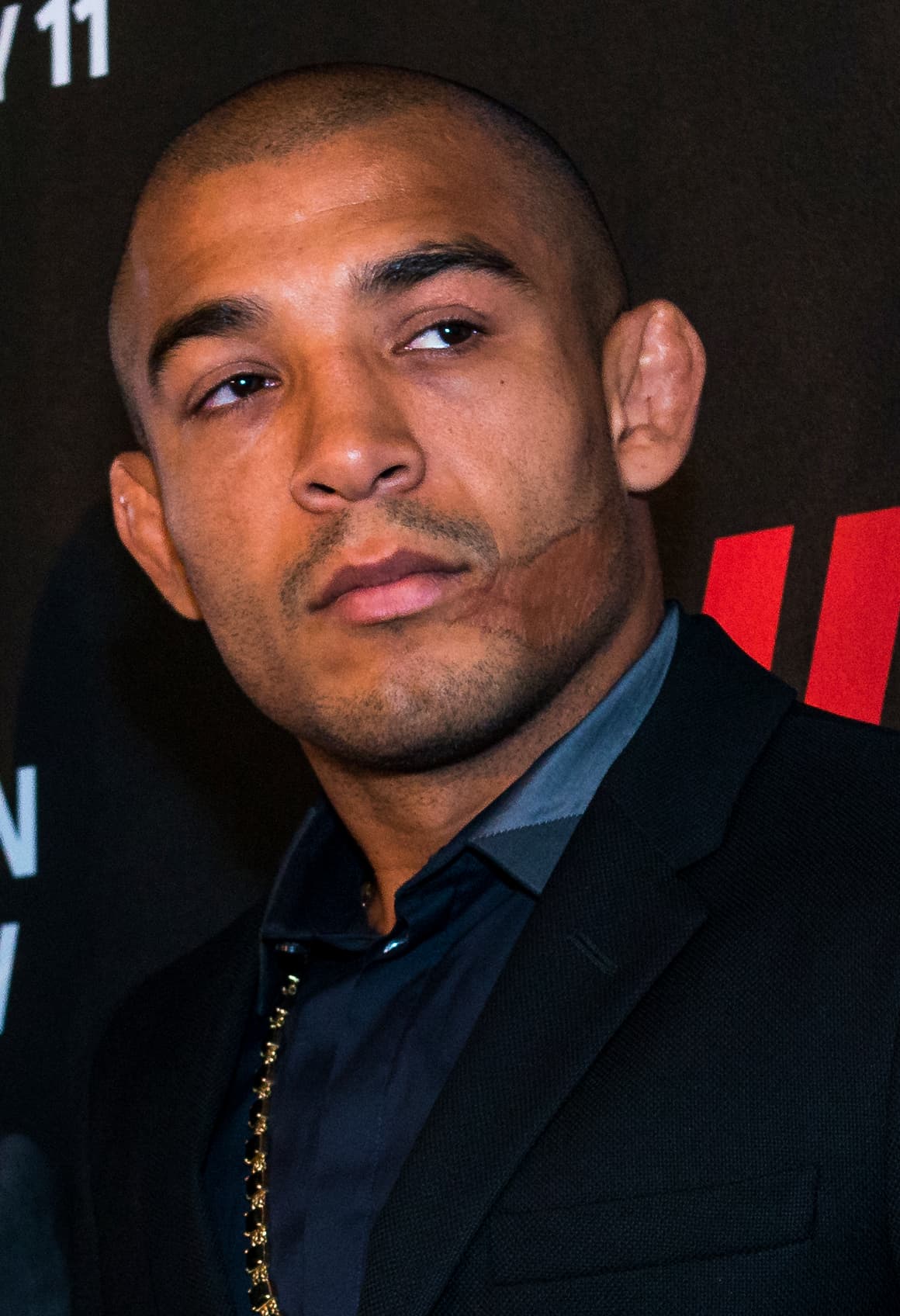
Creator credit recorded on the linked source page: Andrius Petrucenia; crop by UCinternational and FMSky · CC BY-SA 2.0
José Aldo
“Junior”
Source: sherdog.comBefore the UFC's first featherweight belt, José Aldo was a teenager from Manaus sleeping on Nova União's mats, set on a world title in jiu-jitsu.
Biography
Sources for this profile
BJJ Heroes, "José Aldo" (published 24 November 2010, updated 21 September 2016).(opens in a new tab)
José Aldo is a Brazilian jiu-jitsu black belt under André Pederneiras of Nova União.
Where in the source: Opening paragraph of the profile — "under Master André Pederneiras"
Accessed:
BJJ Heroes gives his jiu-jitsu lineage as Mitsuyo Maeda, Carlos Gracie, Carlson Gracie, André Pederneiras, José Aldo.
Where in the source: Fact list under the heading on Aldo's jiu-jitsu, line "Lineage"
Accessed:
BJJ Heroes lists him as champion of the CBJJO World Cup in the brown belt division in 2004, and gives his competition weight as the 64 kg featherweight class.
Where in the source: "Main Achievements (Jiu Jitsu)" list, first line (CBJJO), and the weight-division line below it
Accessed:
According to BJJ Heroes, Aldo won titles in jiu-jitsu's coloured-belt divisions in the early 2000s, before his professional fighting career, including two wins over Rubens Charles in the brown belt division.
Where in the source: Opening paragraph of the profile — "Rubens Charles"
Accessed:
José Aldo was born on 9 September 1986 in Manaus, Brazil.
Where in the source: First sentence of the biography section (date and city of birth)
Accessed:
BJJ Heroes says he moved to Rio de Janeiro on his own, against his mother's wishes, with very little money and no job.
Where in the source: Biography section, second paragraph — "against his mother's will"
Accessed:
In Rio he sought out André Pederneiras at Nova União; after a few weeks, when Pederneiras learned how difficult his situation was, he told Aldo to live in the academy and stopped charging him for classes.
Where in the source: Biography section, third paragraph — "living in the academy"
Accessed:
IBJJF, "Campeonato Brasileiro de Jiu-Jitsu 2003" results.(opens in a new tab)
At the 2003 Brazilian National Jiu-Jitsu Championship, Jose Aldo Jr, entered for the Manaus team MJNV, won the adult male purple belt light featherweight division; Wilson Reis was one of the two bronze medallists in the same division.
Where in the source: Category "Adult / Purple / Male / Light Feather", first row (place 1) and last row
Accessed:
Steven Marrocco, "After leaving family to study jiu-jitsu, WEC's Jose Aldo returned home a champion", MMAjunkie (USA Today Sports), February 2010.(opens in a new tab)
His parents did not want him to move to Rio de Janeiro to learn fighting, but by 16 he had made up his mind: he wanted to become a world champion in jiu-jitsu.
Where in the source: Second paragraph — "world champion in jiu-jitsu"
Accessed:
Aldo started capoeira at 14; the wish to learn jiu-jitsu came when he visited a local jiu-jitsu gym in his home town of Manaus. He found capoeira beautiful but soft.
Where in the source: Third paragraph — "local dojo"
Accessed:
Football was his first sport; in neighbourhood games he was the player his friends sent to fight opponents who made trouble, and he was benched so often for fighting that he missed every other game until he decided to stop.
Where in the source: Fourth and fifth paragraphs — "I've got to stop this"
Accessed:
When he arrived in Rio he spent his first month watching classes rather than training; the first technique he learned in jiu-jitsu class there was an armbar, and he came to see jiu-jitsu as a chance to be the best at something and perhaps make a living.
Where in the source: Paragraph after the WEC 48 preview — "was an armbar"
Accessed:
At Nova União he became a friend and training partner of Vitor "Shaolin" Ribeiro, lived at the gym and took a part-time job as a busboy to pay for food between classes; he said he was always early for practice but that the nights alone were lonely and hard.
Where in the source: Paragraph naming Vitor "Shaolin" Ribeiro and the quote after it — "very lonely"
Accessed:
MMAjunkie describes André Pederneiras, the head of Nova União and a former UFC fighter, as the first person to believe in Aldo, and says Pederneiras trained him to be aggressive in the cage and to carry himself like a world champion.
Where in the source: Paragraph beginning with Pederneiras' name — "first person to believe"
Accessed:
When he joined Nova União, Aldo decided to make stand-up fighting the centre of his game, because the gym's other fighters were known mainly for their ground game and he wanted to be different.
Where in the source: Paragraph on his resolution at Nova União — "centerpiece"
Accessed:
Chris Palmquist, "Jose Aldo, working since he was six years old", MixedMartialArts.com, 20 November 2009.(opens in a new tab)
Aldo received his Brazilian jiu-jitsu black belt from André Pederneiras of Nova União, the same teacher who promoted B.J. Penn to black belt in 2000.
Where in the source: Paragraph on his jiu-jitsu credentials, before the closing quotes — "earned his black belt"
Accessed:
In 2009 Aldo said he wanted to keep his fights standing to please the fans, but called jiu-jitsu his base and said people who thought him a good striker would be impressed by his ground fighting.
Where in the source: Closing quotes — "Jiu-Jitsu is my base."
Accessed:
Aldo grew up in a poor family in the Amazon region of Brazil and has worked since he was six.
Where in the source: Paragraph on his family background — "since he was 6"
Accessed:
UFC.com, "José Aldo" athlete profile.(opens in a new tab)
His UFC athlete profile gives his place of birth as Manaus, Brazil, his gym as Nova União and his fighting style as jiu-jitsu, and lists him as retired.
Where in the source: Info tab, "Bio" fields for place of birth, gym and fighting style
Accessed:
Asked in his UFC athlete Q&A which ranks and titles he has held, Aldo lists four Brazilian jiu-jitsu titles, a world jiu-jitsu title and a Brazilian jiu-jitsu black belt alongside his UFC and WEC titles.
Where in the source: Info tab, "Q&A", answer on ranks and titles — "Four-time Brazilian jiu-jitsu champion"
Accessed:
In the same UFC Q&A, Aldo names the armlock as his favourite technique.
Where in the source: Info tab, "Q&A", favourite-technique answer — "Arm Lock"
Accessed:
The UFC credits Aldo with 17 wins by knockout and one by submission; he won the WEC title in November 2009 and defended it twice, received the first UFC featherweight championship belt in November 2010, made seven successful UFC title defences in his first reign, and was inducted into the UFC Hall of Fame's Modern Wing in 2023.
Where in the source: Info tab, "Fighter Facts" list
Accessed:
Sherdog, "Jose Aldo" fighter profile.(opens in a new tab)
Sherdog's fighter record lists José Aldo, nicknamed "Junior", born 9 September 1986 in Manaus, Amazonas, Brazil, with Nova União as his association.
Where in the source: Fighter header: birthplace line, nickname, age/date line and "Association" field
Accessed:
His fighting nickname is "Junior".
Where in the source: Fighter header, nickname in quotation marks under the name
Accessed:
His first professional MMA fight was on 10 August 2004 at Eco Fight Championship 1, which he won by first-round knockout with a head kick.
Where in the source: Fight history table, last row (EFC 1)
Accessed:
His only submission win in professional MMA came on 19 March 2005 at Shooto Brazil 7, when he finished Luiz de Paula with an arm-triangle choke in the first round.
Where in the source: Fight history table, row for Shooto Brazil 7 — "Arm-Triangle Choke"
Accessed:
His first professional loss came on 26 November 2005 at Jungle Fight 5 in Manaus, where Luciano Azevedo submitted him with a rear-naked choke in the second round.
Where in the source: Fight history table, row for Jungle Fight 5 — "Rear-Naked Choke"
Accessed:
Wikipedia, "José Aldo" (English).(opens in a new tab)
José Aldo da Silva Oliveira Júnior is a Brazilian former professional mixed martial artist, born on 9 September 1986 in Manaus, Amazonas.
Where in the source: Lead sentence and infobox "Born" — "Brazilian former professional mixed martial artist"
Accessed:
After his first loss in November 2005, Aldo went unbeaten for more than ten years, winning 18 straight fights, until Conor McGregor knocked him out 13 seconds into their title unification bout at UFC 194 in December 2015.
Where in the source: Lead, second paragraph, and the section on losing the belt — "13 seconds"
Accessed:
Aldo retired from MMA after losing to Aiemann Zahabi at UFC 315 in May 2025, announcing it in his post-fight interview.
Where in the source: Section on his return from retirement, last paragraph
Accessed:
Wikipédia, "José Aldo" (Portuguese).(opens in a new tab)
The Brazilian feature film Mais Forte que o Mundo, released in June 2016, tells the story of Aldo's path from the outskirts of Manaus to becoming an athlete in Rio de Janeiro.
Where in the source: Lead, second paragraph — "Mais Forte que o Mundo"
Accessed:
Graciemag, "5 of José Aldo's most memorable Jiu-Jitsu matches", 15 January 2012.(opens in a new tab)
Graciemag, writing the day after UFC 142 in January 2012, called Aldo a Nova União black belt who still trained in the gi, usually in the weeks after a fight, and said he first appeared in the magazine in 2004 for a no-gi match against Rodrigo Damm in São João da Barra that turned into a rapid exchange of footlocks.
Where in the source: Introduction, second paragraph — "worn out many a gi"
Accessed:
Graciemag says Aldo competed mainly at purple and brown belt; asked for his memorable matches, Pederneiras said they were hard to remember because back then Aldo was just another member of the team, and Vitor "Shaolin" Ribeiro named opponents including Rubens "Cobrinha" Charles, Bruno Frazatto, Wilson Reis and Celso Venícius.
Where in the source: Introduction, paragraphs quoting Pederneiras and then Shaolin
Accessed:
As Pederneiras remembered it, Aldo met Rubens "Cobrinha" Charles twice while Aldo was a brown belt and won both matches; Graciemag notes Cobrinha went on to win four world titles at black belt.
Where in the source: Numbered item 1, on Cobrinha
Accessed:
Celso Venícius recalled beating Aldo in 2004 at Arena Búzios, when both were brown belts, in the first round of the under-75 kg open class: Aldo pulled guard, Venícius worked to half guard and won; he said Aldo would have made a bigger name in jiu-jitsu had he not concentrated on MMA.
Where in the source: Numbered item 2, Celso Venícius' recollection
Accessed:
At the 2003 IBJJF World Championship at the Tijuca Tennis Club in Rio, Wilson Reis met Aldo in the purple belt light featherweight quarter-final; Reis recalled that Aldo led on advantages until Reis scored a double-leg takedown to win 4-2, and called it one of the jiu-jitsu wins he is proudest of.
Where in the source: Numbered item 3, Wilson Reis' recollection
Accessed:
Bruno Frazatto of Atos recalled losing to Aldo as a brown belt in Niterói in 2004, in a close match of repeated sweeps that he remembered as 4-4 and decided on advantages; he joked that he wanted a rematch, but only in the gi.
Where in the source: Numbered item 4, Frazatto's recollection
Accessed:
Graciemag, "Campeão do UFC, José Aldo revela seu estilo preferido: Jiu-Jitsu ou muay thai?", 12 October 2013.(opens in a new tab)
In a 2013 interview on the Brazilian TV channel Combate, quoted by Graciemag, Aldo said he came from jiu-jitsu and was a black belt, a Brazilian champion and a world champion; he said he had never trained Muay Thai, only kickboxing, and that between the two arts he would choose jiu-jitsu.
Where in the source: First quote from Aldo — "eu fico com a arte suave"
Accessed:
In the same interview Aldo said he loves stand-up fighting and chose to emphasise it when he started in MMA, because everyone enjoys and understands a striking exchange and it would take him where he wanted faster, but that he would never forget jiu-jitsu.
Where in the source: Second quote from Aldo — "nunca vou esquecer o Jiu-Jitsu"
Accessed:
Graciemag, "José Aldo volta ao Jiu-Jitsu em luta especial contra faixa-roxa", 5 September 2017.(opens in a new tab)
In 2017 Aldo, described by Graciemag as a black belt under Dedé Pederneiras, returned to gi competition at the IBJJF International Master and won on his return; he then accepted an invitation to a special exhibition match against a Nova União purple-belt teammate at a SJJSAF South American championship in September 2017.
Where in the source: Introduction and closing sentence — "primeira vitória no retorno aos tatames"
Accessed:
Graciemag, "Fã de Royce, José Aldo confia no sucesso de Kron Gracie no UFC", 4 April 2019.(opens in a new tab)
In 2019 Aldo called Royce Gracie an idol, saying he had great respect for him for entering the cage in 1993 and making the UFC what it became, and that he had had the chance to watch Royce fight.
Where in the source: Quote on Royce Gracie — "O Royce é um ídolo"
Accessed:
Gabriel Almada, "A grande lição do campeão do povo José Aldo, em sua aposentadoria do UFC", Graciemag, 22 September 2022.(opens in a new tab)
After knocking out Chad Mendes in the main event of UFC Rio 2 on 14 January 2012, Aldo ran out of the cage into the crowd with a Flamengo flag on his back and was lifted up by fans; Graciemag calls him the "Campeão do Povo" (the people's champion).
Where in the source: Paragraph on his second reign and the UFC Rio 2 night — "Campeão do Povo"
Accessed:
Frank Curreri, "Legendary Moura Discusses Aldo's Evolution", UFC.com, 26 April 2011.(opens in a new tab)
Robson Moura, a jiu-jitsu world champion and vice-president of Nova União, said that when Aldo came to Nova União he trained jiu-jitsu three to four times a day before moving into MMA, and that he competed twice against Cobrinha as a brown belt and won.
Where in the source: Moura's answer on Aldo's ground game — "three to four times a day"
Accessed:
Moura said in 2011 that people would be very surprised when Aldo got the chance to show his jiu-jitsu, and that he could be a black belt world champion in jiu-jitsu if he wanted to.
Where in the source: Same answer, closing sentences — "black belt world champion"
Accessed:
Moura recalled that Aldo came to Nova União from Manaus very young, lived at the school and slept on the mats, had no money for food, and was helped by people at the gym who bought him lunch.
Where in the source: Moura's answer on Aldo's background — "sleeping on the mats"
Accessed:
In January 2011 Aldo trained lightly in the gi with Moura, and around the same time the two, with many others, held a seminar to raise money for people who had lost their homes in a flood near Moura's home town.
Where in the source: Moura's first answer — "raise money"
Accessed:
According to Moura, Pederneiras had awarded about 100 black belts by 2011, and his approach was that a fighter can always look to win with jiu-jitsu but should stand and strike if needed; if a fighter felt good with his strikes, Pederneiras would build the plan around that.
Where in the source: Moura's answers on Pederneiras' black belts and strategy — "stand up and bang"
Accessed:
Moura said Aldo had tried to become a football player but could not turn professional, and turned to fighting.
Where in the source: Moura's answer on Aldo's background, last sentences
Accessed:
Jessica Portasio, "In Brazil Aldo Is King, Honed by Humble Roots", UFC.com, 7 December 2015.(opens in a new tab)
Marcos Loro, who had trained with Aldo in Manaus, took him in when he came to Rio: Loro shared his R$100 sponsorship with him, the two slept on the gym mat, often went hungry and were alone in the gym at night, and Loro said Aldo always told him he was going to be champion.
Where in the source: Quotes from Marcos Loro — "R$100 sponsorship"
Accessed:
In 2015, between his own training sessions at the Upper gym in Rio, Aldo sat by the Nova União mat area watching the other professionals' jiu-jitsu training, checking their technique and correcting it when necessary.
Where in the source: Opening scene, second paragraph — "correcting when necessary"
Accessed:
After living on the mats of Nova União's former headquarters, Aldo was helped by teammates: Marlon Sandro, later one of his coaches, let him sleep at his house before fights, and Hacran Dias also gave him space in his home. The article notes those closest to him call him "Junior".
Where in the source: Paragraphs after the Loro quotes — "sleep in his house"
Accessed:
Thomas Gerbasi, "Aldo and Barao: Brothers in Harm", UFC.com, 23 November 2013.(opens in a new tab)
Aldo was living at the Nova União gym when Renan Barão arrived from Natal to train there; Barão said he already knew of Aldo from MMA and from Brazilian jiu-jitsu, through friends who had met him at jiu-jitsu championships.
Where in the source: Quotes from Aldo and Barão on their first meeting — "I was living there"
Accessed:
FOX Sports, "The Success of Nova União's Aldo and Barao" (updated 4 September 2022).(opens in a new tab)
FOX Sports described Aldo arriving at Nova União as a young man from the slums trying to make it as a jiu-jitsu competitor and MMA fighter: his tuition was free as long as he helped out at the gym, he slept on the training mats with his gi as a blanket, and teammates shared leftover food with him.
Where in the source: Second-to-last paragraph — "used the training mats as his bed"
Accessed:
FOX Sports describes Nova União as a team co-founded by André Pederneiras, a Carlson Gracie black belt, and fellow black belt Wendel Alexander, which became a jiu-jitsu powerhouse especially in the lighter weight classes, and says Pederneiras was unusual in teaching children from Rio's favelas who could not afford to pay.
Where in the source: Paragraphs on the team's history
Accessed:
Ag. Fight, "José Aldo homenageia treinador e 'segundo pai' por se tornar faixa-coral", ESPN Brasil, 2 December 2019.(opens in a new tab)
When André Pederneiras was promoted to coral belt in 2019, Aldo congratulated him publicly on 1 December, calling him his master, his friend and a second father; ESPN Brazil notes Pederneiras was also his manager.
Where in the source: Quoted post — "segundo pai"
Accessed:
Portal do Vale Tudo, "José Aldo é graduado faixa preta de luta livre", 2 September 2014 (Internet Archive copy of 12 September 2014).(opens in a new tab)
Portal do Vale Tudo reported on 2 September 2014 that Aldo had just been promoted to black belt in Luta Livre by the International Federation of Luta Livre and Submission, receiving the diploma from Marco Ruas, who had taught him at the start of his MMA career; the report describes Pederneiras as his current teacher.
Where in the source: Headline and first two paragraphs — "graduado faixa preta de luta livre"
Accessed:
BJJ Eastern Europe, "Jose Aldo Returns To Jiu-Jitsu Competition At Rio Masters Open", 21 July 2017.(opens in a new tab)
In July 2017 Aldo entered the IBJJF Masters International in Rio de Janeiro at the Tijuca Tennis Club, in the Master 1 lightweight division, his return to IBJJF competition after years in MMA.
Where in the source: Paragraphs on the event and his registration — "Master 1 category"
Accessed:
BJJ Eastern Europe, "Jose Aldo Grappled in Master 1 Light Weight Quarter Final", 29 July 2017, quoting MMA Fighting.(opens in a new tab)
Aldo told MMA Fighting, as quoted by BJJ Eastern Europe, that after his MMA fights he always goes back to training in the gi, that his teammate Hacran Dias talked him into entering the 2017 Masters International, and that after competing for so many years he could simply go in and enjoy it.
Where in the source: Quotes attributed to MMA Fighting — "I always put the gi to train"
Accessed:
BJJ Eastern Europe, "Jose Aldo: I'm Always Berimboloing!", 5 August 2016.(opens in a new tab)
In a 2016 interview presented by BJJ Eastern Europe, Aldo advised beginners to train jiu-jitsu every day if they could, called it addictive and something he had never stopped doing, said he rolls with friends whether or not he has a fight scheduled, joked that he was the gym's 'back king', and said he preferred basic jiu-jitsu because the modern game has to rest on mastered basics.
Where in the source: Quoted answers, from the advice to beginners to the point on basics — "back king"
Accessed:
BJJ Eastern Europe, "Jose Aldo Set To Face Marlon Vera In Grappling Rematch", 30 August 2026.(opens in a new tab)
In August 2026 Aldo announced a submission-only grappling match against Marlon Vera, scheduled for 4 October 2026 at Hype FC in Quito, Ecuador; he had beaten Vera by decision in MMA in December 2020.
Where in the source: First paragraphs and his quoted post — "submission-only grappling match"
Accessed:
BJJ Eastern Europe, "Jose Aldo: 'MMA Fighters Who Haven't Trained in The Gi Should Not Be Promoted to BJJ Black Belt'", 15 September 2020, quoting Tatame.(opens in a new tab)
In a 2020 interview with Tatame, quoted by BJJ Eastern Europe, Aldo said an honorary black belt for a famous fighter can be a symbolic way to promote the sport, but that giving the belt to someone who has never trained in the gi and will then teach with it is wrong, and he criticised belts earned through online courses.
Where in the source: Quoted Tatame interview — "never trained in the Gi"
Accessed:
Primicias, Chito Vera no logra someter a José Aldo, pero se lleva los aplausos del público en Hype, en Quito, liveblog updated 4 October 2026 at 23:56.(opens in a new tab)
At HYPE Ecuador in Quito on 4 October 2026, José Aldo and Marlon Vera contested the main-event grappling match as a single 10-minute round. Primicias reported live at 23:39 that it ended in a draw without a submission.
Where in the source: Liveblog, 04/10/2026, 23:29 Inicia el combate estelar: 10 minutos; 23:39 Empate en la estelar: termina con un empate. No hubo sumisión.
Accessed:
El Universo, Marlon Chito Vera y José Aldo empatan en la pelea estelar del HYPE Quito, 5 October 2026 at 00:05.(opens in a new tab)
El Universo reported that José Aldo and Marlon Vera fought a 10-minute submission-only main event at HYPE Fighting Championship in Quito on 4 October 2026. Neither submitted the other, and the bout ended in a draw.
Where in the source: Headline: empatan en la pelea estelar; opening paragraphs: 4 de octubre, submission only, 10 minutos; result: La decisión fue un empate.
Accessed: