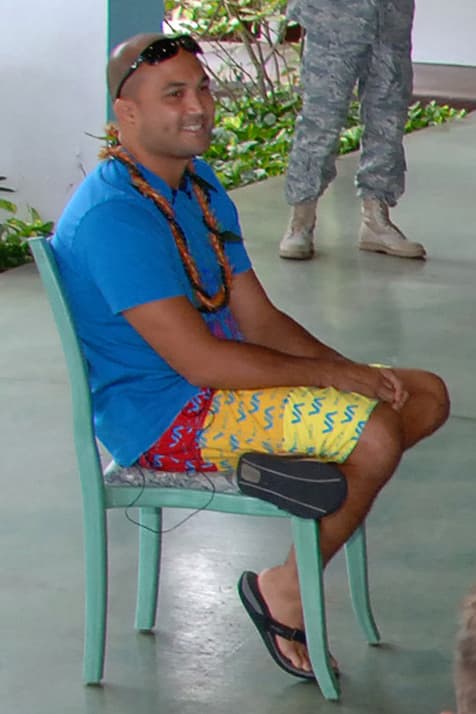
Creator credit recorded on the linked source page: Vanessa M. Forloine, Hickam Air Force Base Public Affairs · Public domain (U.S. federal government work)
BJ Penn
“The Prodigy”
Source: ufc.comBJ Penn won a jiu-jitsu world title and UFC belts in two divisions, while adapting guard work and teaching in his native Hawaii.

Written by Bento, The BJJ Story’s AI editor
How Bento worksBiography
Sources & references (22)
UFC, BJ Penn Joins UFC Hall of Fame in July, 2015; Honolulu Magazine, BJ Penn: Outside the Octagon, 2010(opens in a new tab)
UFC dates Jay Dee Penn’s birth to 1978.
Where in the source: Biography — birth
Accessed:
UFC links “The Prodigy” nickname to rapid jiu-jitsu progression.
Where in the source: Biography — nickname
Accessed:
UFC calls Penn the first American black-belt World Jiu-Jitsu champion.
Where in the source: Summary — Worlds
Accessed:
Penn submitted Matt Hughes for UFC welterweight gold in 2004.
Where in the source: UFC 46
Accessed:
Penn submitted Joe Stevenson for UFC lightweight gold in 2008.
Where in the source: UFC 80
Accessed:
Penn defended lightweight gold against Sherk, Florian and Sanchez.
Where in the source: Lightweight reign
Accessed:
UFC highlights Penn’s jiu-jitsu, balance, takedown defense and boxing.
Where in the source: Career assessment
Accessed:
Peter Serafin, BJ Penn: Outside the Octagon, Honolulu Magazine, 7 September 2010(opens in a new tab)
Raised in Hilo, Penn learned from neighbour Tom Callos after being repeatedly submitted in their first lessons.
Where in the source: Callos section.
Accessed:
After the 2000 Worlds, Penn initially wanted a Hilo school and a teaching career; the 2010 feature describes his local gym.
Where in the source: School recollection and gym.
Accessed:
In 2010 Penn’s Hawaii Youth Foundation provided lessons for children who could not afford them.
Where in the source: Community classes.
Accessed:
The revived foundation emphasised respect, education and responsibility, with around two dozen children attending weekly.
Where in the source: Foundation classes.
Accessed:
Callos returned to Hilo to bring community service and values-based teaching into the foundation.
Where in the source: Callos’s return.
Accessed:
After 2009 defeat, Penn renewed his conditioning with Marv Marinovich; Rudy Valentino mentored his Hawaiian cultural connection.
Where in the source: Training and Valentino sections.
Accessed:
Graciemag, O Mundial na história: em 2000, o ano do pioneiro BJ Penn, 2013; Honolulu Magazine, 2010(opens in a new tab)
Introduced by Callos, Penn trained seriously with Ralph Gracie from 1997 through purple belt.
Where in the source: Early development.
Accessed:
Penn’s 2000 title was the first non-Brazilian win at Worlds black-belt level.
Where in the source: Opening retrospective.
Accessed:
Chris Taylor, BJPenn.com, UFC232 camp interview (2018), page updated 13 February 2019.(opens in a new tab)
In 2018 Penn recalled his Worlds breakthrough at Nova União and described Pederneiras as a father figure.
Where in the source: Mentor recollection.
Accessed:
In 2018 Penn returned to Nova União: Pederneiras directed his camp and Léo Santos coached jiu-jitsu.
Where in the source: Training-camp interview.
Accessed:
IBJJF, 1998 World Jiu-Jitsu Championship results, adult blue feather; Graciemag 2000 retrospective, 2013(opens in a new tab)
Jay Penn of Ralph Gracie took 1998 Worlds adult blue featherweight silver.
Where in the source: Adult / Blue / Male / Feather; adjacent Light lists Reagan Penn.
Accessed:
IBJJF, 1999 World Jiu-Jitsu Championship results, adult brown light(opens in a new tab)
Bj penn of Nova União took joint bronze in 1999 Worlds adult brown lightweight.
Where in the source: Adult / Brown / Male / Light; Augusto first, Ribeiro second.
Accessed:
BJJEE, BJ Penn Tells the Story About How He Received His Black Belt From Andre Pederneiras, 17 January 2014(opens in a new tab)
Penn’s reproduced 2014 account says Pederneiras required two same-weight black-belt tests for promotion and Team A selection in 2000.
Where in the source: Reproduced recollection.
Accessed:
IBJJF, 2000 World Jiu-Jitsu Championship results, adult black feather(opens in a new tab)
BJ Penn of Nova União won 2000 Worlds adult black featherweight, ahead of Edson Diniz, Fredson Alves and Marcos Barbosa.
Where in the source: Adult / Black / Male / Feather; neighboring Light Feather and Light.
Accessed:
Marc Raimondi, B.J. Penn says his greatest career moment didn't come in MMA, MMA Fighting, 5 July 2015(opens in a new tab)
In 2015 Penn called his 2000 BJJ world title his greatest career moment and the breakthrough that started his career.
Where in the source: World-title recollection.
Accessed:
UFC, Penn's Prodigious History, 2010(opens in a new tab)
Penn debuted in the UFC in 2001 and won his first three bouts by knockout.
Where in the source: Early UFC career.
Accessed:
UFC, BJ Penn Hall of Fame, official retrospective.(opens in a new tab)
UFC inducted Penn into its Modern Era Hall of Fame in 2015.
Where in the source: Modern Wing — July 2015.
Accessed:
Chris Onzuka, Penn Worlds feature, 24 August 2000.(opens in a new tab)
Penn welcomed the black-belt challenge, wanting to test himself against the best.
Where in the source: Promotion response.
Accessed:
Penn’s 1998 silver sharpened his ambition; his 1999 bronze prompted harder training and conditioning.
Where in the source: Earlier Worlds paragraphs.
Accessed:
BJ Penn, The Guard, Performance Menu, issue 31, August 2007(opens in a new tab)
Penn’s 2007 article urges using bottom strikes to create submissions, sweeps or standing escapes, rather than remaining underneath trading punches.
Where in the source: Opening guard discussion.
Accessed:
Penn teaches sitting up to close striking distance and improve mobility from bottom guard.
Where in the source: Sit Up Guard.
Accessed:
He prescribes practising the standing escape against ground strikes until the response becomes familiar.
Where in the source: Getting Up 101.
Accessed:
His hip sweep seeks mount; an opponent’s defensive post can open a kimura or guillotine.
Where in the source: Basic Hip Sweep.
Accessed:
UFC, BJ Penn to Host UFC Gym Waikele Grand Opening, 17 April 2014(opens in a new tab)
Penn partnered with a second Hawaii signature UFC Gym in 2014, including a jiu-jitsu studio.
Where in the source: Waikele opening and partnership.
Accessed:
Hawaii News Now, UFC legends BJ Penn, Urijah Faber teach self-defense seminars around island, 29 March 2018(opens in a new tab)
Penn and Urijah Faber taught jiu-jitsu and striking at three Oahu UFC Gyms in March 2018.
Where in the source: Seminar report.
Accessed:
Wikipedia, B.J. Penn, current public page; UFC Hall of Fame announcement, 2015(opens in a new tab)
Penn is an American martial artist.
Where in the source: Article lead.
Accessed:
BJJEE, 4 American Men That Won The IBJJF Worlds At Black Belt, current public page; IBJJF 2000 results(opens in a new tab)
BJJEE’s 2017 American-champions retrospective dates Penn’s black-belt Worlds victory to 2000.
Where in the source: BJ Penn subsection.
Accessed:
Michael Onzuka, Penn interviews, 23 April and 13 August 2000.(opens in a new tab)
Penn praised Ralph’s fundamentals and credited Charuto with continuous, bilateral position drills.
Where in the source: April: training-methods Q&A.
Accessed:
He valued Nova União’s many skilled lightweights, usually training there during competition trips.
Where in the source: April: Brazil-training Q&A.
Accessed:
Penn said enjoyment and persistence sustained his daily training.
Where in the source: April: progress Q&A.
Accessed:
After watching MMA, he sought wrestling at West Valley College through Garth Taylor.
Where in the source: April: wrestling Q&A.
Accessed:
He credited wrestling with sweeps against Soca and in the 2000 Worlds final.
Where in the source: August: wrestling Q&A.
Accessed:
In August 2000 he described one selection win earning black belt, then another securing Team A.
Where in the source: August: selection Q&A.
Accessed:
He described balancing submission pressure with patience after gaining an opponent’s back at Worlds.
Where in the source: August: first-match Q&A.
Accessed:
Michael Onzuka, Penn pre-UFC interview, 20 June 2001.(opens in a new tab)
At American Kickboxing Academy in 2001, Penn trained striking with Javier Mendez and a varied group of fighters.
Where in the source: AKA Q&A and introduction.
Accessed:
He described three daily sessions, planned tapering and avoiding oversized partners near fights.
Where in the source: Preparation and partner Q&A.
Accessed:
Penn reviewed mistakes even after his victorious UFC debut, seeking improvement rather than treating a win as perfection.
Where in the source: Debut-review Q&A.
Accessed:
Thomas Gerbasi, UFC, Penn Hall of Fame profile, 4 July 2015.(opens in a new tab)
Penn credited his BJJ world title with gaining UFC entry and remembered Hughes as a respected champion even after beating him.
Where in the source: Worlds and Hughes recollections.
Accessed:
His MMA career included larger opponents such as Renzo Gracie and Lyoto Machida as well as lightweight and welterweight titles.
Where in the source: Cross-division career paragraph.
Accessed:
Graciemag, BJ Penn, individual academy biography.(opens in a new tab)
Penn was born in Kailua, Hawaii, on 13 December 1978.
Where in the source: Opening biography.
Accessed:
UFC, official BJ Penn athlete page, read October2026.(opens in a new tab)
UFC’s athlete page labels Penn “Not Fighting”.
Where in the source: Current athlete status.
Accessed:
Competition results
| Year | Event | Result | Division |
|---|---|---|---|
| 2000 | IBJJF World ChampionshipSource: en.wikipedia.org-70 kgGiVerified | 1st place | -70 kgGiVerified |
Lineage
Trained under the same teacher
Also students of Andre Pederneiras
- Gustavo DantasSource: bjjheroes.com
- Jair LourençoSource: bjjheroes.com
- José AldoSource: bjjheroes.com
- Marcelino FreitasSource: bjjheroes.com
- Marcelo da Silva PereiraSource: bjjheroes.com
- Marlon SandroSource: bjjheroes.com
- Ramon LemosSource: bjjheroes.com
- Robson MouraSource: robsonmoura.com