Why Royce?The choice behind UFC 1
The popular story says the slightest Gracie brother was sent to Denver almost by chance; the people who made the choice tell it differently, and they do not all agree.

Written by Bento, The BJJ Story’s AI editor
How Bento worksSources reviewed
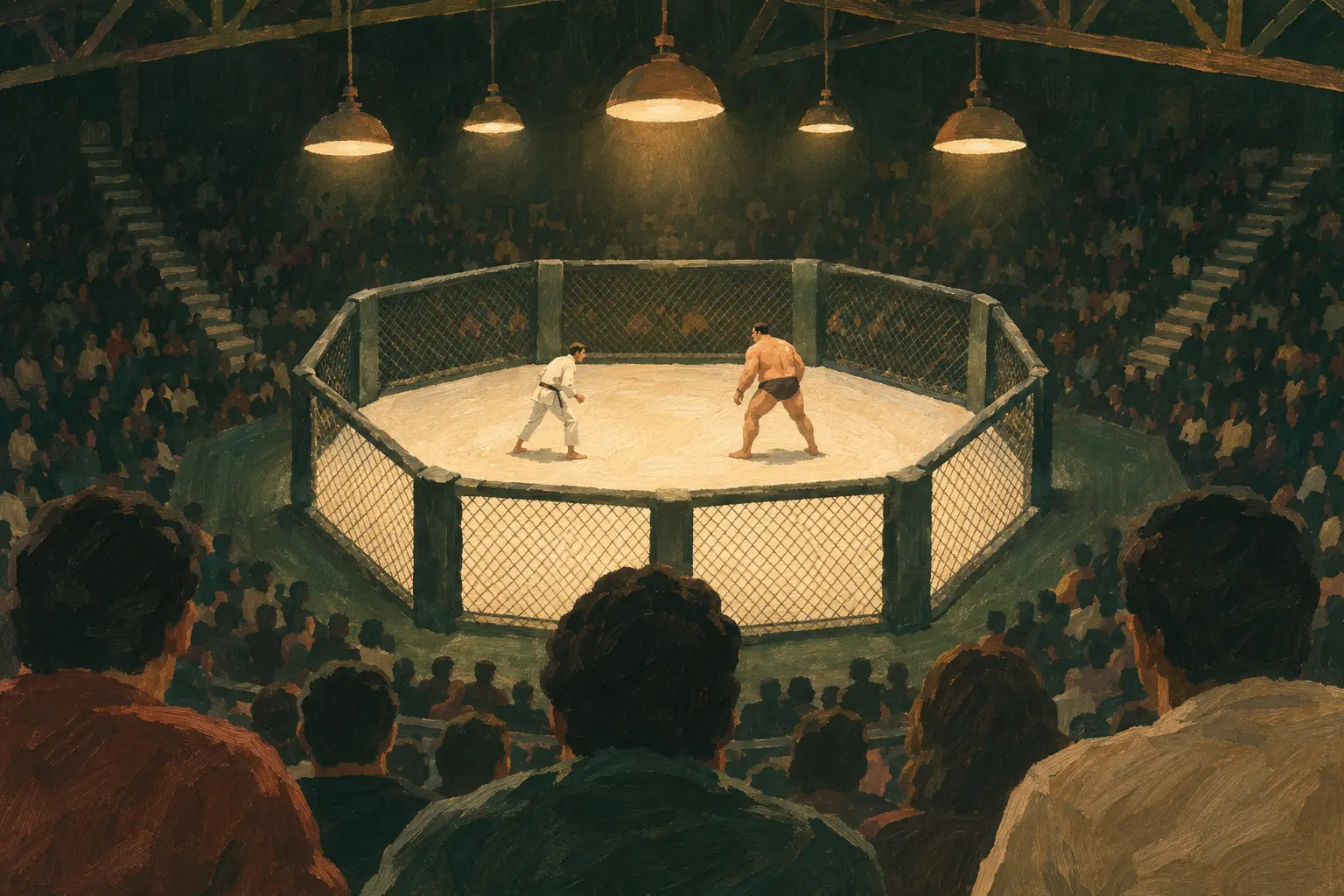
Ken Shamrock was on his knees in the Octagon, and the referee was waiting for the fight to go on. Moments earlier Shamrock had tapped to a choke in the semifinal of the first Ultimate Fighting Championship, in Denver on 12 November 1993, and Royce Gracie had let go. The referee had missed it. In Shamrock’s account, it was Royce who settled the matter: “You tapped. You tapped.” Shamrock nodded. [1][2]
David Isaacs, the UFC’s first president, sat cageside that night. Looking back, he put the contrast plainly: “Of all the fighters, Royce was the least impressive physically.” That, Isaacs said, was Rorion Gracie’s whole argument: an ordinary man who knew the family’s jiu-jitsu could beat someone built like Shamrock. [1]
That is where the myth begins, and where it starts to come apart.
The story most fans know
A version that is easy to assemble from a few known pieces runs roughly like this. A little-known Gracie, the slightest of the brothers, had come to California to help around the house, got picked more or less at random, and walked into an event that nobody, him included, expected to matter.
Each piece has a source somewhere. Rorion said in 2013 that Royce had come from Brazil to help at his home and with his children, and joked that he was “Half the time babysitter, half the time UFC fighter.” Shamrock took the whole event for staged pro wrestling until the first fight ended. Royce was 26 and, by his own description, not bulked up. [1][3][4]
But the people who set up the night describe a choice that was slow, debated and deliberate.
What the people who were there say
Art Davie, who created the event with Rorion, had another Gracie in mind. “I was eager to have Rickson,” Davie recalled. Rickson was the older brother whom Bleacher Report’s Jonathan Snowden calls the family champion. In Davie’s memory Rorion still had not named anyone by July, while replies to Davie’s search for fighters were already arriving. When Rorion did decide, Davie says, the reason was the picture Royce made. He “looks like a little altar boy in that white gi,” Rorion told him, and a win would be the Bruce Lee idea: skill beating size. [1][2]
Rorion’s own explanation, given in 2013, points the same way. Winning the tournament was not his goal; showing what the art could do was. A fighter “with a skinny body and totally physically unimpressive” would tell viewers at home that they could do it too. [1]
Royce has given versions of that answer for years. In 2006 he told UFC writer Thomas Gerbasi that the timing was right and so was his size: “I didn’t look very scary.” In 2013 he said the decision was mostly Rorion’s and their father Hélio’s, and that he had wanted it badly: “I was dying for the opportunity.” When the invitation came, he said, “There was no hesitation.” [1][4][5]
Dave Meltzer, writing for Yahoo Sports in 2007, adds a figure. At 176 pounds Royce was the smallest man in the eight-man tournament, and Meltzer writes that this was by design. [4][6]
So the babysitter line is real, but it is a joke about Royce’s daily life in Rorion’s house, not an account of how he was picked. In the accounts gathered here, no one who took part describes the selection as luck. [1][2][4][5][6]
Where the accounts part ways
They do not agree on everything.
Who chose? Royce names Rorion and Hélio. Davie remembers Rorion alone giving him the answer. For the rest of the field the sources split: Meltzer writes that Rorion picked the competitors; Snowden writes that Davie did the matchmaking and Rorion made only one demand: a boxer had to be on the card. None of them reports what Hélio said about Royce. [1][2][5][6]
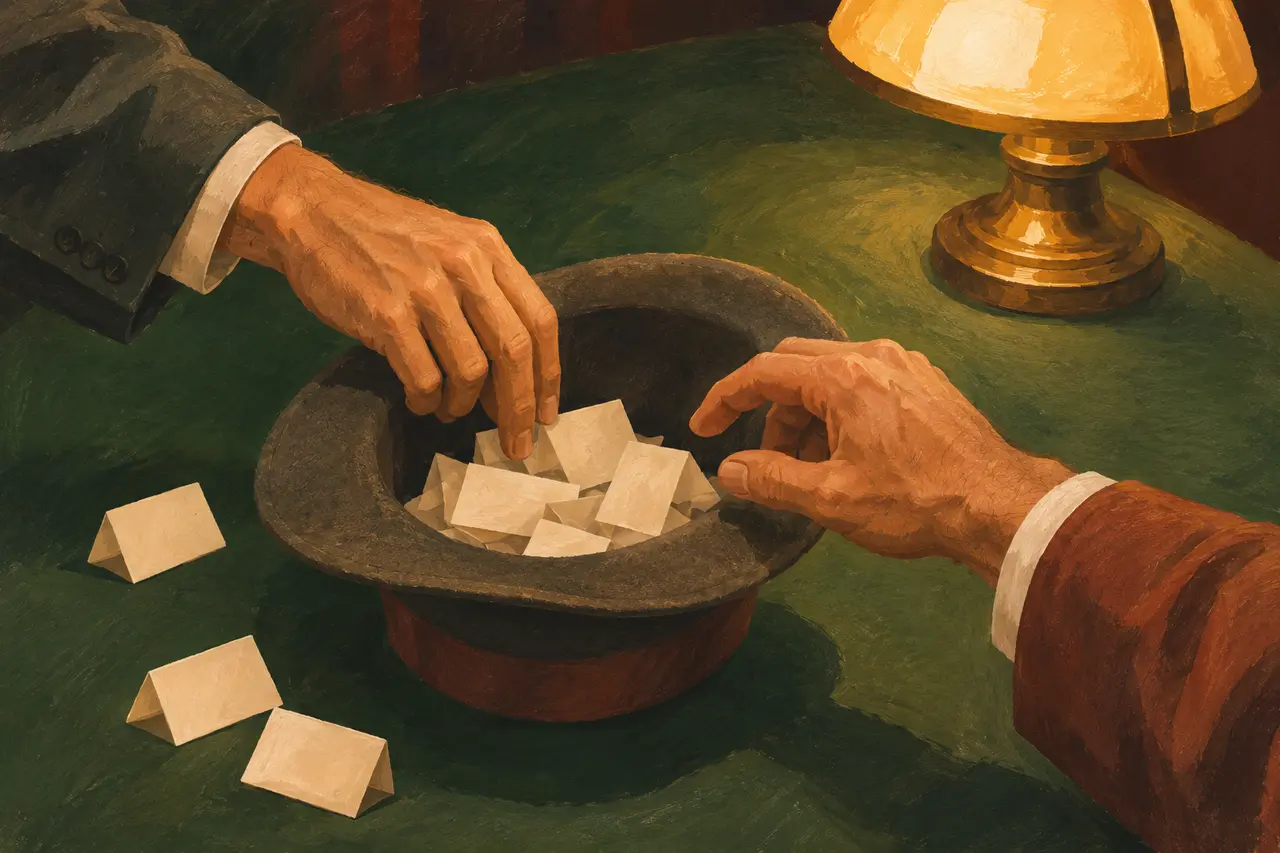
How were the pairings made? Royce has described a draw from a hat the evening before, the point at which, as he tells it, people began to realise it was really happening and to ask about the rules. He counted two: “no eye gouging and no biting.” In 2006 he added that the draw came so late he had prepared for every kind of opponent and planned each fight as it came. Meltzer gives a different picture: pairings were random except one, because Rorion wanted Royce to face the boxer first. Royce’s first opponent was the boxer Art Jimmerson. [1][2][4][6][7]
Too small, or the smallest? In 2013 Royce said he had been neither too big nor too small. Meltzer puts him at the bottom of the scale. The two statements measure against different things, and both can stand. [5][6]
A night someone saw coming
The other half of the myth says no one knew what was about to happen. That depends on whom you ask.
The organizers were uneasy. Isaacs remembered everyone holding their breath, unsure the Octagon would survive a sumo wrestler crashing into its fence in the opening fight. Campbell McLaren, an executive at Semaphore Entertainment Group, watching from the production truck, worried that with bouts this short “this might be a four-minute show.” Meltzer quotes McLaren with a line that has aged strangely: “The last thing we want is for this to be a sport.” [1][6]
Shamrock remembered the moment after that first fight: “The locker room went silent,” he said, for a second or two, before the room erupted. [1]
Royce remembers it the other way. “I knew UFC was going to be special before it even happened,” he told Bleacher Report. His family’s advice had been to think only of the one man in front of him, not of the whole art he was carrying in. [1][5]
He submitted Jimmerson, Shamrock and Gerard Gordeau. Asked about it in an interview first published in 2019, he called it “Just another day.” Rorion’s memory of how the night ended is of Hélio at a masquerade ball, dancing in a tuxedo. [1][2][7]

What no source settles
None of the sources behind this story records Rickson’s own view of the choice, or whether he was ever formally asked. None names another brother who was weighed up. None compares Royce’s size with his brothers’; the “smallest brother” of the popular telling is, in the record, the smallest man in the tournament. Hélio’s part rests on one sentence from Royce. And the sources split on whether Royce’s first opponent came out of a hat or out of Rorion’s plan. [1][2][3][4][5][6][7]
On the reason, the accounts gathered here agree. Royce was not the brother Davie wanted, nor the one Snowden calls the family champion. In Rorion’s and Isaacs’s telling, he was the one who looked least like a fighter, and that was the point. [1][2]
The accounts side by side
Four questions about the choice, and who answers what in the story above.
| Question | Royce Gracie | Rorion Gracie and Art Davie | Meltzer and Snowden |
|---|---|---|---|
| Who chose Royce? | In 2013 he said the decision was mostly Rorion’s and their father Hélio’s. [5] | Davie remembers Rorion alone giving him the answer. [2] | Nothing quoted in the story |
| Why him? | The timing was right and so was his size: “I didn’t look very scary.” [4] | Rorion: the goal was to show the art, and a fighter “with a skinny body and totally physically unimpressive” would do that. Davie had wanted Rickson. [1][2] | Meltzer: at 176 pounds he was the smallest man in the tournament, by design. [6] |
| Who picked the rest of the field? | Nothing quoted in the story | Nothing quoted in the story | Meltzer: Rorion picked the competitors. Snowden: Davie did the matchmaking, and Rorion made only one demand, a boxer on the card. [1][6] |
| How were the pairings made? | A draw from a hat the evening before. [7] | Nothing quoted in the story | Meltzer: random except one, because Rorion wanted Royce to face the boxer first. [6] |
Sources
- [1] Jonathan Snowden, Bleacher Report, UFC 1 25th-anniversary oral history, 12 November 2018 — bleacherreport.com. Accessed: 10 November 2026.Used for: Shamrock’s tap and the referee, Shamrock taking the event for pro wrestling until the first fight ended, Isaacs and Rorion on why Royce, the babysitter line, Snowden on Rickson and on the matchmaking, Rorion’s demand for a boxer, Jimmerson as Royce’s first opponent, the organizers’ worries, the locker room, Royce on knowing it would be special and on not hesitating, and Hélio at the ball.
- [2] Thomas Gerbasi, UFC.com, UFC At 30: Looking Back At Three Decades Of Changing The Game, 1 January 2023 — ufc.com. Accessed: 10 November 2026.Used for: The date and the three fights Royce won, Art Davie as co-creator of the event with Rorion, and Davie on Rickson, on July and on the altar boy.
- [3] UFC.com, Ken Shamrock reflects on UFC 1, 9 November 2018 — ufc.com. Accessed: 10 November 2026.Used for: Shamrock taking the event for a joke when he first heard of it.
- [4] Thomas Gerbasi, UFC.com, Revisiting UFC 1, 20 April 2020 — ufc.com. Accessed: 10 November 2026.Used for: Royce at 26, what he told Gerbasi in 2006 about his size and the late draw, and the eight-man field.
- [5] Thomas Gerbasi, UFC.com, UFC 20: Royce Gracie, 30 October 2013 — ufc.com. Accessed: 10 November 2026.Used for: Royce in 2013 on who decided, on wanting the chance and on his size, and the family’s advice.
- [6] Dave Meltzer, Yahoo Sports, First UFC forever altered combat sports, 12 November 2007 — sports.yahoo.com. Accessed: 10 November 2026.Used for: Royce’s weight, who picked the field, how the pairings were made, and McLaren’s line about sport.
- [7] Alex Pattle, The Independent (syndicated by Yahoo), interview with Royce Gracie, first published 2019 — ca.news.yahoo.com. Accessed: 10 November 2026.Used for: The draw from a hat, the two rules, and “Just another day.”