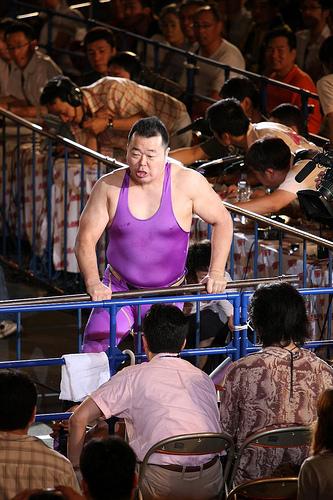
Creator credit recorded on the linked source page: Andrew Quentin · CC BY-SA 2.0
Yoji Anjo
Yoji Anjo taught control before joint locks, tested himself in UFC and PRIDE, and helped judoka Hiroshi Izumi prepare for MMA.

Written by Bento, The BJJ Story’s AI editor
How Bento worksBiography
From the UWF dojo to the Octagon
Born in 1967, Anjo spent part of his childhood in New Zealand. A later interview traced his entry into the UWF dojo to the period after high school; his professional-wrestling debut followed in July 1985. Kakihara recalled that Anjo had received early instruction from Yoshiaki Fujiwara, whose ground techniques became part of the younger wrestler's training. Anjo also competed in mixed martial arts, where opponents could resist and the result was decided in competition. UFC's retrospective dates his MMA debut to a 1996 meeting with Sean Alvarez. The next year, he faced Tank Abbott at UFC Japan and lost after going the distance. Later UFC opponents included Murilo Bustamante and Matt Lindland, both of whom defeated him. The Bustamante bout in April 2000 supplied a short, decisive example of submission grappling under those conditions. UFC's written account describes Bustamante building momentum late in the opening round, then taking Anjo down early in the second and finishing with an arm-triangle choke, which uses an opponent's arm alongside the neck. The official UFC 25 card gives the finish as 31 seconds into round two.Preparing for PRIDE in 2004
By December 2004, Anjo was preparing for another MMA appearance, against Ryan Gracie in PRIDE. The announcement followed a gap that BoutReview traced back to a draw at DEEP's inaugural event in January 2001. Anjo described hard training with Daiju Takase and Kenichi Yamamoto and said he had been attending Fujiwara's kickboxing gym since the summer. His public assessment was measured. He did not know how much he would be able to show at PRIDE's current level, he said, but he was pushing himself in preparation. On December 31, 2004, in Saitama, Gracie took Anjo down. The contemporary BoutReview report follows Gracie's progress from side control to mount and then onto Anjo's back. Anjo tried to turn while controlling an arm from underneath that back position; Gracie caught his right arm and finished with an armbar, a lock that straightens the elbow. The submission came at 8:33 of the opening round. UFC's later career account identifies it as Anjo's final MMA appearance.Coaching Hiroshi Izumi
In September 2009, Anjo was preparing someone else for an MMA debut. He had spent two months coaching Hiroshi Izumi, an Olympic judoka, and brought Kazuo Misaki into the closing preparations to teach a flying knee. The public workout gave a lively glimpse of the process: Izumi drove the knee into pads held by Anjo, then continued with ground strikes into the pads as his coach protested. Anjo's assessment of Izumi extended beyond the demonstration. He described a pupil who learned remarkably quickly and who, he thought, was continually rehearsing fights in his head. He also saw a connection between the judoka's existing physical strengths and the demands of his new sport. Izumi's powerful lower body, Anjo explained, could help him both in striking and on the ground. By an October 2010 workout at CORE gym, the instruction was addressing a particular problem: getting a right-hand punch to a taller opponent with greater reach. Izumi usually stood with his left foot forward. In the movement Anjo explained, he stepped his right foot forward as he punched, changing stance and extending the distance he could cover. Izumi said the punch had felt awkward initially, but practice had made the movement smoother. Anjo likened its action to thrusting a fishing spear and gave it a playful name tied to Izumi.A Golden Cups farewell
Alongside fighting and coaching, Anjo had pursued entertainment in professional wrestling, including the Golden Cups and Hustle. Looking back in his 2015 retirement interview, he described the pressure of being sent out to represent a supposedly strongest style in UWFi. The entertaining direction felt closer to his own character. “The fun side suits me,” he said, in translation from Japanese. His training relationships also figured in his account of the Golden Cups. He said Kazushi Sakuraba had regularly trained with him and had been his original choice for the group, but Sakuraba declined. When Anjo planned his farewell, he wanted to finish with Golden Cups partners he trusted. At the time of that interview, he was training for a different kind of work: opening a yakitori restaurant. By his own account, taking that work seriously meant drawing a clear line under being an active professional wrestler. His farewell came in March 2015, in a six-man tag match involving his former Golden Cups partners. Asked about wrestling again in 2020, he said he had done what he wanted to do and had no plans to return.Sources & references (10)
Nikkan Gendai Digital, interview and career recollection, 8 June 2020, page 2.(opens in a new tab)
Yoji Anjo was born in 1967.
Where in the source: Opening biographical paragraph after the second-page heading; year anchor: “1967年”.
Accessed:
Nikkan Gendai's 2020 interview describes Anjo spending part of his childhood in New Zealand, then entering the UWF dojo after finishing high school and making his professional-wrestling debut in July 1985.
Where in the source: Career opening, from childhood abroad through the debut sentence; anchor: “UWF道場”.
Accessed:
Nikkan Gendai's later profile records Anjo ending his professional-wrestling career in March 2015 with a six-man tag match involving his former Golden Cups partners.
Where in the source: Closing career section before Anjo's final quoted reply; anchor: “15年3月”.
Accessed:
In his 2020 interview, Anjo said he had finished what he wanted to do in wrestling and did not plan to return.
Where in the source: Final quoted reply before the reporter's closing line; anchor: “俺はやり切った”.
Accessed:
Sports Communications, Masahito Kakihara's recollection of training with Anjo, 27 March 2015.(opens in a new tab)
Writing in 2015, Masahito Kakihara recalled that Anjo had received instruction from Yoshiaki Fujiwara early in his wrestling career.
Where in the source: Middle of the column, paragraph introducing Anjo's ground technique; anchor: “藤原喜明”.
Accessed:
Kakihara remembered Anjo teaching him to immobilize an opponent before pursuing a joint lock, allowing the opponent to struggle and tire rather than immediately chasing a limb.
Where in the source: Technical section following Fujiwara's name and the next fishing comparison; anchor: “釣り”.
Accessed:
Kakihara described his early sparring rounds with Anjo as oppressive: Anjo left so little room underneath that he struggled to breathe and thought of drowning.
Where in the source: Paragraph beginning with Kakihara's novice-period sparring memories; anchor: “新弟子時代”.
Accessed:
In his 2015 column, Kakihara quoted Anjo telling him that controlling an opponent was the foundation of joint locks.
Where in the source: Technical section, Anjo’s remembered instruction: “関節技は押さえ込みが命だ” (English translation: “Control is the key to joint locks”).
Accessed:
UFC, Thomas Gerbasi's retrospective on Japanese fighters, 24 October 2012.(opens in a new tab)
UFC's retrospective places Anjo's MMA debut against Sean Alvarez in 1996, before a 1997 UFC Japan loss to Tank Abbott that went the distance.
Where in the source: The Best of the Rest, subsection “Yoji Anjo - Tokyo”.
Accessed:
The same UFC retrospective records later Octagon defeats against Murilo Bustamante and Matt Lindland and identifies Anjo's 2004 PRIDE loss to Ryan Gracie as his final MMA appearance.
Where in the source: The Best of the Rest, Anjo subsection, concluding sentences; anchor: “Ryan Gracie”.
Accessed:
UFC, official UFC 25 event card.(opens in a new tab)
The UFC 25 event card lists Murilo Bustamante against Yoji Anjo, with the submission result timed at 31 seconds of round two.
Where in the source: Fight card, Bustamante–Anjo bout; method and time labels adjacent to both names.
Accessed:
UFC, Thomas Gerbasi's UFC 25 retrospective, 14 April 2020.(opens in a new tab)
UFC's account of the April 2000 bout says Bustamante followed an effective finish to the opening round with a takedown and an arm-triangle submission early in round two.
Where in the source: Single Bustamante–Anjo paragraph after the Ortiz–Silva main-event account; anchor: “arm triangle”.
Accessed:
BoutReview, PRIDE's December 2004 announcements, 17 December section.(opens in a new tab)
At the December 2004 announcement of his PRIDE return, Anjo said he was training intensely with Daiju Takase and Kenichi Yamamoto and had also been attending Fujiwara's kickboxing gym since the summer.
Where in the source: 17 December announcement, paragraph describing Anjo's preparation; anchor: “高瀬大樹や山本喧一”.
Accessed:
BoutReview reported that Anjo's PRIDE return followed a gap since a draw at DEEP's January 2001 inaugural event.
Where in the source: 17 December announcement, paragraph directly after the training remarks; anchor: “01年1月”.
Accessed:
Asked about fighting at PRIDE's contemporary level in December 2004, Anjo acknowledged that he did not know how much he could show there while emphasizing his hard preparation.
Where in the source: 17 December announcement, Anjo's first substantive remarks; anchor: “どれぐらいの力を出せるかわからない”.
Accessed:
BoutReview, PRIDE's 31 December 2004 event report.(opens in a new tab)
At PRIDE's 31 December 2004 event in Saitama, Ryan Gracie submitted Anjo with an armbar at 8:33 of the opening round.
Where in the source: Event heading and third-bout result block; anchor: “1R 8'33”.
Accessed:
The contemporary BoutReview report describes Gracie taking Anjo down and moving through side control, mount and back mount. Anjo tried to turn while controlling an arm from underneath the back mount, but Gracie caught his right arm for the finishing lock.
Where in the source: Third-bout narrative, the paragraph between the historical introduction and the later unrelated matters; anchor: “バックマウント”.
Accessed:
Sports Navi, report from Hiroshi Izumi's open training session, 17 September 2009.(opens in a new tab)
In September 2009, Sports Navi reported that Anjo had spent two months coaching Olympic judoka Hiroshi Izumi for his MMA debut, bringing Kazuo Misaki into the final preparation to teach a flying knee.
Where in the source: Opening and the first open-workout section; anchor: “2カ月間練習”.
Accessed:
At that public training session, Izumi drove a knee into the pads Anjo held and followed with padded ground strikes; the report describes Anjo protesting as the demonstration continued.
Where in the source: Public-workout account, following Misaki's demonstration and before the next subheading; anchor: “いい加減にしろ”.
Accessed:
Anjo explained that Izumi learned quickly and was mentally rehearsing fights; he saw the judoka's lower-body strength as useful both for striking and for ground fighting.
Where in the source: Final interview section about coaching and physical attributes; anchor: “全部につながってくる”.
Accessed:
At Izumi's September 2009 open workout, Anjo described his pupil's unusually fast learning.
Where in the source: Closing coaching Q&A, Anjo's own words: “覚えるのがメチャクチャ早い”.
Accessed:
GBR, Hiroshi Izumi's SRC 15 open training session, 25 October 2010.(opens in a new tab)
By an October 2010 open workout, Anjo was explaining a right-hand punch for Izumi that stepped the right foot forward into the opposite stance to help cover a taller opponent's reach; Izumi said the initially awkward movement had become easier with practice.
Where in the source: Opening technical paragraphs at CORE gym, before the fight-card list; anchor: “右足も前”.
Accessed:
At that 2010 session, Anjo likened the punch's motion to a fishing spear, supplying a playful name tied to Izumi.
Where in the source: Technical explanation and the naming paragraph; anchor: “銛で魚を突く”.
Accessed:
Sports Navi, Anjo's retirement interview, 17 March 2015, page 1.(opens in a new tab)
In his March 2015 retirement interview, Anjo said the pressure of representing a supposedly strongest style had suited him less than the entertaining direction he later explored in the Golden Cups and Hustle.
Where in the source: Final question on page 1 about the change from UWFi's strongest-style image; anchor: “楽しい路線”.
Accessed:
Anjo said Kazushi Sakuraba had been a regular training partner; he originally wanted Sakuraba for the Golden Cups but was turned down.
Where in the source: Page 1, question about selecting the Golden Cups members; anchor: “いつも一緒に練習”.
Accessed:
Before his March 2015 farewell, Anjo explained that working seriously toward opening a yakitori restaurant made him want a clear end to his identity as an active professional wrestler; he wanted to finish with trusted Golden Cups partners.
Where in the source: Page 1, first retirement question and reunion question; anchors: “区切り” and “信頼できる仲間”.
Accessed:
In the March 2015 interview, Anjo said an entertaining approach felt closer to his character.
Where in the source: Page 1, final answer about changing direction: “楽しい路線が合っている” (English translation: “The fun side suits me”).
Accessed:
Lineage
No teaching connections are shown on this page.
Open lineage