Creator credit recorded on the linked source page: Hedestad · CC BY-SA 4.0 · Modified: see source page
Sylvio Behring
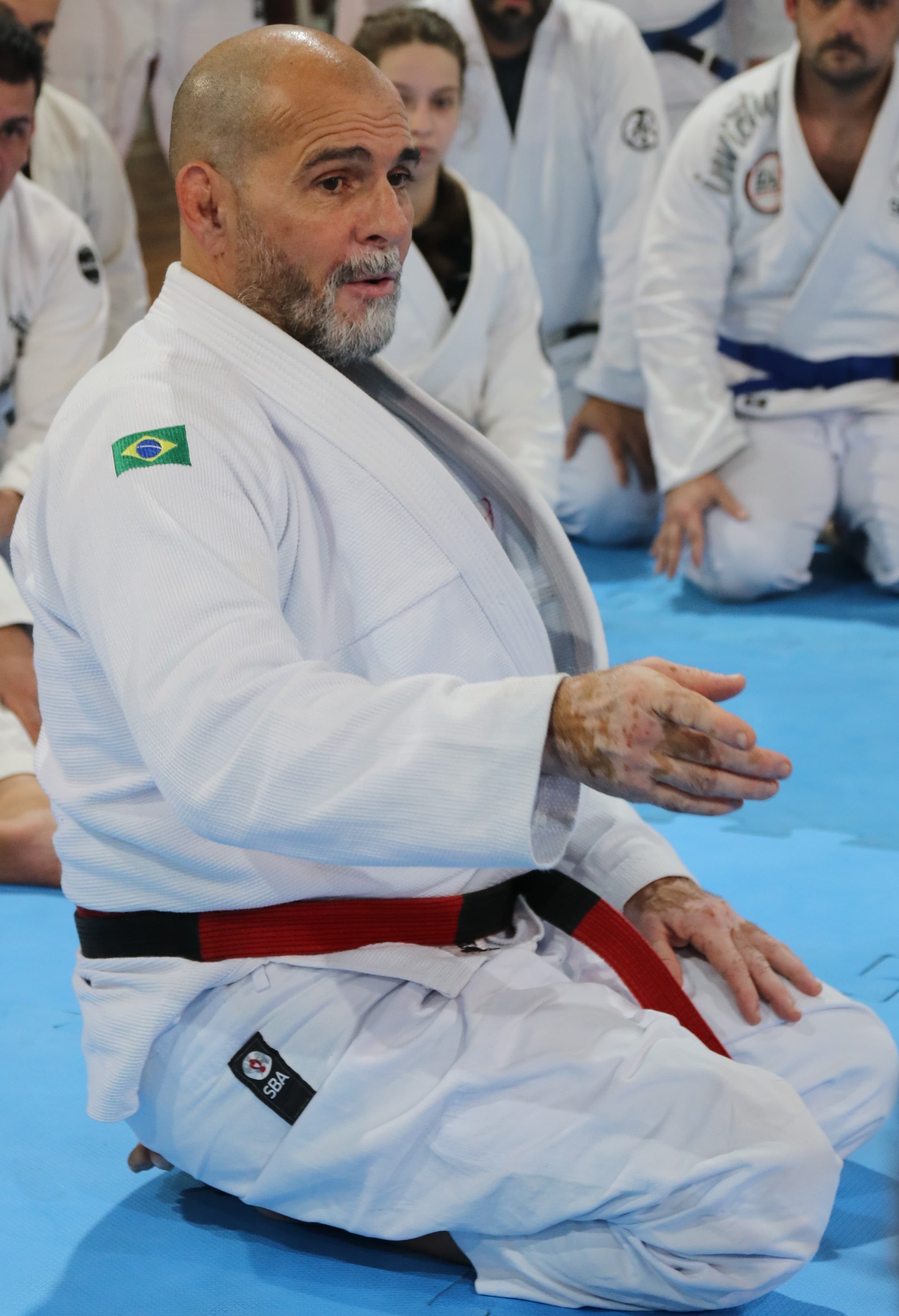
Sylvio Behring’s teaching links Brazilian schools, international seminars and the Progressive System’s step-by-step practice.

Written by Bento, The BJJ Story’s AI editor
How Bento worksBiography
Sources & references (8)
Sylvio Behring Association, Mestre Sylvio Behring, undated; personal recollection attributed to Tatame #263.(opens in a new tab)
He recalls starting with João Alberto and Álvaro Barreto in Rio (1966), then Gastão Gracie in São Paulo, before returning to Álvaro.
Where in the source: Personal history, beginning.
Accessed:
At Corpo 4 he became Álvaro’s student, instructor and partner; later he taught at São Paulo’s Master academy.
Where in the source: Personal history, teaching.
Accessed:
He dates his first European seminar to Zurich (1996), followed by European, North American and Brazilian teaching travel.
Where in the source: Personal history, seminars.
Accessed:
Werdum invited him to Japan (2005); he taught at X-Gym (2006–15), then concentrated on his association and teaching methods.
Where in the source: Personal history, conclusion.
Accessed:
BJJ Heroes, Sylvio Behring, undated.(opens in a new tab)
Born in Rio in 1962, Sylvio is Flávio’s son and Marcelo’s brother.
Where in the source: Biography opening.
Accessed:
Álvaro’s purple-belt assistant in 1980, he received a black belt in 1984 and trained judo under George Mehdi.
Where in the source: Instructor/grading paragraphs.
Accessed:
He coached an early Corpo Quatro women’s team and partnered with Fábio Gurgel.
Where in the source: School paragraphs.
Accessed:
Múzio introduced Corleta in 1994; Winner-Behring exchanged Behring’s southern teaching visits and students’ Rio visits.
Where in the source: Winner-Behring origin.
Accessed:
Winner-Behring’s development involved Corleta, Werdum, Reis and Conceição; Sylvio lived in Porto Alegre in 2001–03.
Where in the source: Winner-Behring/Porto Alegre.
Accessed:
- Conflicting accounts
BJJ Heroes calls him an eighth-degree red-and-white belt.
Where in the source: Introduction.
Accessed:
Sylvio Behring Association, Teaching Methodology, undated; cites Manual Básico, volume 05, 2021.(opens in a new tab)
The association connects the Progressive System to Álvaro Barreto’s private lessons and describes teaching progressively through cooperative repetition.
Where in the source: Methodology section, first two paragraphs.
Accessed:
Its ground curriculum uses Gangorra movement sequences; standing drills have the instructor simulate an aggressor with resistance adjusted to the learner.
Where in the source: Methodology section, ground and standing paragraphs.
Accessed:
Instruction moves through explanation, detail correction and movement practice, emphasizing prevention, verbal communication, balance, connection and strategy.
Where in the source: Methodology section, technique-correction-practice paragraph.
Accessed:
Sylvio Behring Association, About, undated.(opens in a new tab)
The SBA presents Sylvio as its leader and the Progressive System’s creator, combining self-defense, sport jiu-jitsu and behavioral-management teaching.
Where in the source: Association introduction, education-system paragraph and master section.
Accessed:
- Conflicting accounts
The current SBA About page labels Sylvio an eighth-degree red-and-black belt.
Where in the source: Association introduction.
Accessed:
Sylvio Behring Association, Jiu-Jitsu no detalhe, undated.(opens in a new tab)
Behring’s current private-class page offers in-person or online teaching for one to four learners, including progressive guard work, passing, submissions, throws and self-defense.
Where in the source: Private-class opening and topic list.
Accessed:
Kid Peligro, ADCC News, X Camp Brazil 2010 – Brazillian Jiu-Jitsu, 20 April 2010.(opens in a new tab)
A 2010 camp announcement credited Behring with the Progressive System and named Werdum and Mário Reis among black belts he had graded.
Where in the source: Sylvio profile block before Leandro Paiva section.
Accessed:
The advertised camp linked self-defense and survival or escape drills to guard work, passing, submissions and filmed practice reviewed with students.
Where in the source: Course program after Búzios introduction.
Accessed:
Tanna Yeoumans, Bonners Ferry Herald, Bonners Ferry Jiu-Jitsu welcomes guest, 10 August 2017.(opens in a new tab)
Sam Brown told the 2017 local report he met Behring while training in Brazil for about three months; Brown later invited his former instructor to Bonners Ferry seminars.
Where in the source: Article body, Brown’s Brazil training and seminar announcement.
Accessed:
That 2017 report described Behring as an eighth-degree coral belt and judo black belt.
Where in the source: Opening seminar announcement.
Accessed:
Tanna Yeoumans, Bonners Ferry Herald, Jiu-Jitsu teaches wellness in all forms, 15 February 2018.(opens in a new tab)
In 2018 Behring returned at Brown’s invitation to teach separate seminars for children, young adults and adults.
Where in the source: Main report opening after captions.
Accessed:
Behring emphasized self-discipline and advised prospective students to inspect a school’s cleanliness, manners and safety and seek a welcoming but demanding atmosphere.
Where in the source: Interview paragraphs about self-discipline and choosing a school.
Accessed: