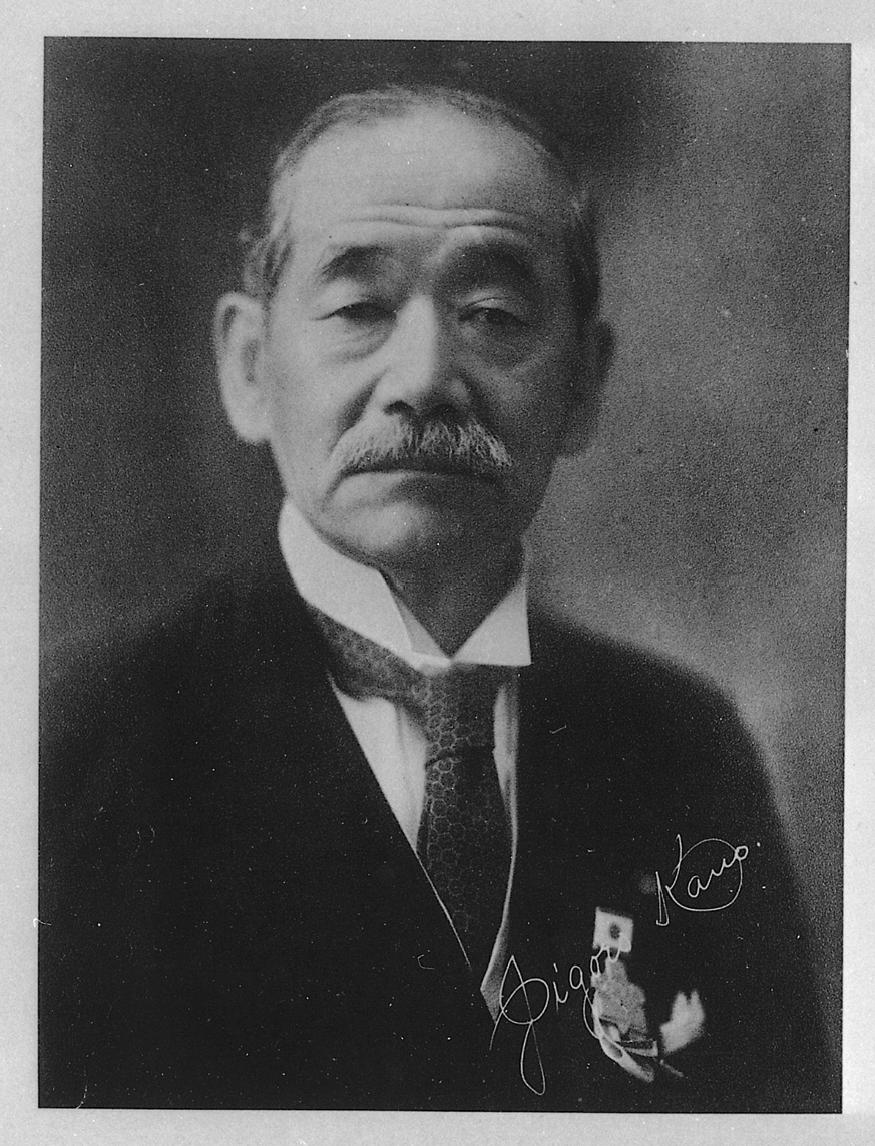
Creator credit recorded on the linked source page: Unknown author · Public domain
Jigoro Kano
Jigoro Kano trained in the old jujutsu schools, opened Tokyo's Kodokan in 1882 and founded judo; Mitsuyo Maeda later studied there before going to Brazil.

Written by Bento, The BJJ Story’s AI editor
How Bento worksBiography
Early years and jujutsu
Kano was born in 1860 in Kobe, the third son of a well-off family. As a schoolboy he was small and was bullied. Wikipedia tells how a family friend, Nakai Baisei, showed him a few jujutsu techniques that let a smaller man defeat a bigger one; Nakai called that kind of training out of date and dangerous, and Kano decided to learn it anyway. Finding a teacher took months. He began by seeking out bonesetters, on the theory that doctors who knew the art would teach it better, and so came to Fukuda Hachinosuke, a bonesetter and former instructor at the Kobusho who taught Tenjin Shin'yo-ryu jujutsu in a ten-mat room beside his practice. Kano's father was unhappy with the choice but accepted it. Fukuda had students take fall after fall from the teacher or a senior until they grasped how a technique worked, and he let beginners spar freely before they learned the set forms (kata). Two years into his training Kano was good enough to appear in a demonstration for Ulysses S. Grant, the former US president. It took place on August 5, 1879, at the home of the businessman Shibusawa Eiichi, with Fukuda and Iso Masatomo also taking part. Wikipedia says Kano came to be judged the most advanced of Fukuda's students in kata, and after Fukuda's death his widow chose Kano to inherit the school's scrolls. He moved on to Iso, a 62-year-old known for his kata, and taught under him as an assistant instructor. Iso died in 1881. That year Kano turned to Iikubo and the Kito school, which stressed throwing rather than the striking and grappling of his first system. The IJF's history credits Iikubo's attention to the spiritual side of the art with leading Kano to stress the moral side of his own method.Founding the Kodokan
In 1882 Kano opened the Kodokan in a twelve-mat room at the Eishoji, a Buddhist temple in the Shitaya district of Tokyo. The same year he also began teaching at the Gakushuin, the school for children of the aristocracy. The first students numbered fewer than a dozen. Iikubo helped with the teaching two or three days a week, and the students tested themselves in regular matches against local police jujutsu teams. Kano took the word judo from Terada Kan'emon, the fifth headmaster of Kito-ryu, who had used it for his own Jikishin-ryu. Its characters join pliancy and the Way. Paul McMichael Nurse, writing for Fighting Arts, adds that an existing word helped set the new system apart from the poor reputation of jujutsu. In technique, Kano joined the throws of Kito-ryu to the chokes and pins of Tenjin Shin'yo-ryu, and judo's Koshiki-no-kata preserves the Kito forms. In 1898 he wrote that he had taken the good points of the various schools and added his own inventions and discoveries. Nurse sees him as more a synthesizer than an inventor, and counts as perhaps his greatest innovation the practice of teaching new students to fall safely (ukemi) before any technique; in many jujutsu systems that Kano looked into, a student was thrown and had to land as best he could. Kano also left techniques he judged too dangerous out of the general syllabus. The same account dates to 1883 a system of kyu and dan grades marked by belt colors: white for the first three grades, brown for the next three and black for dan holders. Early students sealed a register in blood and swore five oaths.Rivals and growth
Nurse writes that in 1886 the Tokyo police board sponsored a tournament between the Kodokan and the Yoshin-ryu of the jujutsu master Totsuka Hikosuke, to decide which system its officers would learn. The Kodokan team, led by Yokoyama Sakujiro and Saigo Shiro, won clearly, and in his view the result secured judo's reputation and official backing. The IJF's history says Kano's method was adopted by the Navy and the police and introduced in schools and universities, and from there it spread across Japan. By 1911, Wikipedia says, the Kodokan had more than a thousand dan-graded members. Nurse reports that many jujutsu schools merged with it, that Kano met a gathering of jujutsu masters in Kyoto in July 1906 to settle the judo syllabus, and that judo and kendo became required school subjects in 1911. He also describes a Kansai movement around the Butokuden that kept some techniques Kano had dropped, among them pain holds, and put more weight on ground grappling (katame-waza), where the Kodokan favored throws (nage-waza). He calls it a stylistic rival, not a separate tradition, and says it did not survive the Second World War.Teacher and Olympic delegate
Alongside the Kodokan, Kano made a career in education and was president of the Tokyo Higher Normal School from 1900 until he retired on January 16, 1920. He described judo as having three parts: physical exercise, a martial art, and the cultivation of wisdom and virtue for daily life. His Kodokan Cultural Association, founded in 1922, took two mottoes, one about using energy efficiently and one about mutual welfare. In a 1934 speech he said: "Nothing under the sun is greater than education." In 1909 he became Japan's representative on the International Olympic Committee, and he represented Japan at the 1912 Stockholm Games. Nurse writes that Kano traveled abroad to promote judo, and that in London in 1933 he spoke of hoping for a world judo federation and for the Kodokan's teaching to serve world peace. Writing in 1936, Kano said he did not feel inclined to take the initiative in bringing judo into the Olympics, though he would not stand in the way if other member countries wanted it. He took part in Japan's bid for the 1940 Games and died at sea on May 4, 1938, aboard the Hikawa Maru on the way home from an IOC conference.Mitsuyo Maeda and Brazil
Mitsuyo Maeda was a student at the Kodokan. Gracie Magazine says Maeda trained with Kano and went to San Francisco in 1904 at Kano's request. Wikipedia says Kano noticed him when he arrived and placed him with Tomita Tsunejiro, one of the Kodokan's Four Heavenly Kings, to show that size does not matter in judo, and it gives a different reason for the trip: after a 1903 visit by Yamashita Yoshitsugu, the Japanese Legation asked the Kodokan to send teachers, and on November 16, 1904, Tomita, Maeda and Satake left Yokohama for the United States. Maeda reached Brazil in 1914. In Wikipedia's account, the 14-year-old Carlos Gracie watched him demonstrate at the Teatro da Paz in Belém in 1917 and decided to learn judo, and Maeda accepted Carlos Gracie and Luiz França as students; Gracie Magazine also says Maeda taught Carlos Gracie. The Kodokan promoted Maeda to sixth dan in 1929 and to seventh dan in 1941, and he died in Belém in November 1941 without learning of the last promotion.Sources & references (5)
International Judo Federation history series 'From Martial Art to Olympic Sport', excerpt from Michel Brousse, Judo for the World.(opens in a new tab)
Jigoro Kano was born in 1860 in the Mikage area of what is now Kobe.
Where in the source: Part 1 article, paragraph on Kano’s life and family; gives the birth year and the district of Kobe.
Accessed:
Kano's first jujutsu master was Fukuda Hachinosuke, a former teacher at the Kobusho who Kano found after months of searching; Kano's father was unhappy about the choice but accepted it.
Where in the source: Part 1 article, paragraph on his entry to Tokyo Imperial University and the search for a jujutsu instructor.
Accessed:
Two years into his jujutsu training Kano knew enough to take part in a jujutsu demonstration held to honour the visit to Tokyo of the former US President Ulysses Grant; when Fukuda died Kano continued under Iso Masatomo.
Where in the source: Part 1 article, paragraph on Fukuda and the demonstration for General Grant.
Accessed:
In 1881 Kano began studying the Kito school of jujutsu with Iikubo Tsunetoshi, an expert at throws who stressed the spiritual side of the art; this influenced Kano to emphasise the moral side of his own method, and he kept the Kito forms as Koshiki-no-kata.
Where in the source: Part 1 article, paragraph on the Kito school and Koshiki-no-kata.
Accessed:
In 1882 Kano opened a judo academy, the Kodokan, in a twelve-tatami room at the Eishoji Buddhist temple in the Shitaya district of Tokyo; the same year he took up a teaching post at the Gakushuin, the school for children of the aristocracy.
Where in the source: Part 1 article, paragraph on the landmark year 1882.
Accessed:
After the Kodokan opened, its students multiplied and it moved several times; the IJF text says it was then that Kano's method was adopted by the police and the Navy and introduced to schools and universities, from where it spread across Japan.
Where in the source: Part 1 article, final paragraph on the growth of the Kodokan.
Accessed:
Paul McMichael Nurse, 'The Beginnings of Kodokan Judo, 1882-1938', Fighting Arts.(opens in a new tab)
Kano was born in 1860 in Kobe, in Hyogo Prefecture, the third son of a well-off family.
Where in the source: Opening section of the article, paragraph beginning with the birth date and Kobe.
Accessed:
Kano died at sea on 4 May 1938 aboard the ship Hikawa Maru, on the way home from an International Olympic Committee conference.
Where in the source: Closing section on Kano's last years; sentence naming the ship and the date.
Accessed:
Nurse describes Kodokan Judo as a modern budo founded by the Japanese educator Jigoro Kano to instil physical and moral education in the youth of Meiji-era Japan.
Where in the source: Second paragraph of the article, the sentence on the origin of Kodokan Judo.
Accessed:
At seventeen Kano began studying Tenjin Shin'yo-ryu jujutsu under Fukuda Hachinosuke; after the deaths of Fukuda and his successor Iso Masatomo he moved to Kito-ryu under Iikubo Tsunetoshi, a school that stressed throwing rather than the striking and grappling of his first system.
Where in the source: Early part of the article, paragraphs on his first jujutsu training and the move to Kito-ryu.
Accessed:
- Conflicting accounts
Nurse writes that Kano chose the name Kodokan Judo, 'the place for studying the way of flexibility', using the already existing word judo to separate his system from the bad reputation of jujutsu, and that the Kodokan began with nine students on twelve mats at the Eishoji temple; Nurse gives June 1882 as the formal founding date.
Where in the source: Section on naming and founding; sentence on the name and the nine students.
Accessed:
According to Nurse, in 1883 Kano began a kyu and dan ranking system at the Kodokan based on coloured belts, with white belts for the first three grades, brown for the next three, and black for dan holders; early students had to place a seal of blood on a register and declare five oaths.
Where in the source: Section after the founding; paragraphs on the blood-sealed register with five oaths and the 1883 ranking system.
Accessed:
Nurse describes Kano as more a synthesiser than an inventor; he singles out the teaching of breakfalling (ukemi) before a new student studies technique as perhaps Kano's greatest innovation, a departure from jujutsu systems where students were thrown and had to land as best they could, and says Kano removed techniques he judged too dangerous from the general Kodokan syllabus.
Where in the source: Section on technique; paragraphs on ukemi and on removed techniques.
Accessed:
In 1886 the Tokyo police board sponsored a tournament between the Kodokan and the Yoshin-ryu of the jujutsu master Totsuka Hikosuke to decide which system to train its forces in; the Kodokan side, led by Yokoyama Sakujiro and Saigo Shiro, won clearly, and Nurse says this secured judo's reputation and official sanction.
Where in the source: Section on the early years of the Kodokan; paragraphs on the rivalry with Totsuka and the 1886 tournament.
Accessed:
Nurse reports that by the early twentieth century many jujutsu schools merged with the Kodokan, that Kano and a gathering of jujutsu masters met at the Butokuden in Kyoto in July 1906 to formulate modern kata and finalise the judo syllabus, and that judo and kendo became required school subjects in 1911.
Where in the source: Section on the spread of judo; paragraphs on the 1906 Kyoto meeting and the Ministry of Education syllabus.
Accessed:
Nurse writes that a Kansai movement centred on the Butokuden and backed by the Dai Nippon Butokukai kept some techniques Kano had discarded, including pain holds, and placed more emphasis on ground grappling (katame-waza) than the Kodokan's emphasis on throws (nage-waza); he calls it a stylistic rival of the Kodokan, not a separate tradition, and says it did not survive the Second World War.
Where in the source: Section on rival judo styles; paragraph on the Kansai variety and katame-waza.
Accessed:
Nurse says Kano made foreign journeys to promote judo, and in London in 1933 spoke of his wish for a world judo federation and for Kodokan teachings to spread worldwide as a means to world peace; he had become Japan's first representative on the IOC in 1909.
Where in the source: Section on Kano's international work, paragraph on the London trip and the IOC.
Accessed:
English Wikipedia, article 'Kanō Jigorō', section on death and legacy.(opens in a new tab)
Kano died on 4 May 1938 during a voyage on the NYK Line ship Hikawa Maru that he made as a member of the IOC.
Where in the source: Section on death and legacy, first paragraphs.
Accessed:
Kano was a Japanese educator and the founder of judo.
Where in the source: Lead paragraph of the article.
Accessed:
As a schoolboy Kano was small and was bullied; a family friend, Nakai Baisei, showed him a few jujutsu techniques by which a smaller man might beat a larger one, and Kano decided to learn the art even though Nakai called such training out of date and dangerous.
Where in the source: Early years, Childhood section, second paragraph.
Accessed:
Kano found his way to Fukuda Hachinosuke by looking first for bonesetters, on the assumption that doctors who knew the martial art would be better teachers; Fukuda, a bonesetter, taught Tenjin Shin'yo-ryu jujutsu in a ten-mat room next to his practice.
Where in the source: Early years, Jujutsu section, first paragraph.
Accessed:
Fukuda's teaching had students take many falls from the teacher or a senior until they understood the mechanics of a technique, with free practice (randori) offered to beginners before traditional forms (kata); Kano was later judged the most advanced of Fukuda's students in kata, and Fukuda's widow chose him to inherit the school's scrolls.
Where in the source: Early years, Jujutsu section, paragraphs on Fukuda's method and his death.
Accessed:
On 5 August 1879 Kano took part in a jujutsu demonstration for the former US president Ulysses S. Grant at the home of the businessman Shibusawa Eiichi, together with the teachers Fukuda Hachinosuke and Iso Masatomo.
Where in the source: Early years, Jujutsu section, paragraph on the Grant demonstration.
Accessed:
After Fukuda died, Kano studied with Iso Masatomo, a 62-year-old known for excellence in kata, and became an assistant instructor at Iso's school; Iso died in 1881.
Where in the source: Early years, Jujutsu section, paragraph on Iso.
Accessed:
Kano recalled that, once he had worked out how to break an opponent's posture before the throw, he began throwing his Kito-ryu teacher Iikubo in randori with increasing regularity; he said Iikubo then told him he had nothing more to teach him, after which Iikubo gave him the school's books and manuscripts. A menkyo certificate from Iikubo is dated October 1883.
Where in the source: Kodokan judo, Establishment section; Kano's quoted recollection, and the later menkyo certificate paragraph. Iikubo's reported words: 'nothing more to teach you'.
Accessed:
Technically Kano combined the throwing techniques of Kito-ryu with the choking and pinning techniques of Tenjin Shin'yo-ryu; judo's Koshiki-no-kata preserves Kito-ryu forms, Itsutsu-no-kata comes from Tenjin Shin'yo-ryu, and Kime-no-kata was composed new by Kano for his students. In 1898 Kano wrote that he took the good points of the various schools and added his own inventions and discoveries.
Where in the source: Kodokan judo, Establishment section, last two paragraphs; the 1898 sentence is Kano's own, as quoted there.
Accessed:
Kano started Kodokan judo in 1882 with twelve mats in space belonging to the Eisho-ji temple in the Shitaya ward of Tokyo, with Iikubo attending the dojo three days a week to help teach; the few early students tested themselves in regular contests with local police jujutsu teams.
Where in the source: Kodokan judo, Development section, paragraph on the first dojo.
Accessed:
Kano took the word judo from a term that Terada Kan'emon, fifth headmaster of the Kito-ryu, had used when founding his own Jikishin-ryu; the name joins the characters for 'pliancy' and 'the Way'.
Where in the source: Kodokan judo, Establishment section, paragraph on the name.
Accessed:
Pedagogical innovations attributed to Kano include black and white belts and the introduction of dan ranks to show relative standing within a martial art.
Where in the source: Lead paragraph, second sentence group on pedagogical innovations.
Accessed:
The Kodokan's enrolment grew from fewer than a dozen students in 1882 to more than a thousand dan-graded members by 1911; in 1909 Kano incorporated the Kodokan and endowed it with 10,000 yen.
Where in the source: Kodokan judo, Development section, paragraphs on growth and the 1909 incorporation.
Accessed:
Kano described judo as having three parts: judo as physical exercise (rentai-ho), as a martial art (shobu-ho), and as the cultivation of wisdom and virtue applied to daily life (shushin-ho); the mottoes of his Kodokan Cultural Association, founded in 1922, were usually rendered 'Maximum Efficiency with Minimum Effort' and 'Mutual Welfare and Benefit'.
Where in the source: Kodokan judo, Ideals section; Kano's own account of the three parts, then the 1922 association paragraph.
Accessed:
Kano became active in the work of the International Olympic Committee in 1909 and represented Japan at the Olympics in Stockholm in 1912; he took part in Japan's bid for the 1940 Games and, writing in 1936, said he did not feel inclined to take any initiative in bringing judo into the Olympics, though he would not object if other member countries wished it.
Where in the source: Professional life, International Olympic Committee section; paragraphs on 1909, Stockholm 1912 and the 1936 letter to Gunji Koizumi.
Accessed:
Kano spoke in 1934 of the value of teaching: 'Nothing under the sun is greater than education.'
Where in the source: Death and legacy, third paragraph: 'Nothing under the sun is greater than education'.
Accessed:
As an educator Kano worked as a teacher at the Gakushuin from 1882 and held his post as president of Tokyo Higher Normal School from 1900 until his retirement on 16 January 1920; he also served as director of primary education at the Ministry of Education from 1898 to 1901.
Where in the source: Lead, third paragraph, and Professional life, Educator section.
Accessed:
Gracie Magazine, 'Count Koma: 5 lessons from Jiu-Jitsu's pioneer in Brazil'.(opens in a new tab)
Gracie Magazine says that Mitsuyo Maeda was introduced to jiu-jitsu in Tokyo, trained with Kano, and later taught the art to Carlos Gracie in Brazil, and that in 1904 Maeda travelled to San Francisco at Kano's behest to spread Japanese combat techniques.
Where in the source: Article on Count Koma's lessons; the introductory paragraph on Tokyo and the paragraph on the 1904 trip.
Accessed:
English Wikipedia, article 'Mitsuyo Maeda', sections on his years at the Kodokan and the 1904 voyage.(opens in a new tab)
Wikipedia says that when Maeda arrived at the Kodokan, Kano noticed him and assigned him to Tomita Tsunejiro, one of the Kodokan's 'Four Heavenly Kings', to show that size is not important in judo; Tomita, Maeda and Satake sailed from Yokohama for the United States on 16 November 1904, after the Japanese Legation asked the Kodokan to send teachers following Yamashita Yoshitsugu's 1903 visit.
Where in the source: Career, Formative years at the Kodokan, and Prelude to Kodokan's expansion; plus the United States section's first sentence.
Accessed:
According to Wikipedia, Maeda did a judo demonstration in Santos on 24 September 1914 and arrived in Porto Alegre in November 1914 (passport copy); in 1917 the 14-year-old Carlos Gracie watched a demonstration by Maeda at the Teatro da Paz in Belém and decided to learn judo, and Maeda accepted Carlos Gracie and Luiz França as students.
Where in the source: Brazil section; passages on the 1914 arrival and on Influence on the creation of Brazilian jiu jitsu.
Accessed:
Wikipedia says Maeda became a naturalised Brazilian citizen, helped settle Japanese immigrants in Pará from 1925, was promoted by the Kodokan to 6th dan in 1929 and to 7th dan on 27 November 1941, and died in Belém on 28 November 1941 without learning of the last promotion.
Where in the source: Later years section, paragraph on 1925-1941.
Accessed:
Lineage
No teaching connections are shown on this page.
Open lineage