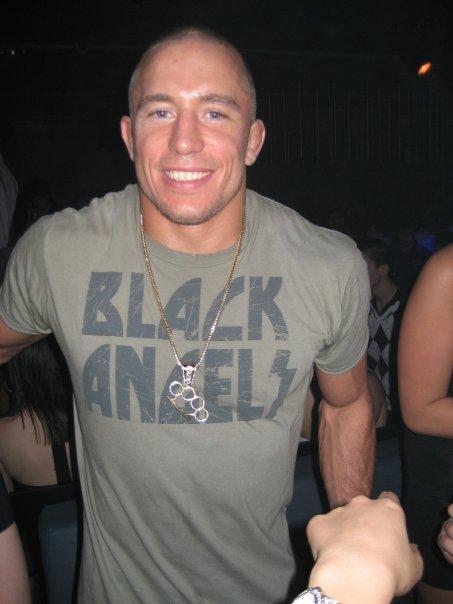
Creator credit recorded on the linked source page: Bad intentionz · CC BY-SA 3.0 · Modified: see source page
Georges St-Pierre
“Rush”
Source: gspofficial.comGeorges “Rush” St-Pierre pursued BJJ across cities, became UFC champion in two divisions and kept learning through injury and retirement.

Written by Bento, The BJJ Story’s AI editor
How Bento worksBiography
Sources & references (9)
UFC, Thomas Gerbasi, Zuffa Fighters get Belted, 13 October 2008.(opens in a new tab)
Georges St-Pierre received his Brazilian jiu-jitsu black belt from Bruno Fernandes in 2008.
Where in the source: Opening paragraph naming St-Pierre and Fernandes; the article date is 13 October 2008.
Accessed:
UFC, announcement and career retrospective for Georges St-Pierre in the Hall of Fame class of 2020, 9 May 2020.(opens in a new tab)
St-Pierre is a Canadian mixed martial artist from Saint-Isidore, Quebec.
Where in the source: Opening announcement, Canada career context and final native-of-Saint-Isidore paragraph.
Accessed:
St-Pierre won his UFC debut against Karo Parisyan by unanimous decision in Las Vegas on 31 January 2004.
Where in the source: Career retrospective, UFC 46 debut paragraph.
Accessed:
His first UFC title challenge ended in a first-round armbar loss to Matt Hughes in October 2004.
Where in the source: UFC 50 paragraph, with date and final armbar.
Accessed:
He won a later series of bouts, including a first meeting with B.J. Penn, to earn a rematch with Hughes.
Where in the source: Return against Jason Miller and four-fight UFC winning streak paragraph.
Accessed:
At UFC 65 in November 2006 he stopped Hughes in the second round to become UFC welterweight champion.
Where in the source: Complete UFC 65 recap, head kick and ground strikes.
Accessed:
He lost his first title defence to Matt Serra, returned with a win over Josh Koscheck, then submitted Hughes to win the interim title.
Where in the source: Paragraphs from UFC 69 through UFC 79.
Accessed:
He unified the welterweight title by stopping Serra at UFC 83 in Montreal in 2008, on the UFC’s first Canadian card.
Where in the source: UFC 83 unification paragraph.
Accessed:
His second welterweight reign included nine successful title defences, with Carlos Condit, Nick Diaz and Johny Hendricks among his final challengers.
Where in the source: Welterweight reign and final three defences paragraphs before the 2013 hiatus.
Accessed:
After the Hendricks defence, he stepped away from competition in December 2013.
Where in the source: Ninth-defence and December 2013 hiatus paragraph.
Accessed:
He returned four years later at UFC 217 and submitted Michael Bisping with a rear-naked choke in the third round to win the middleweight title.
Where in the source: Complete UFC 217 return and finish paragraphs.
Accessed:
He founded the Georges St-Pierre Foundation in 2009 to support young people and physical activity in schools.
Where in the source: Foundation paragraph after the acting and documentary summary.
Accessed:
His book The Way of the Fight, written with Justin Kingsley, was published in 2013.
Where in the source: Book paragraph below the foundation account.
Accessed:
Georges St-Pierre, official website biography, undated current page.(opens in a new tab)
He is also known as Rush and by the initials GSP.
Where in the source: Main biography paragraph beginning In 2006, Georges Rush St-Pierre.
Accessed:
He grew up in Saint-Isidore, Quebec, and his father introduced him to Kyokushin karate at seven.
Where in the source: Opening About GSP biography paragraph.
Accessed:
He identifies watching Royce Gracie at UFC 1 in 1993 as a turning point in deciding to pursue mixed martial arts.
Where in the source: About GSP paragraph on 1993 and UFC 1.
Accessed:
Before his professional success, he worked nightclub doors and on a garbage truck while continuing to train.
Where in the source: Biography paragraph on school, training and work before sunrise.
Accessed:
He added boxing, wrestling and Brazilian jiu-jitsu to his karate foundation.
Where in the source: Paragraph beginning Georges kept growing.
Accessed:
His UFC Hall of Fame induction took place in 2021; he belonged to the 2020 class.
Where in the source: Official biography paragraph on the Hall of Fame, read alongside the UFC’s class-of-2020 announcement.
Accessed:
On his website he distinguishes preparing for a fight from his continuing goal of improving as a martial artist.
Where in the source: Opening About GSP first-person statement about training for himself and seeking improvement.
Accessed:
Graciemag Newsroom, first-person interview with Bruno Fernandes about teaching in Montreal and coaching Georges St-Pierre, 16 December 2009.(opens in a new tab)
When Fernandes began teaching a small group at Tristar in Montreal, St-Pierre was among its first three or four students.
Where in the source: Complete Tristar discovery and small-group paragraph.
Accessed:
As that relationship developed, St-Pierre asked Fernandes to become his BJJ coach.
Where in the source: Same Tristar paragraph, explicit request and ongoing-coach statement.
Accessed:
Fernandes described him as a quick, attentive learner who adapted the jiu-jitsu they practised to his MMA fights.
Where in the source: Fernandes’s full answer on coaching St-Pierre after the 2008 promotion.
Accessed:
Graciemag, Portuguese first-person interview with Bruno Fernandes about St-Pierre’s jiu-jitsu and Roger Gracie’s visit, 29 November 2010.(opens in a new tab)
In 2010 Fernandes said St-Pierre’s earlier BJJ contact was with Wagnney Fabiano in Montreal, followed by training trips to Renzo Gracie’s academy in New York.
Where in the source: Complete answer on how his relationship with St-Pierre began, before the Koscheck preparation question.
Accessed:
Fernandes recalled St-Pierre driving overnight from Montreal to New York, training through the day and driving home again.
Where in the source: Same answer, night-driving and full-day training passage.
Accessed:
He said St-Pierre enjoyed gi training and usually focused on improving jiu-jitsu itself, adjusting the work to MMA rules nearer a fight.
Where in the source: Complete training-method answer, gi preference and near-fight adjustment passages.
Accessed:
Ahead of UFC 124 in 2010, Fernandes described a focus on controlling opponents, creating difficult positions and preparing submissions patiently.
Where in the source: Complete answer about preparation for Josh Koscheck.
Accessed:
Roger Gracie spent a week alongside St-Pierre’s training, including boxing, wrestling, conditioning and Muay Thai, while helping refine details of his ground game.
Where in the source: Complete answer on the productive St-Pierre–Roger Gracie meeting.
Accessed:
UFC, Elias Cepeda, interviews with Firas Zahabi, Phil Nurse and Renzo Gracie on St-Pierre returning to training, 7 September 2012.(opens in a new tab)
A torn ACL kept him out of competition after the April 2011 Jake Shields bout as he underwent surgery and rehabilitation.
Where in the source: Opening injury and return-to-training context, followed by Zahabi’s surgery account.
Accessed:
Firas Zahabi kept him involved through coaching, attending practices and cornering fights during the recovery.
Where in the source: Zahabi’s first full answer, coaching and cornering passage.
Accessed:
Zahabi described rebuilding sparring gradually, starting with lighter partners and increasing the number of rounds before returning to welterweights.
Where in the source: Zahabi’s incremental return paragraph.
Accessed:
Phil Nurse recalled St-Pierre studying unfamiliar moves during sparring, finding answers and then testing creative variations.
Where in the source: Nurse’s complete mechanical and creativity account.
Accessed:
Renzo Gracie said his jiu-jitsu looked more technical when they trained during that return, praising his habit of learning wherever he went.
Where in the source: Renzo Gracie’s complete two quoted paragraphs.
Accessed:
UFC, Thomas Gerbasi, retirement-day interview with Georges St-Pierre, 21 February 2019.(opens in a new tab)
He formally announced his retirement in Montreal on 21 February 2019 and said his motivation had changed and he was satisfied with his career.
Where in the source: Opening retirement-day report and complete motivation/satisfaction answers.
Accessed:
His final professional MMA record was 26 wins and two losses, with 20 wins in the UFC.
Where in the source: Opening career-summary paragraph of the retirement interview.
Accessed:
At retirement he said he intended to keep training and remain available to help other fighters.
Where in the source: Final answer on staying in the sport and being a phone call away.
Accessed:
Georges St-Pierre Foundation, stated mission and resource page, undated current page.(opens in a new tab)
The foundation’s public mission focuses on preventing bullying and promoting youth sport, and its site directs families to organisations including Kids Help Phone and PREVNet.
Where in the source: Mission at the top and complete Canada resources section.
Accessed:
GSP MMA Academy, official public course catalogue, undated current page.(opens in a new tab)
His GSP MMA Academy offers online courses in MMA fundamentals, stand-up attacks, takedowns and ground-and-pound, taught under his name.
Where in the source: Complete public featured-products catalogue with named instructor and course descriptions.
Accessed:
Lineage
No teaching connections are shown on this page.
Open lineage