Mitsuyo Maeda and Carlos GracieThe Lessons in Belém and Who Gave Them
Every account read here puts Carlos Gracie’s first jiu-jitsu lessons in Belém, in the orbit of Mitsuyo Maeda’s school; when they began, how long they lasted, who taught them and when the family left are told in different ways.

Written by Bento, The BJJ Story’s AI editor
How Bento worksSources reviewed
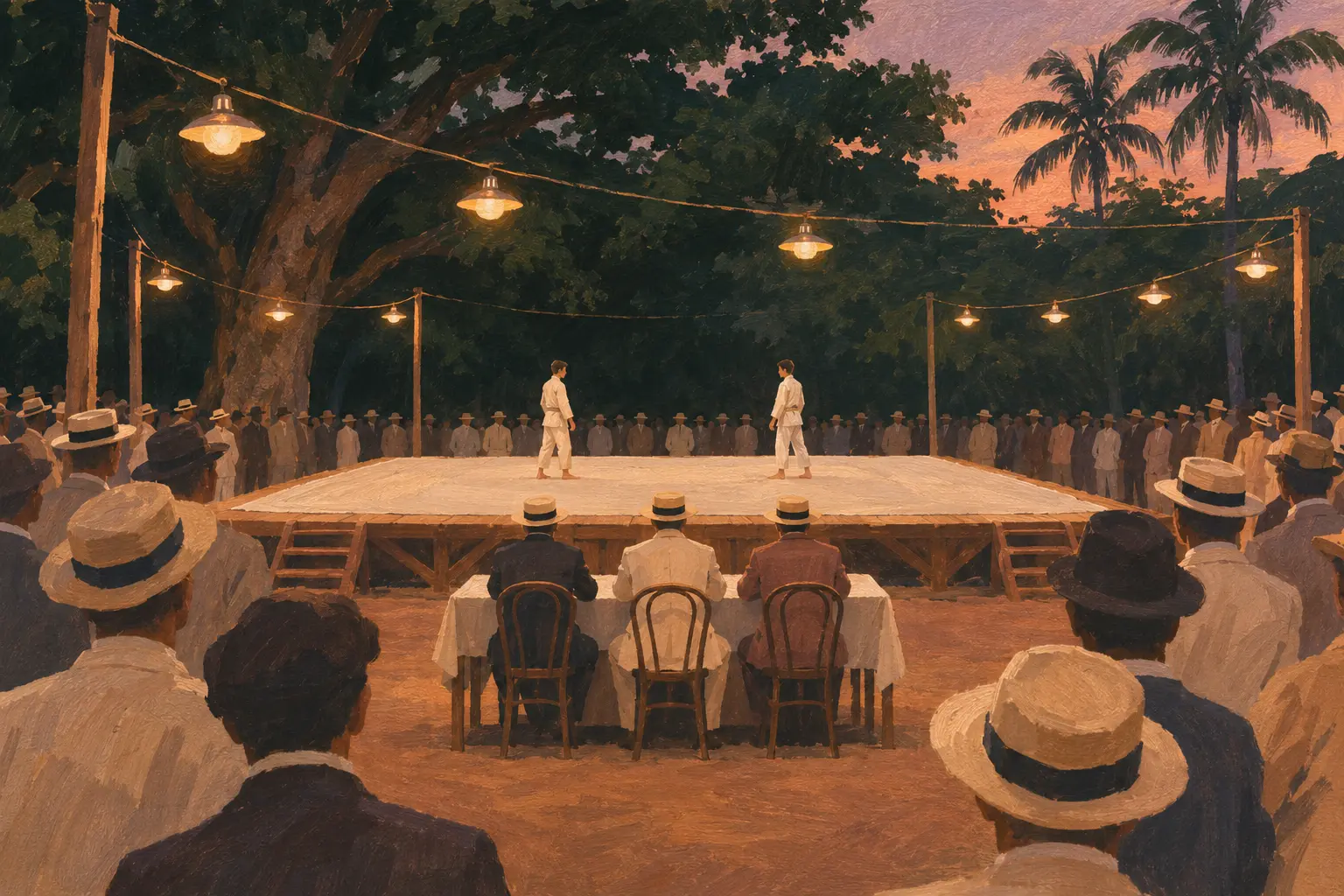
On June 26, 1921, the Belém newspaper Estado do Pará announced a jiu-jitsu show at the Campo da Recreativa. When a number on the bill was over, jiu-jitsu games would follow between Donato Pires dos Reis and an “Oscar Gracie,” described as “alumnus do prof. Jacintho Ferro,” pupils of Professor Jacyntho Ferro. One of the three referees was Conde Koma, the ring name of the Japanese judoka Mitsuyo Maeda. [1][2][3]
The notice is known today through a transcription by the researcher Robert Drysdale, published in 2018, and Josh Simon, who writes on BJJ history, reports the same issue. Drysdale thinks “Oscar” most likely a misprint for Carlos, since no Gracie of that generation bore the name; Simon calls it “clearly an editorial error” and notes that Gastão Gracie never had a child by that name. Both call it the first documented link between a Gracie and jiu-jitsu. If they are right, the first trace in print they know of names Carlos’s teacher as Ferro. The familiar story, as family histories and the library column’s note tell it, runs differently: Maeda himself trained Carlos for years, and everything since grew from those lessons. [1][2][3][4]
Conde Koma comes to Belém
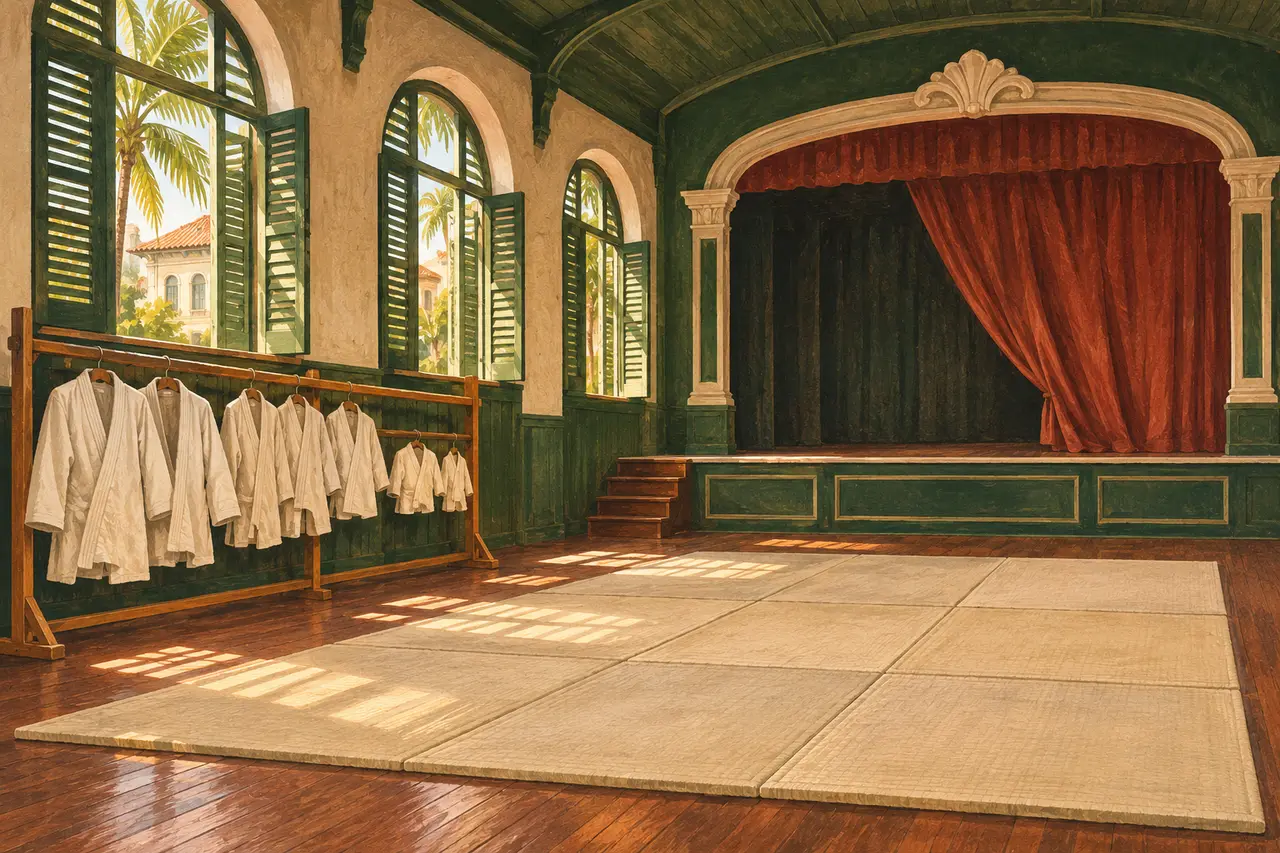
According to the historian José Cairus, Maeda’s touring troupe reached the Amazon in late 1915, and in October Belém’s Folha do Norte advertised the troupe’s jiu-jitsu, wrestling and boxing bouts on a variety bill, with the troupe directed by Count Koma. Cairus also quotes a notice from the same paper in January 1916 offering jiu-jitsu lessons at the Teatro Moderno, with gis supplied for children and adults. [5]
Japan’s National Diet Library, in a column for an online exhibition, says Maeda taught police and soldiers in Belém and took private pupils from the city’s leading families. It adds that Gastão Gracie asked him to teach his son Carlos. Gastão ran the American Circus with a partner, Cairus notes in his 2011 article. [3][5]
When the lessons began
Carlos told his own version in 1981, to the magazine Manchete, in an interview Cairus quotes in English. He remembered the Japanese performing at the Teatro da Paz, and heading afterward to Count Koma’s dojo on Rua Tamandaré, at the Teatro Moderno. He had been “physically frail and had an inferiority complex,” he said, and he learned under the master’s “paternal supervision.” In the passage Cairus quotes he gives no year, and he was speaking about 65 years later. [5]
The years come from other people. Cairus notes that Maeda returned to Belém from a season in Manaus in February 1916, and concludes that Carlos started at the Teatro Moderno school sometime that year. A history published by the Gracie Barra academy in Fribourg, Switzerland, also says 1916, with Carlos aged 14. Simon’s timeline gives 1917 as the year Carlos is believed to have begun, probably under Ferro. A study by Riqueldi Straub Lise and André Mendes Capraro dates Maeda’s decision to settle in Pará to 1917 and has him meeting Gastão Gracie in that period. [4][5][6][7]
The reason for sending him changes with the teller too. Carlos spoke of frailty. Folha de S.Paulo, profiling the family in 1995, described a rebellious teenager whose father sent him to Count Koma, and the Fribourg history says Gastão wanted a restless boy calmed and disciplined. [4][5][8]
Maeda or Ferro
Cairus describes Ferro as a local wrestler who joined Maeda’s dojo and became his chief instructor in Belém. In his estimate, Carlos studied under Maeda and Ferro for three years at most, learning an eclectic mix of judo and wrestling from a teacher who ignored the Kodokan belt system. Cairus also reports that Maeda told a Japanese settler, Hajime Otake, in 1928 that he had given no student in Brazil a black belt. [5]
Simon questions that remark. He points to an Estado do Pará report that on June 19, 1920, Maeda promoted five students to “first rank,” Ferro among them. What the rank meant is unclear, Simon writes, and Carlos is not on the list. Ferro came to jiu-jitsu, by Simon’s account, from cycling, boxing, wrestling and weightlifting. [2]
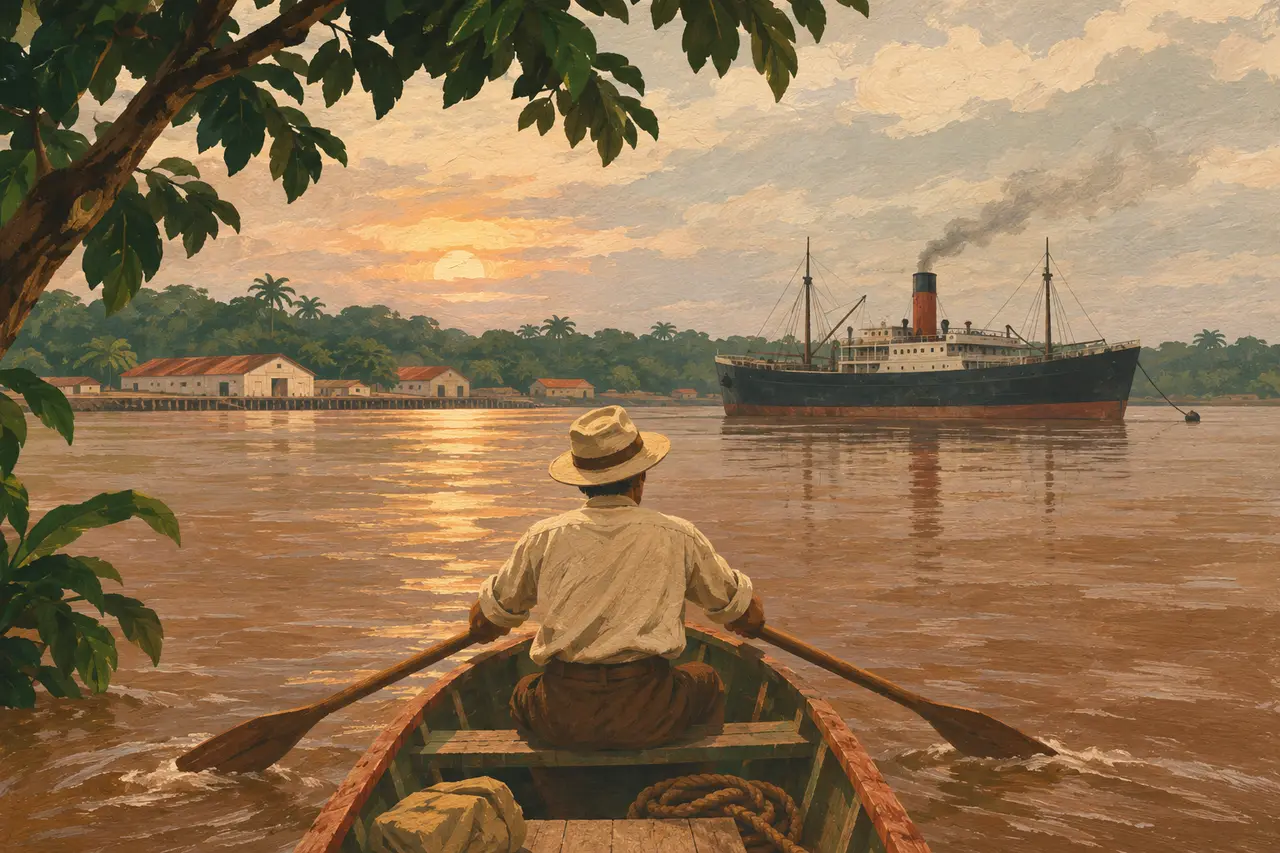
Maeda was not always in the room. The library column says he made trips to Cuba and Mexico while based in Belém, and Cairus records a journey to New York and Cuba in 1921. When Maeda came home in 1922, Ferro went out in a small boat to meet him off the harbor. [2][3][5]
From there the researchers split. Drysdale concludes that the best available evidence makes Ferro, not Maeda, Carlos’s teacher; he allows that Carlos might have had the odd lesson from Maeda, though none is documented. The writer Roberto Pedreira goes further: “There is no evidence that Carlos ever met Maeda.” Simon disagrees on that point. If Oscar was Carlos, the two were at the same event, and he thinks it safe to say they met; whether Carlos ever trained directly with Maeda he calls “impossible to prove or disprove,” while judging that most of the training was likely with Ferro. Donato Pires dos Reis, the other name on the 1921 bill, is said to have declared in an O Globo article of the period that Carlos did not even know Maeda. This comes only from Drysdale, speaking in an April 2020 online interview reported by Portal do Vale Tudo; the report does not date the article, and it has not been read here. [1][2][9][10]
When the family left
Cairus dates the end of the Gracies’ time in the Amazon to 1919–1920, citing Carlos’s own remark in the Manchete interview that the family left Belém when he was 17. The same article says the family went back to Rio after the death of Carlos’s grandfather, and Cairus’s footnote dates that death to February 1921. The article does not say how the two dates fit together. The June 1921 notice, if it means Carlos, puts him in Belém later still. [1][5]
Simon’s article on Ferro has Carlos moving to Rio two years after the 1920 promotions, and his timeline says they left shortly after the 1921 notice. Lise and Capraro also give early 1922. The library column’s note says Carlos learned from Maeda for about four years and moved to Rio in 1925. [2][3][6][7]
The length of the apprenticeship moves with the dates. Cairus says three years at most, the library column about four, Lise and Capraro a little over four, and the Fribourg history speaks of some years. Lise and Capraro cite a 2008 book about the Gracie family for their figure, rather than a record from the period. [3][4][5][7]
What the sources do not settle
Some of it stands. Carlos Gracie’s jiu-jitsu began in Belém, and every account read here ties it to Maeda’s school, directly or through Ferro. Jacyntho Ferro was a senior figure there and, by Simon’s reading, taught while Maeda traveled. Carlos’s training there ended when the family moved to Rio de Janeiro. [1][2][3][5][9]
The rest does not. No source read here fixes the year Carlos began, how long he trained, how often Maeda himself stood on the mat with him, or the year the family left. Whether “Oscar Gracie” was Carlos is a strong reading, not a certainty. What followed in Rio has its own dispute: family accounts date Carlos’s academy to 1925, at an address on Rua Marquês de Abrantes, while Rio newspapers of September 1930, as quoted by Lise and colleagues, report a school opening at that address under Donato Pires dos Reis, with Carlos among the teachers. [1][2][3][4][5][6][7][9][11][12]
Ferro died in 1929, Simon writes. Of his pupils, only two are known to have gone on to open jiu-jitsu academies of their own: Donato Pires dos Reis and Carlos Gracie. [2]
The accounts side by side
Five questions the tellers answer differently, each in the words of the story above.
| Question | Carlos, family histories and the library column | José Cairus | Josh Simon | Other researchers |
|---|---|---|---|---|
| When did the lessons begin? | Carlos gives no year in the passage Cairus quotes. The Fribourg history: 1916, with Carlos aged 14. [4][5] | Sometime in 1916, at the Teatro Moderno school, after Maeda returned from a season in Manaus in February. [5] | His timeline gives 1917 as the year Carlos is believed to have begun, probably under Ferro. [6] | Lise and Capraro give no start year for the lessons; they date Maeda’s decision to settle in Pará to 1917 and have him meeting Gastão Gracie in that period. [7] |
| Who taught Carlos? | The familiar story, as family histories and the library column’s note tell it: Maeda himself, for years. [3][4] | Maeda and Ferro, a local wrestler who joined Maeda’s dojo and became his chief instructor in Belém. [5] | Most of the training was likely with Ferro, who taught while Maeda traveled. [2][6] | Drysdale: the best available evidence makes Ferro, not Maeda, Carlos’s teacher. [1] |
| How long did the lessons last? | The library column: about four years. The Fribourg history: some years. [3][4] | Three years at most. [5] | Nothing quoted in the story | Lise and Capraro: a little over four years, citing a 2008 book about the Gracie family. [7] |
| When did the family leave Belém? | Carlos, in 1981: when he was 17. The library column’s note: he moved to Rio in 1925. [3][5] | 1919–1920, from Carlos’s remark. The same article has the family returning after his grandfather’s death, which a footnote dates to February 1921. [5] | Two years after the 1920 promotions, in his article on Ferro; shortly after the June 1921 notice, in his timeline. [2][6] | Lise and Capraro: early 1922. [7] |
| Did Carlos ever meet Maeda? | Carlos remembered heading to Count Koma’s dojo and learning under the master’s “paternal supervision.” [5] | Has Carlos studying under Maeda and Ferro. [5] | If Oscar was Carlos, the two were at the same event, and he thinks it safe to say they met. Direct training is “impossible to prove or disprove.” [2] | Pedreira: “There is no evidence that Carlos ever met Maeda.” Drysdale allows the odd lesson from Maeda, though none is documented. [1][9] |
Sources
- [1] Robert Drysdale, “Who was Oscar Gracie and who taught him Jiu-Jitsu?”, Global Training Report, 13 February 2018; Internet Archive copy of 15 February 2018 — web.archive.org. Accessed: 29 September 2026.Used for: His transcription of the Estado do Pará notice of 26 June 1921: the jiu-jitsu games at the Campo da Recreativa, Donato Pires dos Reis and “Oscar Gracie” as pupils of Jacyntho Ferro, and Conde Koma among the three referees. Also his reading of “Oscar” as most likely Carlos, the notice as the first documented link between a Gracie and jiu-jitsu, and his conclusion that the best available evidence makes Ferro, not Maeda, Carlos’s teacher.
- [2] Josh Simon, “Carlos Gracie’s Instructor, Jacyntho Ferro”, Simon BJJ / BJJHistory.org (undated page) — simonbjj.com. Accessed: 29 September 2026.Used for: The 1921 show, “Oscar” as “clearly an editorial error” and Gastão Gracie having no child of that name, the five students promoted to “first rank” in June 1920 without Carlos, Ferro’s path from cycling, boxing, wrestling and weightlifting, Ferro teaching while Maeda was away and taking a small boat out to meet him in 1922, the view that Carlos and Maeda met but that direct training is “impossible to prove or disprove,” the move to Rio two years after the promotions, Ferro’s death in 1929 and his two pupils who opened academies.
- [3] National Diet Library (Japan), column “Undefeated Conde Koma who challenged the Amazon”, online exhibition 100 Years of Japanese Emigration to Brasil — ndl.go.jp. Accessed: 11 October 2026.Used for: Conde Koma as Maeda’s ring name, his teaching of police, soldiers and private pupils from leading families in Belém, Gastão Gracie asking him to teach Carlos, his trips to Cuba and Mexico, and the note that Carlos learned from Maeda for about four years and moved to Rio in 1925.
- [4] Gracie Barra Fribourg, “L’héritage” — gbfribourg.ch. Accessed: 10 November 2026.Used for: The academy’s family history: Carlos introduced to jiu-jitsu in 1916 at 14, a restless boy his father wanted calmed and disciplined, some years of training, and a school on Rua Marquês de Abrantes dated to 1925.
- [5] José Cairus, “Modernization, nationalism and the elite: the Genesis of Brazilian jiu-jitsu, 1905-1920”, Revista Tempo e Argumento (Universidade do Estado de Santa Catarina), 2011; full text via Redalyc — redalyc.org. Accessed: 10 November 2026.Used for: The troupe’s arrival in late 1915 and the Folha do Norte notices of October 1915 and January 1916, Gastão’s American Circus, Carlos’s 1981 Manchete interview in English, with his remark that the family left when he was 17, Maeda’s return from Manaus and a start in 1916, Ferro as a local wrestler and chief instructor, three years at most of eclectic training, the belt system and the 1928 remark to Hajime Otake, the 1921 journey to New York and Cuba, Ferro’s boat in 1922, and the departure dated 1919–1920 beside a grandfather’s death in February 1921.
- [6] Simon BJJ, “BJJ History Timeline” — simonbjj.com. Accessed: 17 November 2026.Used for: 1917 as the year Carlos is believed to have begun, likely under Ferro, and the move to Rio shortly after the 1921 notice.
- [7] Riqueldi Straub Lise and André Mendes Capraro, “Primórdios do jiu-jitsu e dos confrontos intermodalidades no Brasil: contestando uma memória consolidada”, Revista Brasileira de Ciências do Esporte 40(3), 318–324, September 2018 — scielo.br. Accessed: 11 October 2026.Used for: Maeda settling in Pará in 1917 and meeting Gastão Gracie in that period, a little over four years of training with a 2008 book about the Gracie family as the reference, and the family’s move in early 1922.
- [8] Mário Magalhães, Folha de S.Paulo, 21 May 1995 — folha.uol.com.br. Accessed: 10 November 2026.Used for: The profile’s rebellious teenager whose father sent him to Count Koma.
- [9] Roberto Pedreira, “Top 20 Myths About Mitsuyo Maeda”, Sonny Brown reprint — sonnybrown.net. Accessed: 10 November 2026.Used for: The view that Carlos learned from Ferro rather than Maeda, and the line “There is no evidence that Carlos ever met Maeda.”
- [10] Portal do Vale Tudo, “Robert Drysdale levanta polêmicas sobre a origem do Jiu-Jitsu no Brasil e relembra principais conquistas da carreira”, 24 April 2020 — portaldovaletudo.com.br. Accessed: 29 September 2026.Used for: Drysdale, in an online interview, on an O Globo article of the period in which Donato Pires dos Reis is said to have declared that Carlos did not even know Maeda; the report gives no date for the article, which has not been read here.
- [11] Gracie University, timeline — gracieuniversity.com. Accessed: 18 October 2026.Used for: The family account that dates Carlos’s academy in Rio to 1925.
- [12] Riqueldi Straub Lise, Natasha Santos, Fernando Renato Cavichiolli and André Mendes Capraro, “A biografia escrita por Reila Gracie e as fontes jornalísticas: revisando a história hegemônica”, Movimento (UFRGS), vol. 23, no. 4, 2017, pp. 1149–1160 — seer.ufrgs.br. Accessed: 29 September 2026.Used for: Reila Gracie’s biography dating the first academy to 1925 at Rua Marquês de Abrantes, and the Rio newspapers of September 1930 reporting a school opening at that address under Donato Pires dos Reis, with Carlos among the teachers.