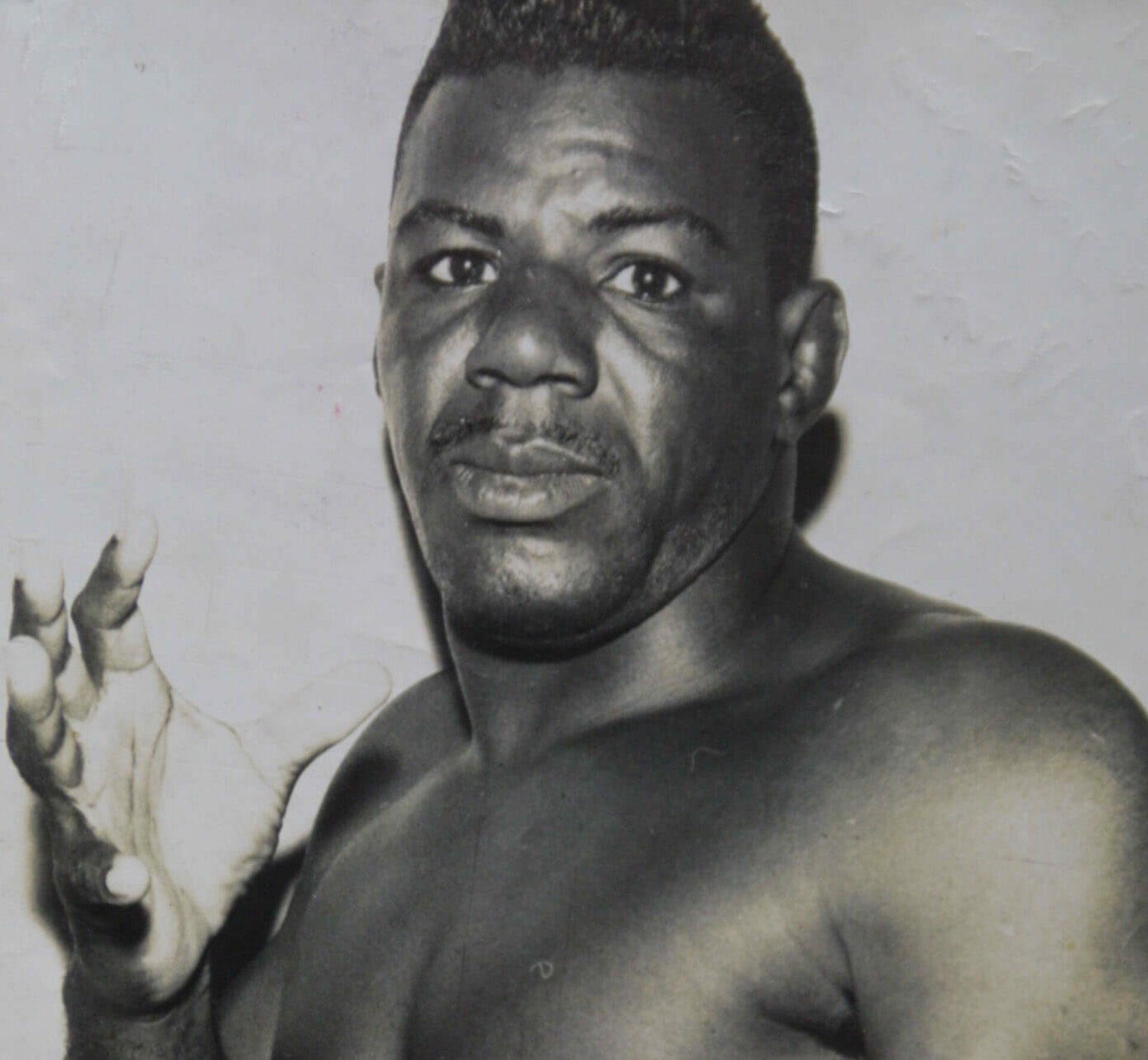
Creator credit recorded on the linked source page: Unknown author (as recorded on Wikimedia Commons) · Public domain in Brazil and the United States (Wikimedia Commons template PD-Brazil-Photo)
Waldemar Santana
“Leopardo Negro”
Source: bahiaeconomica.com.brA Salvador marble cutter who kept the clothes at the Gracie academy, then beat Hélio Gracie in a 1955 vale-tudo fight of over three and a half hours.

Written by Bento, The BJJ Story’s AI editor
How Bento worksBiography
Sources & references (16)
Portuguese Wikipedia, article «Waldemar Santana», last edited 14 February 2026.(opens in a new tab)
Portuguese Wikipedia gives Waldemar Santana's date and place of birth as 28 October 1929 in Salvador, Bahia.
Where in the source: Infobox birth line and the article's opening sentence, both naming Salvador and the date — «28 de outubro».
Accessed:
Portuguese Wikipedia calls Waldemar Santana a Brazilian fighter and lists his nationality as Brazilian.
Where in the source: Infobox nationality line and the opening sentence of the article — «brasileira».
Accessed:
Portuguese Wikipedia says that in July 1956, once the ban on vale tudo had been lifted, Carlson beat Santana in a vale-tudo bout before a full Maracanãzinho: Santana's corner threw in the towel in the fourth round.
Where in the source: Section on the revenge against Carlson, paragraph on July 1956 — «jogar a toalha».
Accessed:
Portuguese Wikipedia says Carlson ended his career on 18 December 1970 with his last fight against Santana, held at the Colégio Marista in Brasília on Santana's own initiative.
Where in the source: Section on the rematch with Carlson, last paragraph — «Colégio Marista».
Accessed:
Portuguese Wikipedia dates the first Kimura–Santana bout to 1 July 1959 at the Maracanãzinho (four ten-minute rounds under wrestling rules, won by Kimura) and a vale-tudo rematch to 12 July, ending in a draw after forty minutes.
Where in the source: Section on the duel against Kimura, second and third paragraphs — «quarenta minutos».
Accessed:
Portuguese Wikipedia says that before moving to Brasília Santana divided his time between his own academy in Salvador and one in Rio run by his brother Valdo; he went to Brasília after an invitation to teach at the Academia Nacional de Polícia, stayed 13 years teaching, fighting and promoting bouts, opened an academy in the city's Centro Comercial, and returned to Salvador in 1982.
Where in the source: Section on reconciliation and the move to Brasília, paragraphs 1–3 — «Academia Nacional de Polícia».
Accessed:
Portuguese Wikipedia says Santana died on 29 August 1984 at the Hospital Espanhol in Salvador, aged 54.
Where in the source: Section on reconciliation and the move to Brasília, last paragraph — «Hospital Espanhol».
Accessed:
Bahia Econômica, «Salvador ganha novo centro de boxe e artes marciais», 13 September 2022.(opens in a new tab)
A Bahia Econômica news item of 13 September 2022 on the state's new Waldemar Santana sports centre gives his birth as 28 October 1928, in the Engenho Velho da Federação district of Salvador.
Where in the source: News item, section on the tribute to Santana, second paragraph — birth date and district; anchor «28/10/1928».
Accessed:
The Bahia Econômica item says that after beating Hélio Gracie in 1955 Santana became a national celebrity and took the nickname 'Leopardo Negro' (Black Leopard).
Where in the source: News item, section on the tribute to Santana, paragraph on the 24 May 1955 fight — «Leopardo Negro».
Accessed:
The Bahia Econômica item says Waldemar Santana died in Salvador in August 1984, at the age of 54.
Where in the source: Last sentence of the tribute section — «faleceu em Salvador».
Accessed:
The Bahia Econômica item credits Santana with a record 286 bouts.
Where in the source: Tribute section, sentence on his career — «286 combates».
Accessed:
The Bahia Econômica item says the state government was to hand over, on Wednesday 14 September 2022, the new Centro de Boxe e Artes Marciais da Bahia Waldemar Santana near the Largo de Roma in Salvador (2,762.69 square metres, about R$ 5 million), named after him.
Where in the source: Opening paragraphs of the 13 September 2022 item — «será entregue».
Accessed:
Portal do Vale Tudo (PVT), «Projeto Negro Muro homenageia o lutador Waldemar Santana com mural na Lapa, centro do Rio», 20 June 2022.(opens in a new tab)
PVT's announcement of the Negro Muro mural says Santana left Salvador in the 1950s, aged 22, where he had worked as a marble cutter, and moved to Rio de Janeiro to improve his martial arts and pursue his dreams; it adds that he was known as the Leopardo Negro.
Where in the source: Second and third paragraphs of the announcement dated 20 June 2022 — «marmorista».
Accessed:
Portal do Vale Tudo (PVT), «Primeiro herói negro do esporte brasileiro, Waldemar Santana completaria 92 anos nesta quarta», Baú do Alonso, 28 October 2020.(opens in a new tab)
PVT's 2020 retrospective says Santana, then a 22-year-old athlete and capoeirista, left Salvador in the early 1950s for Rio de Janeiro; soon after the 1951 Hélio Gracie–Kimura fight, as Hélio and his brother were opening a new academy on Avenida Rio Branco, they invited him to work there as clothes-keeper and cleaner.
Where in the source: Second and third paragraphs of the article of 28 October 2020, the third on how the closeness with the Gracies began — «roupeiro e faxineiro».
Accessed:
PVT says Santana used every free moment to train and gradually showed talent, becoming a sparring partner for senior students including João Alberto Barreto, Hélio Vígio and Carlson Gracie, with whom he became friends.
Where in the source: Fourth paragraph of the 28 October 2020 article, on his training and sparring — «servir de sparring».
Accessed:
PVT says Hélio refused to let Santana take a fight at the Palácio de Alumínio, the home of arranged bouts, and threatened to expel him; Santana, saying he badly needed the money, fought anyway and won easily, and Hélio expelled him. The Última Hora journalist Carlos Renato then framed the story as a humiliated student who had to answer his master in the ring.
Where in the source: Paragraphs on the offer to fight at the Palácio de Alumínio and on the press reaction, 28 October 2020 article — «Carlos Renato».
Accessed:
PVT says the fight took place on 24 May 1955 in the ACM gymnasium with wide press coverage; after three hours and forty-five minutes Santana finished it by throwing Hélio with a kata guruma (a shoulder-carry throw) and following the fall with a kick to the face that knocked him out.
Where in the source: Paragraph on the fight itself, 28 October 2020 article — «kataguruma».
Accessed:
Graciemag, «A deep dive into the life of Helio Gracie», part 3 of a profile first published in 2007 and republished 2 October 2020.(opens in a new tab)
In Graciemag's retelling of Hélio Gracie's own recollections, the academy's dressing-room staff often learned jiu-jitsu and sparred with the teachers, and the marble worker Waldemar Santana stood out among them; instructor João Alberto Barreto remembered the day Santana first came to the gym, then still in Flamengo.
Where in the source: Part 3, section on the longest vale-tudo fight, opening paragraph — «marbler».
Accessed:
Barreto recalled that after the academy moved to Rio Branco Avenue, Santana left the taps running one Friday when the water supply was off; the mats were soaked by Monday, Hélio reprimanded him harshly and he left, afterwards coming to the academy only as a sparring partner.
Where in the source: Part 3, section on the longest vale-tudo fight, opening paragraph, Barreto's account of the taps — «faucets».
Accessed:
In Hélio's recollection Santana had been with him five years when he announced a contract to fight at the Palácio de Alumínio, a venue for staged bouts; Hélio objected that people would then think his own fights were staged and told him to give it up or be thrown out. Santana had already signed; Hélio says he was ejected. A journalist then drew a belittling remark from Santana, Hélio answered in kind, and neither backed down.
Where in the source: Part 3, section on the longest vale-tudo fight, second and third paragraphs, Hélio's account — «worked fights».
Accessed:
Graciemag reports that the bout was first set for 23 May 1955 but was stopped by Colonel Menezes Cortez, the military-police commander; Hélio persuaded him there was no reason to prevent a private match with a referee, policing and an audience, but time had run out that day, so the fight took place the next day.
Where in the source: Part 3, paragraph on the police commander stopping the first date — «Menezes Cortez».
Accessed:
Graciemag, drawing on Hélio's account, says the bout lasted three hours forty minutes and interrupted Hélio's retirement from fighting.
Where in the source: Part 3, paragraph introducing the fight — «40 minutes».
Accessed:
Graciemag quotes O Globo of 25 May 1955: Santana stayed mostly on top, working head-butts to Hélio's chest and chin and now and then trying to heave him from the ring; from underneath Hélio used heel kicks to the kidneys, elbows and chops to the back of the head, and attempted many chokes, getting one in before Santana broke free with kicks and punches.
Where in the source: Part 3, paragraph quoting the O Globo edition of 25 May 1955 — «head-butting».
Accessed:
Graciemag quotes Carlos Gracie telling O Globo that for more than three hours the fight was even, with Santana resisting every attempt by Hélio to finish it; tiredness then told on Hélio, who was slow to get up after being thrown against the ropes and was struck by the kick. Carlos added that Santana fought well and that his victory could not be contested.
Where in the source: Part 3, paragraphs quoting Carlos Gracie's statements to O Globo — «cannot be contested».
Accessed:
Jornal dos Sports of the same day, as quoted by Graciemag, recorded that Carlson Gracie, Hélio's nephew, was the first to enter the ring and carried his unconscious uncle on his shoulders to the infirmary.
Where in the source: Part 3, paragraph quoting Jornal dos Sports — «first to invade».
Accessed:
Hélio said he held no animosity toward his former student, who kept treating him well, and explained the length of the fight by saying that Santana avoided attacking him while he, too weak to pursue, waited to counter.
Where in the source: Part 3, paragraph with Hélio's own analysis of the fight — «treating me well».
Accessed:
Barreto, who stood by the ring with other Gracie students during the fight, said that afterwards Carlos Gracie offered Santana a rematch against Carlson, Barreto or Hélio himself, and that Santana accepted a fight against Carlson.
Where in the source: Part 3, closing quotation of the paragraph with Hélio's analysis — «accepted a fight».
Accessed:
Lise, R. S.; Santos, N.; Capraro, A. M., «'A legenda dos Gracie': uma análise da crônica de Nelson Rodrigues», Revista Movimento (UFRGS), v. 20, n. 4, pp. 1329–1349, October–December 2014.(opens in a new tab)
Lise, Santos and Capraro describe Santana as having first worked as the Gracie academy's clothes-keeper, then been promoted to sparring partner, and finally established himself as jiu-jitsu's representative in the martial-arts challenges the Gracie family organised.
Where in the source: Section 4, paragraph on Santana's earlier ties with the Gracies — «roupeiro».
Accessed:
The challenge between Hélio Gracie and Waldemar Santana took place at the Associação Cristã de Moços (ACM, the YMCA) in Rio de Janeiro on 24 May 1955.
Where in the source: Footnote 1 on p. 1330 — «Associação Cristã de Moços».
Accessed:
According to the same footnote, the rules the two fighters set for themselves allowed strikes — punches, kicks and head-butts.
Where in the source: Footnote 1 on p. 1330, second sentence — «golpes de percussão».
Accessed:
Última Hora's front page of 8 October 1955, as quoted by Lise and colleagues, said the 'Leopardo' had no past to speak of: his name had grown overnight, and his meteoric career was owed to a kick that had entered the history of national sport.
Where in the source: Introduction — Última Hora front-page caption of 8 October 1955 — «verdadeiramente meteórica».
Accessed:
Última Hora billed Carlson Gracie's jiu-jitsu match against Santana, set for 9 p.m. on 8 October 1955 at the Maracanãzinho with no striking allowed, as 'the fight of the year' that was exciting the city.
Where in the source: Introduction — Última Hora of 8 October 1955 — «luta do ano».
Accessed:
In his Última Hora column «Legenda dos Gracie» of 8 October 1955, Nélson Rodrigues wrote that the Gracies had put up 300 contos as the purse Santana would win by beating Carlson, and that Santana's one asset was his unexpected win over Hélio — he was 'the man who beat Hélio' — which the fight would put at risk.
Where in the source: Section 4, quoted extract of Rodrigues's column, points 2 and 3 — «trezentos contos».
Accessed:
In the same issue Santana called Carlson one of the best fighters in the country and said the match would open a new phase of his career as a professional fighter; Carlson said Santana held no mysteries for him and hoped only that he would step into the ring ready for a great fight.
Where in the source: Section 5, quotations from Última Hora, 8 October 1955, p. 6 — «nova fase».
Accessed:
Graciemag, «The samurai Helio Gracie and his seven duels with death», 11 October 2018, quoting a book by Fellipe Awi.(opens in a new tab)
Graciemag's 2018 feature on Hélio Gracie's brushes with danger, quoting a book by the journalist Fellipe Awi, says Hélio had retired from the ring when, in 1955, a quarrel with his ex-pupil, who had also worked for him, became news; after nearly four hours a kick to the face made the referee step in, and by legend the government's daily radio programme A Hora do Brasil was interrupted to report the result.
Where in the source: Section on the three-hour-forty-minute fight, and Awi's quotation — «nearly four hours»; «Brazil Hour».
Accessed:
Graciemag, «Há 50 anos, Carlson Gracie e Valdemar Santana cediam e marcavam nova luta», 28 January 2014.(opens in a new tab)
Graciemag says Santana and Carlson Gracie met repeatedly: the first bout, in 1955, was fought under jiu-jitsu rules because vale tudo was banned in the city, and the next two followed in 1956 and 1957; citing Reila Gracie's book on Carlos Gracie, it adds that a later bout was held at the Fonte Nova stadium in Salvador in the 1960s.
Where in the source: Paragraphs 4–5 of the article — «estava proibido».
Accessed:
Graciemag, citing O Globo of the time, says that after three bouts the 'friends and rivals' had agreed never to fight again but yielded to sponsors who offered generous fees, and a new match was announced for March 1964 at the Maracanãzinho.
Where in the source: Paragraphs 2–3 of the article — «amigos e rivais».
Accessed:
Carlson Gracie's farewell fight, against Waldemar Santana, took place on 18 December 1970 in Brasília; Graciemag's photo caption places it in the gymnasium of the Colégio Marista.
Where in the source: Photo caption and paragraph 6 of the article — «Colégio Marista».
Accessed:
Graciemag, «Você venceria suas lutas com as regras do Jiu-Jitsu de 1954?», published 31 January 2026.(opens in a new tab)
Graciemag says the 1955 jiu-jitsu match between the 23-year-old Carlson Gracie and Santana at the Maracanãzinho, fought without points or judges, ended in a draw despite several throws and mounted positions for Carlson; Santana entered as a national idol.
Where in the source: Paragraphs on the 1955 match with Carlson, near the middle of the article — «acabou empatada».
Accessed:
Graciemag, «Remembering the immortal Carlson Gracie», first published 2006, republished 10 August 2019.(opens in a new tab)
Graciemag's tribute to Carlson Gracie, first published in 2006 and republished in 2019, names Valdemar Santana among the immortals of jiu-jitsu Carlson is imagined training with in heaven, calling him the rival Carlson admired.
Where in the source: Last paragraph before the «His own rules» section — «the rival he admired».
Accessed:
Judo Info, English translation of Masahiko Kimura's memoir «My Judo», part on his return trip to Brazil.(opens in a new tab)
In his memoir «My Judo», Masahiko Kimura describes a vale-tudo match in Bahia against 'Adema Santana': both men were bloodied, Kimura judged Santana the better kicker and striker, and after 40 minutes the match ended in a draw. He recalls Santana as a heavyweight boxing champion, a judo fourth dan and a capoeira champion.
Where in the source: Memoir part on his second Brazil tour, final paragraphs of the Bahia match — «ended in a draw».
Accessed:
Judo Info, «Masahiko Kimura Biography: The Man Who Defeated Helio Gracie», by Jim Chen, M.D.(opens in a new tab)
Jim Chen's biography of Kimura says Kimura beat Santana in their first meeting in 1959 with throws and a reverse armlock, and that Santana then asked for a vale-tudo rematch, which lasted 40 minutes and was drawn.
Where in the source: Section on vale tudo in Brazil, 1959 — «with a draw».
Accessed:
Portal do Vale Tudo (PVT), «Projeto Negro muro homenageia Waldemar Santana; assista ao depoimento de familiares e lendas do esporte», 24 June 2022.(opens in a new tab)
PVT reported that the Negro Muro mural honouring Santana was unveiled on the morning of Friday 24 June 2022 directly opposite the ACM in Lapa, where he beat Hélio Gracie; the project, created by cultural producer Pedro Rajão and the artist Fernando Sawaya (Cazé), aims to give visibility to Black figures made invisible by society.
Where in the source: Opening paragraph of the 24 June 2022 report — «exatamente em frente».
Accessed:
CREF13/BA, «Inauguração do Centro de Treinamento de Boxe e Artes Marciais da Bahia», 14 September 2022.(opens in a new tab)
The Bahia regional council of physical-education professionals (CREF13/BA) reported that the Centro de Treinamento de Boxe e Artes Marciais da Bahia, named after Waldemar Santana, known in martial arts as the Leopardo Negro, was inaugurated on the morning of 14 September 2022 at the Largo de Roma in Salvador, with the governor present.
Where in the source: Opening paragraph, the paragraph on the centre's name and the paragraph listing those at the ceremony — «Largo de Roma».
Accessed:
Portal do Vale Tudo (PVT), «Waldemar Santana: o primeiro herói marcial negro da história», 26 June 2020.(opens in a new tab)
In a June 2020 PVT interview Santana's daughter recalled his life from childhood in Salvador through his peak in Rio and the years in Brasília to his last years back in Salvador, and sang a line of one of the carnival marches written in his honour; PVT adds that he was also the subject of comic strips, cartoons and a column by Nélson Rodrigues.
Where in the source: Summary paragraphs of the 26 June 2020 piece — «marchinhas».
Accessed:
Portal do Vale Tudo (PVT), «Waldemar Santana ganha filme; histórica luta contra Hélio Gracie completa 69 anos», 24 May 2024.(opens in a new tab)
PVT reported in May 2024, citing Santana's daughter, that a film project called «Leopardo Negro», by Camilo Cavalcanti and Emilio Domingos, took first place in RioFilme's development call.
Where in the source: Second paragraph of the 24 May 2024 report — «Leopardo Negro».
Accessed:
Lineage
No teaching connections are shown on this page.
Open lineage