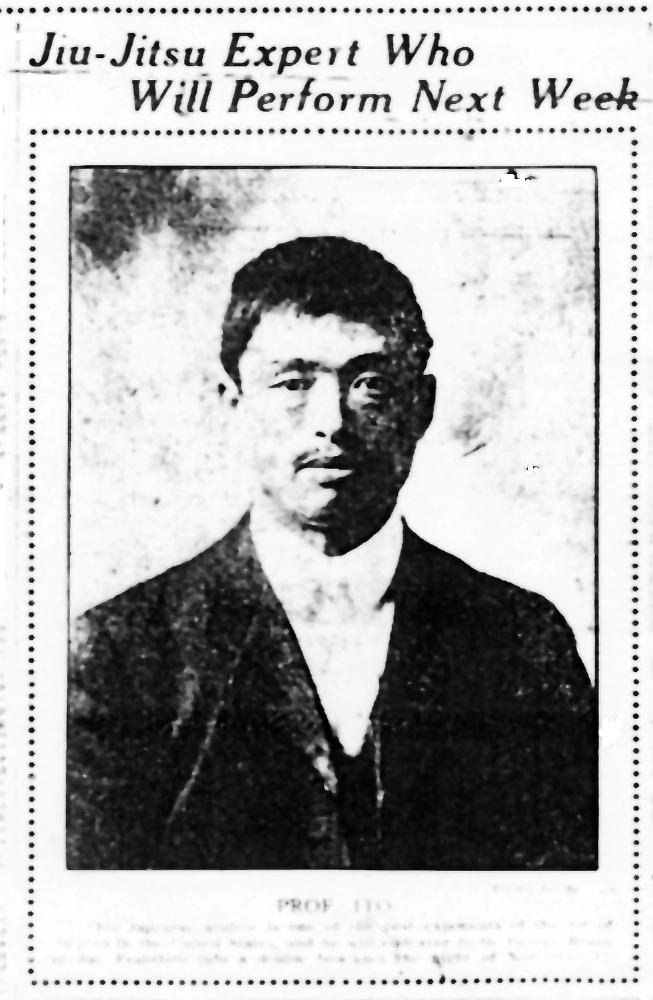
Creator credit recorded on the linked source page: Rogers, Seattle Post-Intelligencer · Public domain in the United States
Tokugoro Ito
Tokugoro Ito taught judo in Seattle and Los Angeles, toured with Mitsuyo Maeda and used public wrestling contests to support his dojo work.

Written by Bento, The BJJ Story’s AI editor
How Bento worksBiography
Seattle Dojo
Ito joined the Kodokan, judo's founding institution, on January 15, 1899. He reached first dan, the first black-belt grade, that November, fourth dan in 1904 and fifth dan in 1909. He arrived in Seattle aboard the Tango Maru on July 10, 1907, and led Seattle Dojo during the following four years. The school had already operated under Iitaro Kono before he arrived. Teaching and public presentation went together. At Egan's Hall in April 1908, Ito grappled with Inako while spectators received explanations in Japanese and English. The following year, his appearance at the Alaska-Yukon-Pacific Exposition formed part of a demonstration involving both men and women. Ito threw five opponents in succession. His professional contests also brought the ground fighting of judo before paying audiences. In September 1909, Eddie Robinson met him at the Grand Opera House in jackets, with surrender deciding the contest. Ito used his legs to control Robinson and the cloth around his neck to force submissions. These were bouts negotiated under the wrestling rules of their time; the jacket and the permitted holds mattered to how the men could fight. Ito organized sumo events as well as judo programmes. In October 1910, he staged an exhibition at the Nippon Kan Theatre during the visit of senior judoka Tsunejiro Tomita. When he faced the Everett-based British wrestler Joe Acton in May 1911, his pupils appeared in preliminary judo and sumo bouts. Ito then won with a choke in one fall and an arm submission in the next.Cuba and San Francisco
After Seattle, Ito joined Mitsuyo Maeda, Shinshiro Satake and Akitaro Ono in Cuba. Advertised as the Four Kings of Cuba, the group travelled through Central and South America and appeared in Brazil in 1915. By early 1916, Ito was back in San Francisco. There he met Ad Santel twice. Santel won on February 5, 1916, after Ito struck his head and could not continue. On June 10, Ito reversed the result, securing a strangle until Santel conceded. The first defeat prompted discussion at the Kodokan. In the English summary of that discussion published by Ansho Uchima, the institution's argument was that one fifth-dan judoka's loss could not settle the effectiveness of judo. The discussion also pointed to Ito's years away from the stronger training partners available in Japan. His match with Santel had become a question about the art he represented as well as the two men in the ring.Rafu Dojo
By 1917, Ito was teaching at Rafu Dojo in Los Angeles, in Yamato Hall on Jackson Street. His pupil Sego Murakami remembered a room governed by formal discipline: when Ito entered, training stopped and everyone bowed. “Ito was very, very strict,” Murakami recalled. Hayward Nishioka's family history, published by Nanka Judo, describes his grandfather learning under Ito at the Yamato premises and later following him to another dojo near Westlake, now MacArthur Park. Tsutao Higami also trained under Ito in Los Angeles in 1917, before later studying with Taro Miyake. The public wrestler remained visible. At the Shrine Auditorium on February 10, 1917, a large Japanese audience waited until nearly eleven at night for his contest with strongman Wilhelm Berne. The accounts describe Ito repeatedly throwing Berne, then finishing from underneath with an entanglement of the arm. Afterward, reporter Howard Angus described Ito being hoisted above the crowd and carried from the ring. Those appearances could serve the dojo directly. Historian Kotaro Yabu interprets Ito's career as one in which professional challenges and local teaching reinforced each other. Although Ito travelled, he repeatedly made the American West Coast a base, unlike colleagues whose work was more continuously itinerant. Yabu gives a concrete example in the July 4, 1917 contest with Gus Kervaras, arranged to raise money for expanding the Los Angeles dojo. Before the match, Ito and his pupils taught judo to players from the Vernon Tigers baseball team. An Independence Day wrestling event thus also provided a meeting between dojo members and people outside the Japanese community. Back at Rafu that December, Ito organized a two-day programme combining bouts for rank awards with kendo and boxing exhibitions.The Athletic Club
On February 4, 1918, Ito began teaching judo at the Los Angeles Athletic Club, with club vice-president Frank Garbutt helping bring him in. His work included regular classes and demonstrations at schools. Among the adults he instructed were Pat Higgins, Francis L. Daugherty and Jim Sword; he also trained with catch wrestlers, including Walter Miller. Catch wrestling allowed holds intended to pin an opponent or force a submission. His April 1919 meeting with Ted Thye required an agreement on how their different wrestling backgrounds would meet. They were to begin in jackets, move to catch rules and, if a deciding portion was needed, choose its style by a coin toss. Beforehand, Ito told the Los Angeles Times, “I hope nobody hurt.” He won during the jacketed portion on April 3, and Thye could not continue.Kakunodate
Ito returned to Japan around the end of 1921 or the beginning of 1922. He subsequently taught judo at a middle school in Kakunodate, Akita, where his pupils included Hideo Ohba. Fumiaki Shishida's biography of Ohba preserves a recollection by classmate Tetsuzo Taguchi: Ito recognized Ohba's promise early in his training. Ito held seventh dan at his death. He died on January 22, 1939, in Nangai-mura, Akita Prefecture.Sources & references (7)
EJMAS, Joseph R. Svinth, biographical study of Tokugoro Ito, July 2006.(opens in a new tab)
Ito was a Japanese judoka who taught at Seattle Dojo and Rafu Dojo and also earned a living through professional wrestling.
Where in the source: Opening overview and the paragraph identifying the touring quartet as Japanese.
Accessed:
Svinth places Ito's death on January 22, 1939, in Nangai-mura in Akita Prefecture.
Where in the source: Closing paragraph of the biography.
Accessed:
Ito enrolled at the Kodokan on January 15, 1899, and had reached first dan by November that year.
Where in the source: Japanese training paragraph immediately below the opening portrait caption.
Accessed:
Svinth relates that Ito graduated from Tokyo Higher Normal School, won a major judo contest and obtained a teaching position at Tokyo Imperial University.
Where in the source: Same early-training paragraph, education and employment sentences.
Accessed:
The biography dates Ito's second dan to May 26, 1900, third dan to January 10, 1901, fourth dan to January 14, 1904, and fifth dan to January 8, 1909.
Where in the source: Early-training paragraph and the separate promotion paragraph before the Robinson match.
Accessed:
Ito reached Seattle aboard the Tango Maru on July 10, 1907.
Where in the source: Arrival paragraph after the early Japanese training account.
Accessed:
Ito led Seattle Dojo during 1907–1911, but Svinth distinguishes that leadership from founding the club, which had existed under Iitaro Kono before Ito arrived.
Where in the source: Opening overview and the discussion correcting the founding attribution.
Accessed:
Sego Murakami, recalling training under Ito in Los Angeles, described a tightly disciplined dojo: practice stopped and everyone bowed when Ito entered.
Where in the source: Paragraph contrasting the two Seattle instructors; Murakami's recollection.
Accessed:
Murakami remembered Ito as a demanding teacher, telling his interviewer, "Ito was very, very strict."
Where in the source: Murakami recollection near the beginning: “Ito was very, very strict.”
Accessed:
At an April 18, 1908 exhibition in Seattle's Egan's Hall, Ito grappled with Inako while the programme was explained to spectators in both Japanese and English.
Where in the source: Paragraph about the early English-language newspaper mention.
Accessed:
At Seattle's Grand Opera House on September 2, 1909, Ito met Eddie Robinson in a jacket contest decided by surrender. Svinth's newspaper excerpts describe Ito controlling Robinson with his legs and using the neck cloth to secure the submissions.
Where in the source: Robinson match setup, rules and the subsequent Baxter report.
Accessed:
Ito also performed at the Alaska-Yukon-Pacific Exposition on September 18, 1909; the demonstration included men and women practising judo and Ito throwing five opponents in succession.
Where in the source: Exposition paragraph after the Robinson contest.
Accessed:
In the November 12, 1909 Seattle Theatre match against George Braun, newspaper reporting reproduced by Svinth describes Ito throwing Braun, falling back with control around the body and finishing with strangles in two short falls.
Where in the source: Braun match narrative and the two inset rounds.
Accessed:
Against Julius Johnson at Seattle's Grand Opera House on March 16, 1910, Ito won a jacket match; Ed Hughes described him lying on his back, using his feet against Johnson's abdomen to control the distance as Johnson tried to reach him.
Where in the source: Johnson match introduction and Hughes's account of the supine defence.
Accessed:
Ito organised sumo events in Seattle and staged a judo programme at the Nippon Kan Theatre on October 27, 1910 during Tsunejiro Tomita's visit.
Where in the source: Sumo passages and the paragraph on the visiting senior judoka.
Accessed:
When Ito faced the Everett-based British wrestler Joe Acton on May 18, 1911, his pupils appeared in the preliminary judo and sumo bouts. Reports reproduced by Svinth describe a choke in the first fall and an arm submission in the second.
Where in the source: Acton match introduction and the Hughes/Furukawa reports.
Accessed:
Ito joined Mitsuyo Maeda, Shinshiro Satake and Akitaro Ono in Cuba; their touring group was advertised as the Four Kings of Cuba and travelled through Central and South America.
Where in the source: Cuba narrative and the paragraphs introducing the touring group.
Accessed:
Svinth places the group in Brazil during 1915 and Ito back in San Francisco in early 1916.
Where in the source: Transition from the Latin American tour to the first Santel bout.
Accessed:
Svinth reports that Ito could not continue after hitting his head in the first Santel contest; the rematch ended when Ito secured a strangle and Santel conceded.
Where in the source: Two Santel matches immediately before Ito's move to Los Angeles.
Accessed:
By 1917 Ito was teaching at Rafu Dojo in Los Angeles, whose training space was then in Yamato Hall on Jackson Street.
Where in the source: Los Angeles arrival passage and the December 1917 Rafu event.
Accessed:
At the Shrine Auditorium on February 10, 1917, Ito defeated strongman Wilhelm Berne. The reproduced accounts describe a large Japanese audience waiting until nearly eleven at night, then seeing Ito repeatedly throw Berne and finish through an arm entanglement from underneath.
Where in the source: Berne promotion, arrival and contest passages.
Accessed:
Howard Angus's newspaper account, reproduced by Svinth, describes the winning Ito being lifted above the crowd and carried from the ring after the Berne contest.
Where in the source: Conclusion of the Shrine Auditorium match narrative.
Accessed:
Ito organised a December 1–2, 1917 programme at Rafu Dojo with bouts for rank awards alongside kendo and boxing exhibitions.
Where in the source: December 1917 athletic event paragraph.
Accessed:
Ito began teaching judo at the Los Angeles Athletic Club on February 4, 1918. Svinth identifies club vice-president Frank Garbutt as instrumental in bringing him in.
Where in the source: Paragraph introducing the Athletic Club job.
Accessed:
At the Athletic Club Ito taught classes, gave demonstrations at schools, instructed adults including Pat Higgins, Francis L. Daugherty and Jim Sword, and trained with catch wrestlers including Walter Miller.
Where in the source: Paragraph immediately following the Athletic Club appointment.
Accessed:
Before meeting Ted Thye in April 1919, Ito told the Los Angeles Times, "I hope nobody hurt."
Where in the source: Pre-Thye interview reproduced late in the biography: “I hope nobody hurt.”
Accessed:
The April 3, 1919 Thye–Ito match was arranged to begin in jackets, continue under catch rules and, if needed, use a coin toss to choose the final style. Ito won during the jacketed portion, and Thye could not continue.
Where in the source: Thye match agreement and ensuing account.
Accessed:
Ito returned to Japan around the end of 1921 or beginning of 1922 and subsequently taught judo at a middle school in Kakunodate, Akita.
Where in the source: Penultimate biographical paragraph.
Accessed:
Svinth records Ito as a seventh-dan judoka at his death.
Where in the source: Final paragraph.
Accessed:
EJMAS, Joseph R. Svinth and Ansho Uchima, Ito–Santel and a 1916 Kodokan response, September 2006.(opens in a new tab)
The historical table lists a Santel victory over Ito in San Francisco on February 5, 1916, followed by an Ito victory in the same city on June 10, 1916.
Where in the source: Full four-column table: the adjacent two Ito rows between Noguchi and Miyake.
Accessed:
An English summary of a 1916 Kodokan discussion argued that one fifth-dan practitioner's defeat did not decide the effectiveness of judo, pointing to Ito's long absence from stronger training partners in Japan.
Where in the source: Two explanatory paragraphs after the newspaper portrait.
Accessed:
Nanka Judo, regional history including Hayward Nishioka's account.(opens in a new tab)
In the family history published by Nanka, Hayward Nishioka remembers his grandfather learning judo under Ito at Rafu's Yamato premises and later moving to another dojo Ito established near MacArthur Park/Westlake.
Where in the source: Lower history section credited to Nishioka, opening paragraph.
Accessed:
Japan Society of Sport History, Kotaro Yabu, conference abstract on Tokugoro Ito, 2024, pp. 30–31.(opens in a new tab)
Historian Kotaro Yabu interprets Ito's career as an example of how public challenge matches and dojo teaching reinforced one another: unlike more continuously itinerant colleagues, Ito repeatedly based his work on the American West Coast.
Where in the source: Printed p. 30, paragraphs comparing travelling and locally based dissemination.
Accessed:
Yabu describes the July 4, 1917 match with Gus Kervaras as a fundraiser for enlarging the Los Angeles dojo. Before the contest, Ito and his pupils gave judo instruction to Vernon Tigers baseball players, making the Independence Day event an occasion for exchange beyond the Japanese community.
Where in the source: Printed p. 31, closing paragraphs about the Kervaras match and Tigers players.
Accessed:
EJMAS, Joseph R. Svinth, biographical study of Tsutao Higami, January 2007.(opens in a new tab)
Tsutao Higami trained in Los Angeles under Ito in 1917 and later also studied with Taro Miyake.
Where in the source: Early Los Angeles paragraph after Higami's arrival in the United States.
Accessed:
Aikido Journal, Fumiaki Shishida, biography of Hideo Ohba, Part I, March 28, 2003.(opens in a new tab)
Fumiaki Shishida's biography identifies Ito as Hideo Ohba's judo teacher at Kakunodate. It recalls classmate Tetsuzo Taguchi's testimony that Ito recognised Ohba's promise early in his training.
Where in the source: Section on the pupil's martial development, Taguchi testimony and the paragraph before the wartime section.
Accessed:
Sherdog, Jordan Breen, historical feature on Ad Santel and grappling, March 4, 2008.(opens in a new tab)
Jordan Breen's historical feature also places the first Santel match on February 5, 1916 and describes Ito choking Santel in a rematch four months afterward.
Where in the source: Historical discussion between Ito's return to California and Santel's later Seattle visits.
Accessed:
Lineage
No teaching connections are shown on this page.
Open lineage