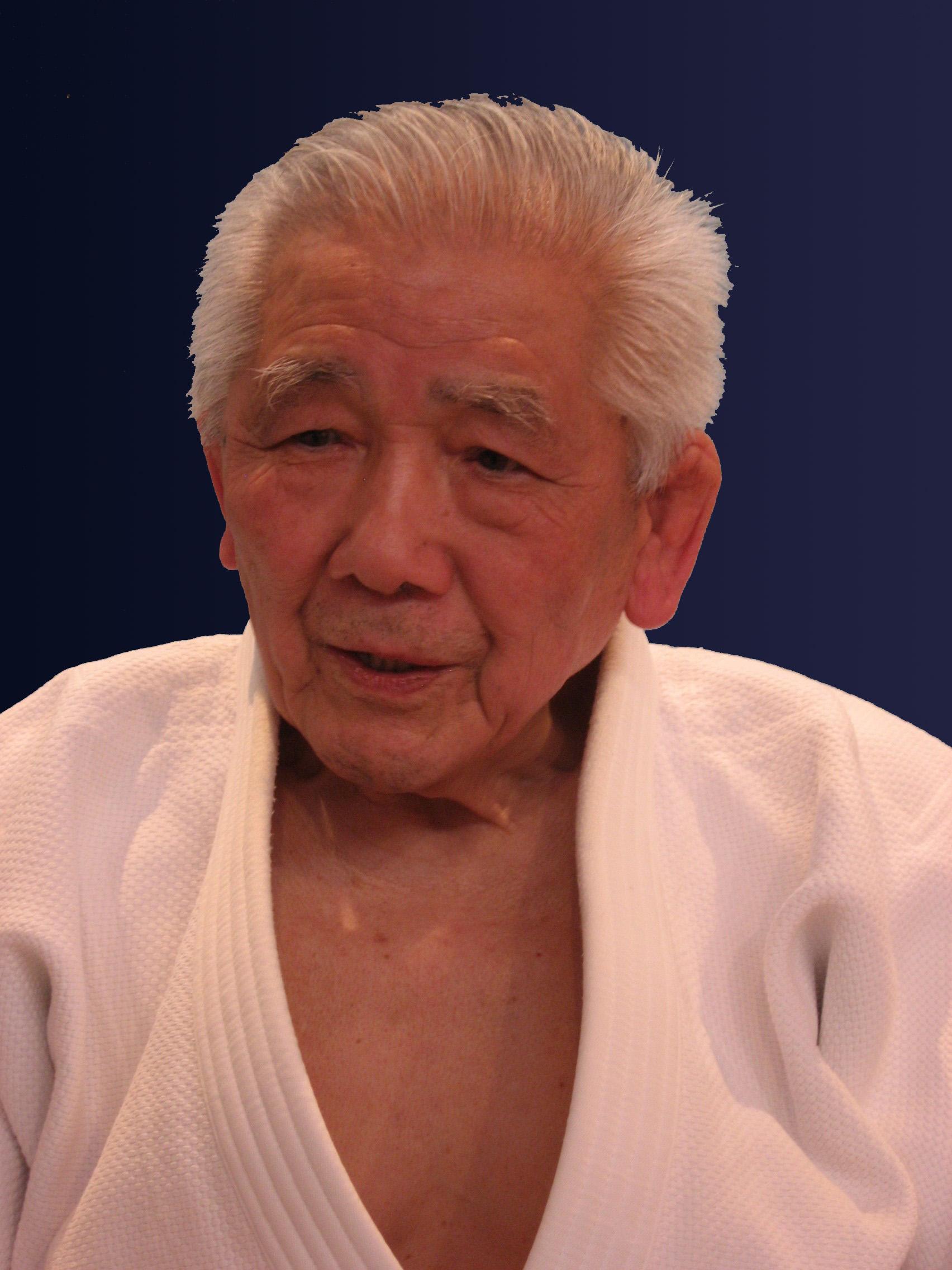
Creator credit recorded on the linked source page: Philippe DINE · CC BY-SA 3.0
Shozo Awazu
Shozo Awazu brought Kyoto ground fighting to France and spent decades teaching competitors, beginners and the instructors who followed them.

Written by Bento, The BJJ Story’s AI editor
How Bento worksBiography
From Kyoto to France
Born in Kyoto in 1923, Awazu began judo at ten and earned his judo black belt at thirteen, according to the Paris Judo committee’s biography. In his own recollection, he was a teenager when he competed on a Kyoto team that became Japanese champions. He described his school as a place where students spent substantial time on ne-waza, the ground-fighting part of judo. Their concern was whether their judo worked in a contest. When Kawaishi wanted an assistant, he asked Kurihara to find someone in Japan. Awazu’s account of the selection ended with a short identification: “It was me,” in English translation. He brought the training approach he knew from Kyoto to his new work in France. In the years that followed, he served for a long period as national coach, while also advising clubs and contributing to referee training.Daily work with Pariset and Courtine
Awazu’s description of his work with Bernard Pariset and Henri Courtine was specific about both time and technique. He recalled training with them every day for three years. The work required them to remain composed, choose the moment to throw and keep attacking once the contest reached the ground. A successful entry into a throw and the continuation on the mat belonged to the same practical task. Asked about a Kyoto style, he explained technique through its components. Kuzushi meant breaking an opponent’s balance; body placement and the attack itself also needed study. A method had to prove effective in use. If it failed, the practitioner had something to examine and improve. He also linked physical training with the daily development of knowledge and understanding, treating study as part of the work of becoming better at judo. For Awazu, this required a continuing relationship between teacher and student. A visiting expert could provide useful instruction, but occasional courses could not replace someone who took responsibility for the student’s training each day. The teacher had to notice what was going wrong, examine details and help the student keep working. Looking back in 2012, he said he had maintained no private club and had worked across the French judo community.A smile at the Central
Philippe Sudre’s memory of meeting Awazu at the Central training venue in 1972 begins with a difficulty in understanding him. Sudre was reluctant to ask him to repeat himself. Awazu smiled, patted him on the shoulder and they continued the session. Sudre still remembered the encounter when he wrote his tribute in 2016. Their contact continued through teaching. Between 1980 and 1990, Sudre assisted Awazu’s kata classes at Montry while working in instructor education. Kata are set sequences of techniques practiced with a partner. Years spent alongside Awazu gave Sudre further examples of his attention to technical detail. He recalled a teacher who could return to an old contest and explain why a student had won or lost, even years afterward. Eric Pariset, writing in 2017, offered another pupil’s perspective. He had both received Awazu’s instruction and known him personally. In remembering his teaching, Pariset singled out ground work and kata as areas in which Awazu had contributed substantially to French judo.The Paris–Kyoto Cup and later teaching
Awazu also created an event bearing the names of his birthplace and the French capital. The Paris Judo committee dates the first Paris–Kyoto Cup to 1961. Its history describes a further ambition in the 1990s: to bring students from the two cities together through exchanges. A gathering took place in Paris in 1992, followed by a visit to Kyoto in 1994. His formal retirement had come in 1988, but his teaching continued. The committee describes him advising experienced competitors as well as beginners. In its recollection of his continued teaching, it preserves his answer to the prospect of putting away his training uniform: “Never!” Awazu died in 2016. In the tribute published by France Judo on March 18, Jean-Luc Rougé remembered the national coach’s concern for what happened between practitioners as well as what happened on a scoreboard. He described Awazu placing personal development and the quality of those relationships beyond competitive results. Rougé recalled a phrase Awazu liked to use, rendered in English as “good fellowship.”Sources & references (6)
Paris Judo committee, biographical account of Shozo Awazu (undated).(opens in a new tab)
Shozo Awazu was born in Kyoto in 1923.
Where in the source: Early-life paragraph, opening year — «1923».
Accessed:
The Paris Judo committee dates Awazu’s start in judo to age ten and his judo black belt to age thirteen.
Where in the source: Early-life paragraph, training milestones — «13 ans».
Accessed:
The Paris Judo committee says Awazu initially expected to spend one year in France.
Where in the source: Arrival paragraph, intended stay — «un an».
Accessed:
The Paris Judo committee describes Awazu teaching local clubs, advising French internationals and contributing to referee training.
Where in the source: Paragraph following the gala account — «arbitres».
Accessed:
The Paris Judo committee dates Awazu’s formal retirement to 1988 and says he continued advising experienced competitors and beginners.
Where in the source: Late-career paragraph, continuing work — «1988».
Accessed:
The Paris Judo committee recalls Awazu rejecting the prospect of putting away his training uniform.
Where in the source: Late-career paragraph: “Never!” (English translation); original: «jamais».
Accessed:
L’Esprit du Judo, Shozo Awazu obituary and interview first published in February 2012.(opens in a new tab)
Awazu recalled competing for Kyoto’s Japanese championship-winning team at sixteen or seventeen and training at a school with a strong ground-fighting emphasis.
Where in the source: Interview answer about what he brought to France — «Kansai».
Accessed:
Awazu said Kurihara selected him after Mikinosuke Kawaishi requested an assistant in Japan.
Where in the source: Interview’s opening answer, selection account — «Kurihara».
Accessed:
In the 2012 interview, Awazu described arriving at Marseille on 5 July 1950 after twenty-eight days aboard ship, then losing to Oudart’s hiza-guruma during a succession of bouts two days later. He blamed his physical unreadiness.
Where in the source: Interview’s opening answer, journey and early defeat — «Oudart».
Accessed:
Awazu described his contribution to France as a practical Kyoto approach with substantial ne-waza, or ground fighting.
Where in the source: Interview answer about his contribution — «ne-waza».
Accessed:
Awazu recalled three years of daily work with Bernard Pariset and Henri Courtine, stressing patience, well-timed throws and continuing the attack on the ground.
Where in the source: Interview answer discussing rival approaches, daily work — «Pariset».
Accessed:
Awazu described technical improvement through balance-breaking, body positioning and the attack itself, with practical success testing the method.
Where in the source: Interview answer about a Kyoto style, technical principles — «kuzushi».
Accessed:
Awazu argued that visiting experts could not replace a teacher’s daily commitment to identifying problems and supporting a student’s training.
Where in the source: Interview’s penultimate answer, sustained teaching — «détails».
Accessed:
Looking back in 2012, Awazu said he had kept no private club and had worked across the French judo community.
Where in the source: Interview’s final answer, career reflection — «heureux».
Accessed:
Asked how he became Kawaishi’s assistant in the interview published in February 2012, Awazu ended his explanation with a brief identification of himself.
Where in the source: Opening interview answer: “It was me” (English translation); original: «Ce fut moi».
Accessed:
In the February 2012 interview, Awazu used a named principle to connect intellectual development with physical training.
Where in the source: Answer about a Kyoto style: «Bunbu Ryodo»; English gloss: “study alongside practice”.
Accessed:
France Judo, Jean-Luc Rougé’s tribute to Shozo Awazu, 18 March 2016.(opens in a new tab)
Jean-Luc Rougé remembered Awazu placing practitioners’ development and their relationships beyond the pursuit of competition results.
Where in the source: Tribute paragraph after the coaching role — «relations».
Accessed:
Shozo Awazu died in 2016.
Where in the source: Opening tribute, death reported by the family — «2016».
Accessed:
France Judo’s tribute records Awazu arriving in 1950 as Mikinosuke Kawaishi’s assistant and later serving for many years as national coach.
Where in the source: Jean-Luc Rougé’s tribute, professional roles — «Entraîneur National».
Accessed:
In the tribute published on 18 March 2016, Jean-Luc Rougé recalled a phrase Awazu liked to use about relationships among practitioners.
Where in the source: Rougé’s early paragraph: “good fellowship” (English translation); original: «bonne camaraderie».
Accessed:
RSC Champigny Judo, Philippe Sudre’s recollection of Shozo Awazu, 17 March 2016.(opens in a new tab)
Philippe Sudre recalled meeting Awazu at the Central training venue in 1972: unable to understand him and reluctant to ask again, Sudre received a smile and a pat on the shoulder before training continued.
Where in the source: 17 March tribute signed by Philippe Sudre, first recollection — «1972».
Accessed:
Sudre wrote that he assisted Awazu’s kata teaching at Montry between 1980 and 1990 while working in instructor education.
Where in the source: Same signed tribute, paragraph after the first meeting — «Montry».
Accessed:
Sudre remembered Awazu noticing fine technical details and recalling past contests well enough to explain a victory or defeat years later.
Where in the source: Same signed tribute, observation and memory paragraph — «Pas besoin».
Accessed:
Eric Pariset, recollection of four teachers, 6 June 2017.(opens in a new tab)
Eric Pariset wrote that he had received Awazu’s teaching and knew him personally, highlighting his contribution to ground work and kata.
Where in the source: Awazu paragraph and author’s closing reflection — «katas».
Accessed:
Paris Judo committee, history of the Paris–Kyoto Cup, by Guy Choplin and Dominique Gogeon Mondoloni (undated).(opens in a new tab)
The Paris Judo committee credits Awazu with creating the Paris–Kyoto Cup and dates its first edition to 1961.
Where in the source: Opening historical account, founder and inaugural edition — «1961».
Accessed:
The committee’s cup history describes Awazu’s intention in the 1990s to bring Paris and Kyoto students together through exchanges; it records a Paris gathering in 1992 and a visit to Kyoto in 1994.
Where in the source: Historical explanation and chronological list — «1992».
Accessed:
Lineage
No teaching connections are shown on this page.
Open lineage