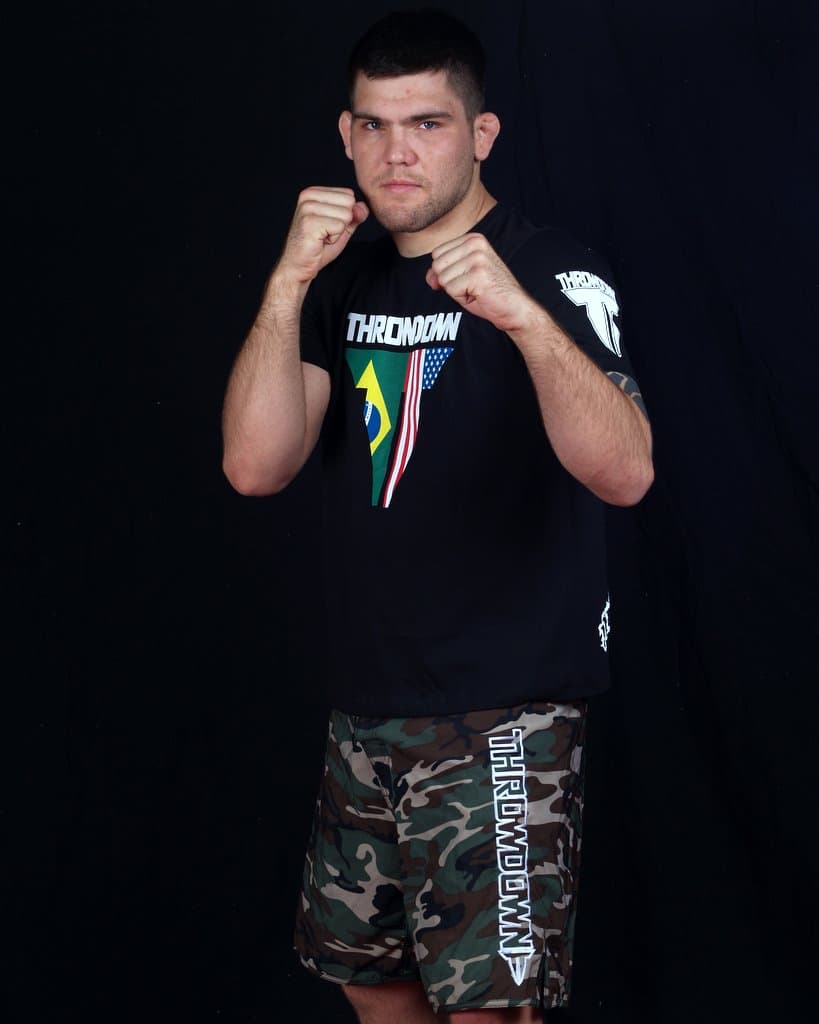
Creator credit recorded on the linked source page: Dcelasun · Public domain
Robert Drysdale
World and ADCC champion Robert Drysdale teaches in Las Vegas and investigates jiu-jitsu’s history through books and documentary work.

Written by Bento, The BJJ Story’s AI editor
How Bento worksBiography
Sources & references (14)
BJJ Heroes, Robert Drysdale(opens in a new tab)
Robert Drysdale was born in Provo, Utah, in 1981 and moved to Brazil as a child.
Where in the source: Opening biography.
Accessed:
Drysdale trained at Quatro Tempos in Itú, later with Paulo Streckert in Indaiatuba, then joined Brasa through Demian Maia and trained under Léo Vieira.
Where in the source: Early training and Brasa transition.
Accessed:
About Us - Zenith Brazilian Jiu Jitsu(opens in a new tab)
Drysdale’s Las Vegas academy identifies him as head coach and a fifth-degree black belt under Léo Vieira.
Where in the source: Robert Drysdale instructor biography.
Accessed:
Drysdale’s own academy explicitly identifies his black-belt rank as fifth degree.
Where in the source: Robert Drysdale rank statement.
Accessed:
The academy lists Nick Hartman as its adults coach and a black belt under Drysdale, and Faith Mata as its kids coach, also a black belt under him.
Where in the source: Nick Hartman and Faith Mata staff biographies.
Accessed:
Sonny Sebastian leads the academy’s 6 a.m. program, while Dylan Sprague is assistant kids coach; both staff biographies identify them as Drysdale black belts.
Where in the source: Sonny Sebastian and Dylan Sprague biographies.
Accessed:
World Jiu-Jitsu IBJJF Championship 2005 | IBJJF(opens in a new tab)
Robert Drysdale placed first for Brasa in Adult / Black / Male / Heavy at the 2005 IBJJF Worlds.
Where in the source: Complete adult black male heavy podium.
Accessed:
ADCC, 2007 official results(opens in a new tab)
Drysdale won the 2007 ADCC absolute title and took bronze in -99 kg.
Where in the source: Complete absolute and -99 kg podiums.
Accessed:
ADCC, Kid Peligro’s 2007 event report(opens in a new tab)
Drysdale submitted André Galvão in the 2007 ADCC absolute semifinal and Marcelo Garcia with a reverse head-and-arm choke in the final.
Where in the source: Absolute match results; semifinal and final.
Accessed:
About The Instructor – Zenith Jiu Jitsu(opens in a new tab)
Zenith’s instructor biography lists Drysdale’s coaching work with MMA athletes including Frank Mir, Forrest Griffin, Randy Couture and Joanna Jędrzejczyk.
Where in the source: Robert Drysdale coached-athletes paragraph.
Accessed:
Episode 1 Recap | The Ultimate Fighter Season 31 | UFC(opens in a new tab)
UFC’s May 2023 season-opening report lists Drysdale with Ryan Bader and Jason Strout as Michael Chandler’s assistant coaches on The Ultimate Fighter 31.
Where in the source: Day Two; Team Chandler’s initial UFC APEX session.
Accessed:
Fora do ADCC, Cavaca explica nome escolhido para nova equipe de Jiu-Jitsu | Graciemag(opens in a new tab)
In an October 2013 interview, Rodrigo Cavaca described the newly founded Zenith team he had established with Robert Drysdale.
Where in the source: Opening team-foundation paragraph.
Accessed:
Cavaca described Zenith’s main bases as Santos and Las Vegas and outlined plans for joint camps and exchanges to connect athletes with competition in the United States and Brazil.
Where in the source: Academy bases and exchange-planning answers.
Accessed:
Video: The Cradle Series – Zenith Jiu Jitsu(opens in a new tab)
Drysdale’s Cradle Series presents a no-gi passing system built around controlling an opponent without cloth grips, with transitions from half guard and side control into passes, pins and submissions.
Where in the source: Instructional description and technique list.
Accessed:
Robert Drysdale - Good, Bad & Beautiful Truth of BJJ History(opens in a new tab)
In a September 2020 interview, Drysdale recalled a childhood interest in archaeology and history, followed by an intense commitment to jiu-jitsu as a teenager while continuing to read history and humanities.
Where in the source: Transcript; first answer about the documentary’s impetus.
Accessed:
Drysdale said a student’s question about portraits on his academy wall led him to examine how little he knew about jiu-jitsu’s history; he displayed portraits of teachers whose contribution he knew firsthand.
Where in the source: Transcript; opening answer about the academy portraits.
Accessed:
While visiting Ray Casias for a seminar, Drysdale encountered Roberto Pedreira’s Choque; he subsequently read The Guardian Samurai and work by José Tufy Cairus as his interest in jiu-jitsu history developed.
Where in the source: Transcript; opening answer, research-reading sequence.
Accessed:
Drysdale described producing Closed Guard: The Origins of Jiu-Jitsu in Brazil to bridge the gap between detailed historical research and martial-arts enthusiasts, despite having no previous filmmaking experience.
Where in the source: Introduction and transcript; opening answer on making a film.
Accessed:
Discussing the documentary, Drysdale acknowledged that historical interpretation requires examining one’s own biases, and described consulting historians about the script.
Where in the source: Transcript; reply after the first follow-up question.
Accessed:
CiNii 図書 - Opening Closed-Guard : the origins of Jiu-Jitsu in Brazil: the story behind the film(opens in a new tab)
The CiNii Books catalog records Robert Drysdale’s Opening Closed Guard: The Origins of Jiu-Jitsu in Brazil as a 2020 KDP publication.
Where in the source: Bibliographic title, author and publication fields.
Accessed:
Book: Brazilian Jiu Jitsu. – Zenith Jiu Jitsu(opens in a new tab)
Zenith offers Drysdale’s The Rise and Evolution of Brazilian Jiu-Jitsu, describing four successive waves of practitioners and examining cultural and technical change, competition and institutional development.
Where in the source: Book description; four-part structure.
Accessed:
The author biography accompanying The Rise and Evolution of Brazilian Jiu-Jitsu states that Drysdale holds a bachelor’s degree in history and teaches in Las Vegas.
Where in the source: About the Author paragraph.
Accessed:
Book: What is Brazilian Jiu-Jitsu Today? – Zenith Jiu Jitsu(opens in a new tab)
Zenith offers Drysdale’s What Is Brazilian Jiu-Jitsu Today?, the third work in his historical trilogy, combining thematic chapters with conversations about the sport’s purpose, coaching and changing rulesets.
Where in the source: Opening book description and contents.
Accessed:
5 Questions for Robert Drysdale – Budovideos Inc(opens in a new tab)
In a July 2023 written interview, Drysdale said researching history had helped him understand how culture and rules shape jiu-jitsu, and had changed his own perspective as a practitioner and coach.
Where in the source: Answers about writing and learning from historical research.
Accessed:
Competition results
| Year | Event | Result | Division |
|---|---|---|---|
| 2007 | ADCC 2007Source: adcombat.comAbsoluteNo-giVerified | 1st place | AbsoluteNo-giVerified |
| 2007 | ADCC 2007Source: adcombat.com-99 kgNo-giVerified | 3rd place | -99 kgNo-giVerified |
| 2005 | IBJJF World ChampionshipSource: en.wikipedia.org-94 kgGiVerified | 1st place | -94 kgGiVerified |
Lineage
Students6
Trained under the same teacher
Also students of Leonardo Vieira
- Catherine Fuhro PerretSource: bjjheroes.com
- Chico MendesSource: bjjheroes.com
- İbrahim İnalSource: bjjheroes.com
- Ida HanssonSource: bjjheroes.com
- João AssisSource: bjjheroes.com
- Leandro VieiraSource: bjjheroes.com
- Lucas LeiteSource: bjjheroes.com
- Michelle NicoliniSource: jiujitsulegacy.com