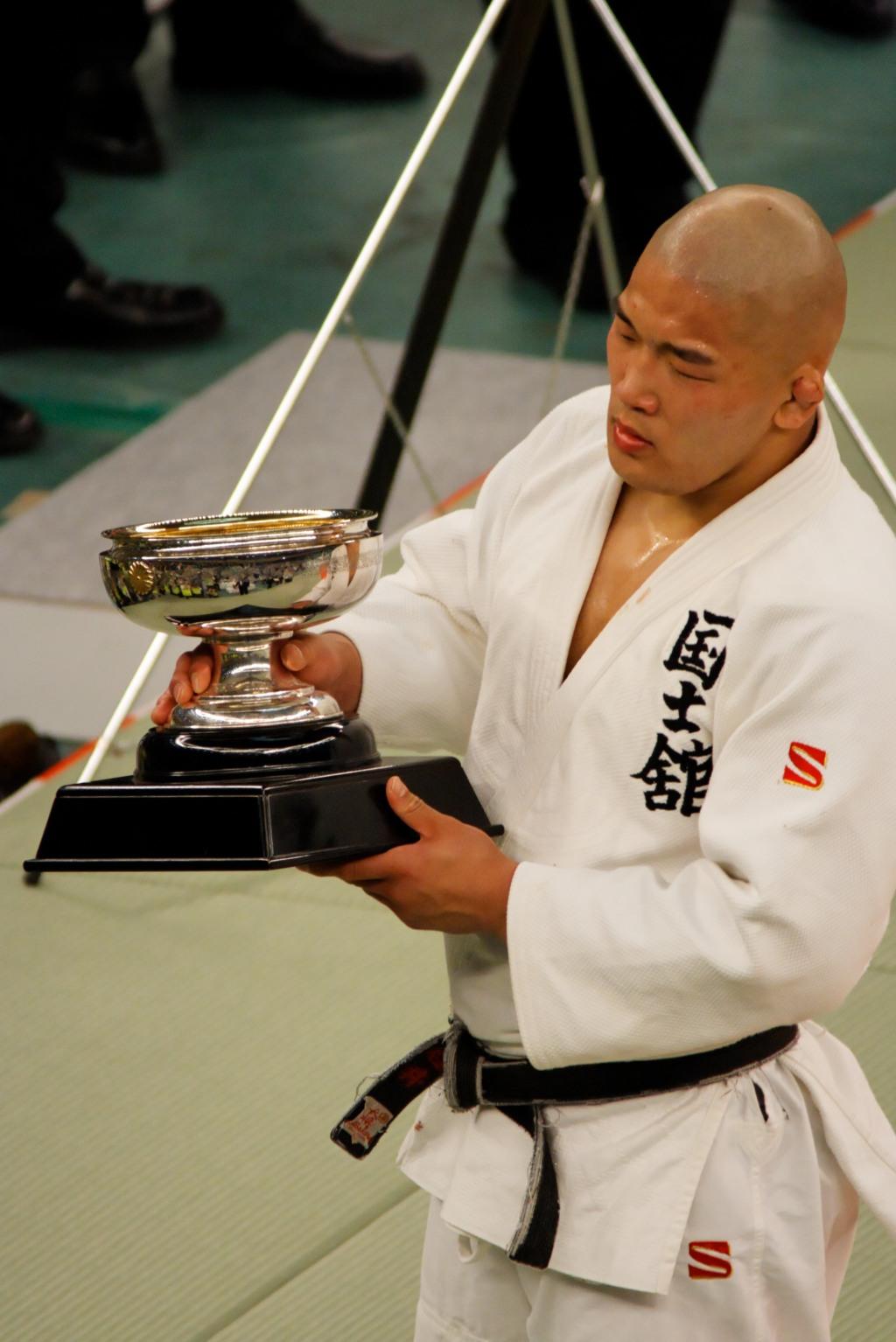
Creator credit recorded on the linked source page: Daniel Vaulot · CC BY-SA 2.5 · Modified: see source page
Satoshi Ishii
Satoshi Ishii carried Olympic judo into QUINTET, Polaris and no-gi teaching, while continuing his grappling education with Nakai, Barnett and Danaher.

Written by Bento, The BJJ Story’s AI editor
How Bento worksBiography
From judo to QUINTET
Born in 1986, Ishii won Olympic judo gold at Beijing in 2008. His later grappling education brought him into distinct traditions. His representative identifies Yuki Nakai as the teacher under whom he became a Brazilian jiu-jitsu black belt, and describes extensive catch-wrestling training with Josh Barnett. By September 2018, QUINTET had recorded Ishii’s appearances in its first two team events and booked him against Frank Mir for a separate match at its Las Vegas debut. The preparation for that show supplied another glimpse of what training with Ishii felt like. Matt Benyon recalled visiting a local gym with Ishii and members of the Polaris team before QUINTET 3. During their rounds, Ishii caught his forearm in a grip so powerful that Benyon felt “it might snap.” Ishii also competed at the 2018 IBJJF world championship in no-gi jiu-jitsu. At Polaris 8 in Wales that year, Daniel Strauss gave him a different problem: Strauss used butterfly guard, a seated position with the feet working inside an opponent’s legs, instead of contesting the standing exchanges. During a scramble, Strauss reached Ishii’s back. The match went to a decision in Strauss’s favor.Between sessions in Zagreb
In July 2019, journalist Marko Petrak met Ishii at Petar, a café in Zagreb’s Stenjevec district where he spent time between sessions at the nearby Cro Cop gym. Ishii had become a Croatian citizen and thanked Croatians for welcoming him. His working life there involved repeated training with Mirko “Cro Cop” Filipović, with MMA and submission grappling both on the schedule. In that interview, Ishii credited Filipović with improving his striking through repetition. He had more confidence when he needed to fight standing, but still regarded the ground as his strongest area. His preference remained to take an opponent down and finish there; the improvement in his striking gave him something to use when he could not get the takedown. There was little space between assignments. Ishii said his preparations for the PFL would lead into more training for an already agreed Polaris grappling appearance. He spoke about the coming work as a continuous schedule, with the next set of preparations following the previous fight. In February 2020, Ishii described Filipović’s advice in a post reproduced by Fight Site. “Your soul is judo,” he recalled his coach telling him. Ishii explained that Filipović had encouraged him to put his judo and grappling at the center of his MMA strategy. The advice came from the same coach he credited with making him more comfortable striking.Ouchi-gari without a jacket
The practical problem of carrying judo into other rulesets also appears in Ishii’s teaching. His representative advertises seminars covering traditional judo, judo without the gi, and judo adapted for jiu-jitsu with or without the jacket. A written explanation of his no-gi ouchi-gari, an inward reaping attack against a leg, shows what such adaptation involves. The jacket supplies handles in conventional judo. Without it, Ishii controls the upper body through an underhook—an arm threaded beneath the opponent’s arm—and a grip at the elbow. The lesson emphasizes getting the opponent to step toward him, then attacking the moving foot before it has taken the opponent’s weight. The opening comes from the timing of the step rather than from hanging his weight on the opponent to load the leg. The height of the attacking foot matters too. The written lesson cautions that raising it too far gives the opponent an opportunity to find balance again and step free. Keeping the action low helps preserve the moment created by the step. These are adjustments to contact, timing and foot placement, rather than a simple instruction to perform the same throw after removing the jacket.Training and teaching in Austin
In September 2022, Fight Site reported that Ishii was in Texas working on his grappling under John Danaher and training with Gordon Ryan. The Olympic champion was continuing to learn on the ground. In the caption quoted by the Croatian report, Ishii described Ryan establishing top position as the point at which the round became a nightmare for him. His teaching also reached Austin through an uchi-mata instructional filmed with New Wave. Uchi-mata is a throw that lifts through the inside of an opponent’s thigh. The publisher’s description places it within a jiu-jitsu game, including the need to keep a useful position when the throw lands. Getting the opponent off the ground is one part of the task; controlling the position afterward is another. The public syllabus connects uchi-mata to other trips and throws and includes an entry when the opponent has a body lock, a clasp around the torso. It also lists the throw as a response to a single-leg attack, in which the opponent has caught one of the legs.Sources & references (11)
Japanese Olympic Committee, Beijing 2008 athlete record.(opens in a new tab)
Satoshi Ishii was born in 1986.
Where in the source: Athlete identity table, birth entry — 1986年.
Accessed:
QUINTET, announcement of the Ishii–Mir match, 22 September 2018.(opens in a new tab)
Ishii entered submission grappling with an Olympic judo gold medal from Beijing 2008 behind him.
Where in the source: Final announcement paragraph, previous Olympic achievement — Beijing.
Accessed:
By September 2018, QUINTET recorded Ishii’s participation in its first two team events and announced a separate match with Frank Mir for its Las Vegas debut.
Where in the source: Closing announcement paragraph, the earlier events and new pairing — QUINTET.1.
Accessed:
Strikers International, Satoshi Ishii talent and seminar page.(opens in a new tab)
Ishii’s representative identifies him as a Brazilian jiu-jitsu black belt under Yuki Nakai.
Where in the source: Judoka Smasher, the sentence listing his grappling teachers — Yuki Nakai.
Accessed:
His representative also describes sustained catch-wrestling training with Josh Barnett.
Where in the source: Judoka Smasher, the same training-history sentence — Catch wrestling.
Accessed:
The same representative page places part of Ishii’s training life in Austin, working with John Danaher and Gordon Ryan.
Where in the source: Judoka Smasher, concluding sentence — Austin.
Accessed:
Ishii’s advertised seminar subjects span conventional judo, judo without the gi, and adaptations for jiu-jitsu in both forms of dress.
Where in the source: Seminar Curriculums, the three listed subjects — No-gi Judo.
Accessed:
Scramble, Matt Benyon’s recollections of training with competitors.(opens in a new tab)
Matt Benyon recalls sharing a Las Vegas gym session with Ishii and Polaris team members before QUINTET 3; Ishii’s grip on his forearm made an especially vivid impression.
Where in the source: Satoshi Ishii section, the gym visit and forearm recollection — forearm.
Accessed:
Describing Ishii’s forearm grip, Benyon wrote that it felt as though “it might snap”.
Where in the source: Satoshi Ishii section, final first-person grip description — “it might snap”.
Accessed:
QUINTET, post-event interviews, 18 July 2018.(opens in a new tab)
After QUINTET 2, Ishii described roughly six weeks of preparation and a fifteen-hour journey each way, followed by only four minutes of competition.
Where in the source: TEAM VAGABOND, the question about one-way travel and Ishii’s answer — 6週間; 試合は4分.
Accessed:
In the same post-event interview, Ishii said “I wanted to win” and hoped to return with Team Vagabond.
Where in the source: TEAM VAGABOND, answer about returning — 勝ちたかったですね (“I wanted to win”).
Accessed:
Geo Martinez’s post-event account recalled Ishii’s heavy pressure, guard passing and deep kimura attacks during their encounter at QUINTET 2.
Where in the source: TEAM 10th Planet, Geo’s first answer about facing Ishii — 深いキムラ.
Accessed:
BJJ Fanatics, report on Strauss–Ishii, 14 December 2018.(opens in a new tab)
At Polaris 8 in Wales, Daniel Strauss used butterfly guard rather than meeting Ishii in standing exchanges, reached Ishii’s back during a scramble, and won the decision.
Where in the source: Opening match report, first two paragraphs — butterfly guard.
Accessed:
BJJ Fanatics, Ishii’s no-gi competition and ouchi-gari teaching, 12 July 2019.(opens in a new tab)
A July 2019 BJJ Fanatics article described Ishii as a Yuki Nakai black belt and recorded a 2018 appearance at IBJJF’s world championship without the gi.
Where in the source: Career paragraph immediately after the first Learn More box — Yuki Nakai.
Accessed:
The same article explains Ishii’s no-gi version of ouchi-gari: he replaces jacket grips with control under one arm and at the elbow, draws an opponent into a step, and attacks before the stepping foot is fully loaded.
Where in the source: Technique explanation after the embedded demonstration, grip replacement and timing paragraphs — underhook.
Accessed:
Ishii’s written ouchi-gari lesson also cautions against lifting the attacking foot too high, because that gives the opponent time to recover balance.
Where in the source: Technique explanation, final mechanics paragraph — close to the ground.
Accessed:
Fight Site, Marko Petrak’s interview with Ishii, 26 July 2019.(opens in a new tab)
In Marko Petrak’s July 2019 interview, Ishii described becoming a Croatian citizen and welcomed the reception he had received in Croatia.
Where in the source: Opening interview, café introduction and first answer — hrvatsko državljanstvo.
Accessed:
Petrak met Ishii at the Petar café in Zagreb’s Stenjevec district, where Ishii spent time between sessions at the nearby Cro Cop gym.
Where in the source: Opening paragraph, location of the interview — Petar.
Accessed:
In that interview, Ishii said the ground remained his strongest area and taking opponents down to finish remained his preference; repeated work with Mirko Filipović had also given him more confidence when forced to strike.
Where in the source: Middle section on improvements in standing exchanges, two complete answers after the Cro Cop subheading — parter.
Accessed:
Ishii said his schedule offered little respite: his PFL preparations would be followed by further training for a previously agreed Polaris grappling appearance.
Where in the source: Answer in the no-summer-holiday section — samo trening.
Accessed:
Fight Site, Ishii on training with Mirko Filipović, 19 February 2020.(opens in a new tab)
In a February 2020 post reproduced by Fight Site, Ishii recalled Cro Cop telling him “Your soul is judo” and encouraging him to build his MMA strategy around judo and grappling.
Where in the source: English Instagram post reproduced beneath the Croatian report — “Your soul is judo”.
Accessed:
Fight Site, Ishii’s training with Gordon Ryan, 14 September 2022.(opens in a new tab)
Fight Site’s September 2022 report placed Ishii in Texas developing his grappling with John Danaher and sharing training rounds with Gordon Ryan.
Where in the source: Opening three article paragraphs before Ishii’s caption — Texasu.
Accessed:
When Ryan established top position, Ishii described it as “the beginning of a nightmare”, according to the caption translated into Croatian by Fight Site.
Where in the source: Paragraph quoting Ishii’s caption — početak noćne more (“the beginning of a nightmare”).
Accessed:
BJJ Fanatics, Ishii’s uchi-mata course description.(opens in a new tab)
Ishii’s uchi-mata course was filmed with New Wave in Austin and presents the throw as part of a jiu-jitsu game that must retain useful position after the landing.
Where in the source: Course description and What You’ll Learn, landing-control bullet — Austin.
Accessed:
The visible syllabus connects uchi-mata with other trips and throws, body-lock situations and single-leg defence rather than treating it as an isolated jacket throw.
Where in the source: What Exactly Do You Get, Parts 1–3, combinations and defensive situations — Part 3.
Accessed:
Lineage
No teaching connections are shown on this page.
Open lineage