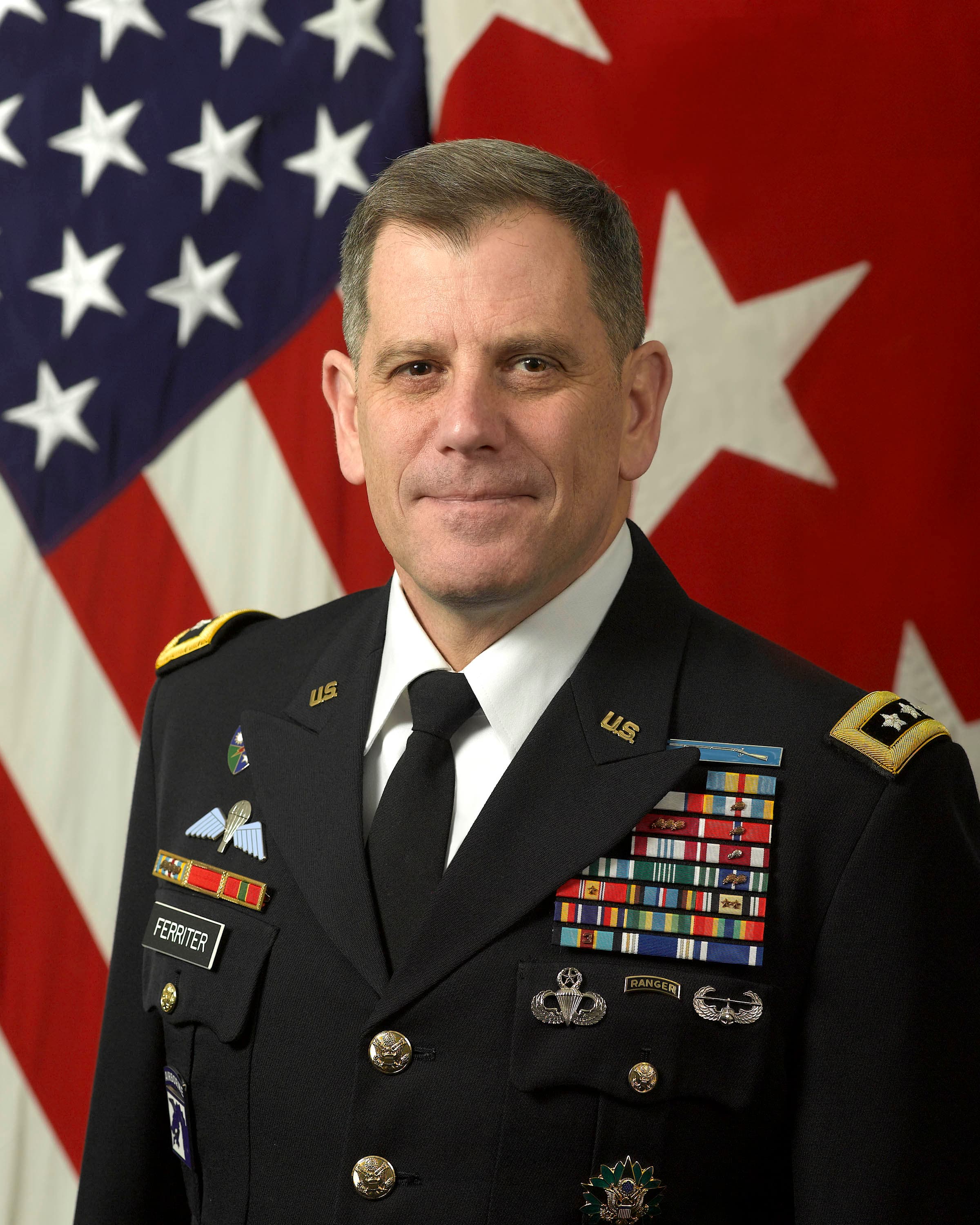
Creator credit recorded on the linked source page: Monica A. King, United States Army · Public domain (PD-USGov-Military-Army)
Michael Ferriter
He met jiu-jitsu as a Ranger commander in 1997, helped take BJJ-based combatives into Army schools and earned a black belt as a three-star general.
Biography
Sources for this profile
Wikipedia, "Michael Ferriter" (last edited 8 May 2026).(opens in a new tab)
Michael Ferriter is an American retired United States Army lieutenant general.
Where in the source: Lead paragraph, first sentence: "an American retired United States Army Lieutenant General"
Accessed:
Ferriter graduated from The Citadel with a Bachelor of Science in business administration in May 1979 and was commissioned as an infantry second lieutenant.
Where in the source: Military career section, first paragraph (sentence naming The Citadel).
Accessed:
As operations officer (S3) of the 75th Ranger Regiment, Ferriter took part in Operation Restore Hope in Somalia.
Where in the source: Military career section, third paragraph: "he participated in Operation Restore Hope in Somalia"
Accessed:
Ferriter served three tours of duty in Iraq, including two as deputy commanding general for operations of Multi-National Corps – Iraq and a 2011 posting as deputy commander for advising and training of U.S. Forces – Iraq.
Where in the source: Lead paragraph ("three tours of duty in Iraq") and Military career section, paragraphs four to six.
Accessed:
On June 19, 2018, Ferriter was named president and CEO of the National Veterans Memorial and Museum in Columbus, Ohio.
Where in the source: Lead paragraph, last sentence (dated June 19, 2018).
Accessed:
Nick Duke, "Bidding farewell: Former IMCOM, MCoE commander retires", U.S. Army (army.mil), 6 May 2014.(opens in a new tab)
Ferriter served with the 75th Ranger Regiment from October 1986 to June 1989 and commanded the 3rd Battalion, 75th Ranger Regiment, at Fort Benning from July 1996 to June 1998.
Where in the source: Fourth paragraph: Fort Benning assignments with the 75th Ranger Regiment and command of its 3rd Battalion (dated 1986-89 and 1996-98).
Accessed:
After commanding the 2nd Battalion, 504th Parachute Infantry Regiment, 82nd Airborne Division, Ferriter returned to Fort Benning to command the 11th Infantry Regiment from June 1999 to July 2001.
Where in the source: Fifth paragraph: "command the 11th Infantry Regiment"
Accessed:
Ferriter commanded the U.S. Army Infantry Center and was commandant of the Infantry School from June to October 2009, then became the first commanding general of the Maneuver Center of Excellence at Fort Benning, overseeing the integration of the Infantry and Armor schools.
Where in the source: Third paragraph (first MCoE commanding general, Infantry and Armor schools) and sixth paragraph (Infantry Center, June to October 2009).
Accessed:
Ferriter's final assignment was assistant chief of staff for installation management and commanding general of Installation Management Command, from November 2011 to April 2014; he retired after 35 years of service in a ceremony at Fort Benning in May 2014.
Where in the source: First and second paragraphs: "After 35 years of service"
Accessed:
Ferriter and his wife, Margie, worked extensively with Gold Star Families and Army families during his career.
Where in the source: Paragraph on the couple's work with Gold Star Families, near the end.
Accessed:
BJJ Eastern Europe (bjjee.com), "3-star US Army General Promoted To BJJ Black Belt", 6 December 2014 (republished Army report).(opens in a new tab)
Ferriter first trained Brazilian jiu-jitsu in 1997 as a lieutenant colonel commanding a battalion of the 75th Ranger Regiment, after the regimental commander, then-Colonel Stanley McChrystal, told his battalion commanders to renew their emphasis on hand-to-hand combat; leaders and soldiers then began training in BJJ.
Where in the source: Second and third paragraphs: "his first taste of Brazilian Jiu-Jitsu in 1997"
Accessed:
Ferriter said he had been a baseball and basketball player who used to look down on wrestlers and grapplers, and that in BJJ he discovered an activity that was as much about leadership, confidence and competence.
Where in the source: Quoted passage after the photo caption: "I was a baseball player, a basketball player."
Accessed:
Ferriter said he decided that, as a promoter of the combatives program, he would keep training for as long as he was in the Army, so that soldiers would see that if an ageing former basketball player could do it, every soldier could.
Where in the source: Quoted paragraph about staying a promoter of the program as long as he served.
Accessed:
While commanding Installation Management Command, Ferriter received his BJJ black belt at a March 8 ceremony in Atlanta, presented by Jacaré Cavalcanti, a founder of the Alliance Jiu-Jitsu team; Ferriter called it humbling and unbelievable.
Where in the source: Paragraph naming the March 8 ceremony in Atlanta and the presenter.
Accessed:
Sgt. 1st Class Chad Menegay, Ohio National Guard Public Affairs, "Combatives tournament seen as more than just fighting", DVIDS, 12 September 2019.(opens in a new tab)
Michael Ferriter holds a black belt in Brazilian jiu-jitsu.
Where in the source: First sentence: "a black belt in Brazilian Jiu-Jitsu"
Accessed:
In 2019, speaking about an Ohio Army National Guard combatives tournament, Ferriter called the combatives tournament a leadership training event and said the aim of the Army tournament was to put new life into the program, because soldiers practise when they know they will be tested; units across the active Army, Guard and Reserve began holding qualifying tournaments.
Where in the source: Quotes in the first and fifth paragraphs: "If you know you're going to be tested, then you practice."
Accessed:
Matt Larsen, "Combatives Competition and the Warrior Ethos", Substack, 11 August 2025.(opens in a new tab)
Matt Larsen, founder of the Modern Army Combatives Program, describes Ferriter as a black belt and the senior Army leader most responsible for championing and spreading the combatives program, and says Ferriter, working with the Combatives School instructors, decided to drop stick fighting from the formal program because it did not look like soldiering.
Where in the source: Part 4, subsection "The Hobbyist Trap", paragraph beginning "This is the same perception": "a black belt himself"
Accessed:
Rick Musselman, "Fort Belvoir Community Hospital claims intramural Combatives title", U.S. Army (army.mil), 21 November 2013.(opens in a new tab)
Ferriter learned of the Rangers' BJJ-based combatives system while commanding the 3rd Ranger Battalion and later the 11th Infantry Regiment, and integrated combatives into the programs of instruction of Officer Candidate School, the Infantry Officer Basic Course and the Infantry Captain's Career Course; with Matt Larsen he laid the foundation for the Army's combatives trainer program.
Where in the source: Paragraph beginning "As the Rangers who were trained in this new system expanded".
Accessed:
Army combatives was designed from 1995 by former Ranger Matt Larsen, with Brazilian jiu-jitsu as its technical base, adding judo and wrestling takedowns and boxing and Muay Thai strikes; it became official Army doctrine with Field Manual 3-25.150 in January 2002.
Where in the source: Two paragraphs after the tournament quotes, on the 1995 origin of Combatives and its Brazilian Jiu-Jitsu base.
Accessed:
Wikipedia, "United States Army Combatives School".(opens in a new tab)
After rewriting the Army's combatives manual, Matt Larsen was asked by the 11th Infantry Regiment to build a training course for its cadre; responsibility for combatives doctrine moved to the regiment, and a disused warehouse at Fort Benning became the U.S. Army Combatives School.
Where in the source: History section, first paragraph (sentence naming the 11th Infantry Regiment).
Accessed:
Theresa Larson, "The Faces Behind Inspired Leadership", drtheresalarson.com, 10 October 2015.(opens in a new tab)
Theresa Larson writes that the retired Ferriter asked her to help with an Inspired Leadership course at a military boarding school in Carlsbad, California, on Veterans Day 2014, where martial artists including Rener Gracie taught boys fighting techniques as lessons for life.
Where in the source: Introduction by the author, first two paragraphs: "on Veterans Day of 2014"
Accessed:
In a 2015 question-and-answer, Ferriter described Hands-On Inspired Leadership, a seminar he developed that uses the physicality of Brazilian jiu-jitsu and the idea that life is like a fight (close the distance, take a dominant position, finish) to teach leadership, and said he had delivered it to wounded warriors, active-duty soldiers, families of the fallen, high-school students and business executives.
Where in the source: Answers to questions 3 and 4: "life is like a fight"
Accessed:
Ferriter named Fort Benning, Georgia, as his favourite duty station, saying it raised him to be the leader he became and was where he and his wife raised their children.
Where in the source: Answer to question 9: "My favorite duty station is Fort Benning"
Accessed:
Marc Marins, "Free Seminar for Wounded Soldiers and Adaptive Athletes", North Vancouver Gracie Jiu Jitsu blog, 5 June 2015.(opens in a new tab)
A June 2015 blog post reports that a free jiu-jitsu seminar for wounded soldiers and adaptive athletes at Camp Murray, Washington, had been put together by retired General Mike Ferriter and Rener Gracie.
Where in the source: Second paragraph: "Retired General Mike Ferriter and Rener Gracie"
Accessed: