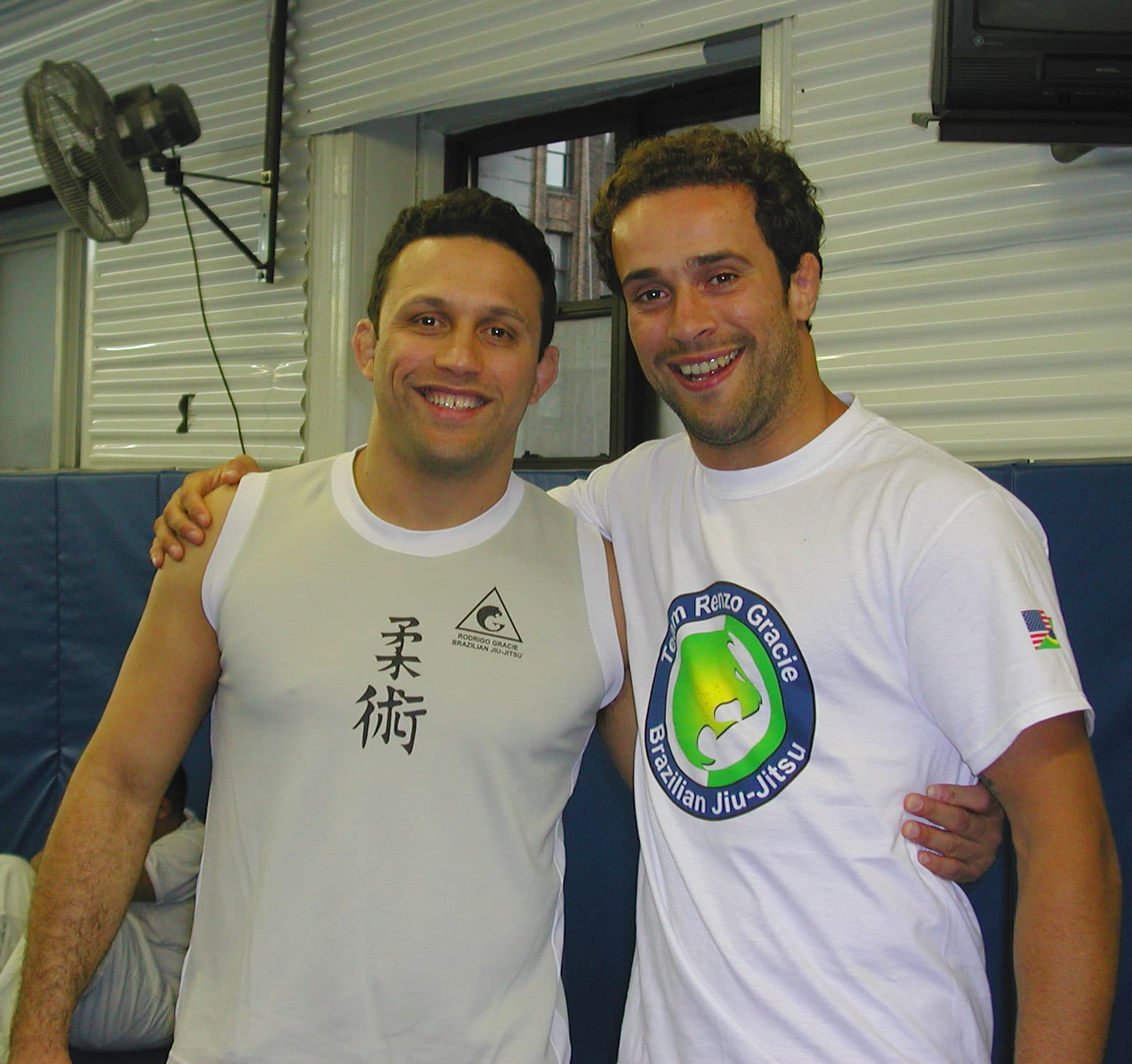
Biography
Sources for this profile
Wikipedia, Marcio Feitosa, revision viewed 9 September 2026.(opens in a new tab)
Wikipedia gives Marcio Feitosa Souza's birth date as 16 May 1976; only the year is proposed for the infobox.
Where in the source: Infobox: born name and date.
Accessed:
Wikipedia identifies Marcio Feitosa as Brazilian.
Where in the source: Infobox: nationality.
Accessed:
Wikipedia lists Marcio Feitosa's team as Gracie Barra.
Where in the source: Infobox: team and teacher rows.
Accessed:
Gracie Barra Institute, Evoluindo seu Jiu-Jitsu com o Prof. Márcio Feitosa, undated.(opens in a new tab)
Gracie Barra identifies Marcio Feitosa as a sixth-degree Brazilian jiu-jitsu black belt who began training with Carlos Gracie Jr. in 1988 at the original Gracie Barra school.
Where in the source: Biographical paragraph on rank and training — “6º grau”.
Accessed:
Gracie Barra describes Marcio Feitosa as a sixth-degree black belt.
Where in the source: Same biographical paragraph, belt description — “6º grau”.
Accessed:
Feitosa was born in Rio de Janeiro, grew up in Barra da Tijuca, began jiu-jitsu at age twelve and started teaching at fifteen.
Where in the source: Biographical paragraph and following teaching sentence — “aos 12 anos”.
Accessed:
Carlos Gracie Jr. selected Feitosa as a contributor to Gracie Barra's international development, including work on the organization's teaching method.
Where in the source: Paragraph on international responsibilities — “desenvolvimento global”.
Accessed:
When Gracie Barra opened its United States headquarters in Irvine in 2005, Feitosa became head instructor and remained in that role for ten years.
Where in the source: Paragraph on the Irvine headquarters — “em 2005”.
Accessed:
During his decade at the Irvine headquarters, Feitosa launched the first CompNet, contributed to the instructor certification program and created Gracie Barra's first recorded curriculum, later known as GB1 and GB2.
Where in the source: Irvine paragraph, named programs — “primeiro CompNet”.
Accessed:
Gracie Barra's undated profile says that after leaving the headquarters in 2015, Feitosa worked between the organization's Brazilian and United States operations on programs intended to make instruction more consistent across schools.
Where in the source: Paragraph after the Irvine account — “Desde que”.
Accessed:
Stephan Kesting, Marcio Feitosa Talks Techniques, Training and Teams, Grapplearts, 17 March 2012.(opens in a new tab)
In an interview, Feitosa said that teaching, rather than becoming a great competitor, was his main preparation: he taught daily from age fifteen and fitted tournament preparation around that work.
Where in the source: Opening personal-history answer — “teaching every day”.
Accessed:
Feitosa described Gracie Barra's teaching aim as developing a student's whole practice rather than narrowing training to competition-specialized positions.
Where in the source: Answer about the academy’s style — “whole picture”.
Accessed:
Feitosa said the teaching method followed a sequence covering self-defense, takedowns and ground techniques, and that the goal was a formal curriculum delivering both techniques and a shared mentality across Gracie Barra schools.
Where in the source: Answer about instruction structure — “formal curriculum”.
Accessed:
IBJJF, World Jiu-Jitsu IBJJF Championship 1997 results.(opens in a new tab)
At the 1997 World Jiu-Jitsu IBJJF Championship, Marcio Feitosa of Gracie Barra placed first in the Adult Black Belt Men's Lightweight division.
Where in the source: Athletes by category: Adult / Black / Male / Light; first-place row.
Accessed:
IBJJF, World Jiu-Jitsu IBJJF Championship 2001 results.(opens in a new tab)
At the 2001 World Jiu-Jitsu IBJJF Championship, Márcio Feitosa of Gracie Barra placed first in the Adult Black Belt Men's Lightweight division.
Where in the source: Athletes by category: Adult / Black / Male / Light; first-place row.
Accessed:
IBJJF, World Jiu-Jitsu IBJJF Championship 2002 results.(opens in a new tab)
At the 2002 World Jiu-Jitsu IBJJF Championship, Marcio Feitosa of Gracie Barra placed first in the Adult Black Belt Men's Lightweight division.
Where in the source: Athletes by category: Adult / Black / Male / Light; first-place row.
Accessed:
ADCC Federation, ADCC Submission Fighting World Championship 2001 official results.(opens in a new tab)
The official ADCC 2001 results list Marcio Feitosa as the gold medalist and first-place finisher in the under-77-kilogram division, ahead of Matt Serra, Leo Santos and Rodrigo Gracie.
Where in the source: Official 2001 results: -77kg table, gold through fourth-place rows.
Accessed:
Competition results
| Year | Event | Result | Division |
|---|---|---|---|
| 2005 | ADCC 2005Source: adcombat.com-66 kgNo-giVerified | 3rd place | -66 kgNo-giVerified |
| 2002 | IBJJF World ChampionshipSource: en.wikipedia.org-76 kgGiVerified | 1st place | -76 kgGiVerified |
| 2001 | ADCC 2001Source: adcombat.com-77 kgNo-giVerified | 1st place | -77 kgNo-giVerified |
| 2001 | IBJJF World ChampionshipSource: en.wikipedia.org-76 kgGiVerified | 1st place | -76 kgGiVerified |
| 2000 | ADCC 2000Source: adcombat.com-77 kgNo-giVerified | 3rd place | -77 kgNo-giVerified |
| 1997 | IBJJF World ChampionshipSource: en.wikipedia.org-76 kgGiVerified | 1st place | -76 kgGiVerified |