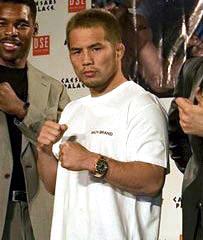
Creator credit recorded on the linked source page: Larry Burton · CC BY-SA 3.0 · Modified: see source page
Hayato Sakurai
Hayato Sakurai’s grappling story runs from recruiting school judo partners to Abu Dhabi medals, clinch throws and teaching at Mach Dojo.

Written by Bento, The BJJ Story’s AI editor
How Bento worksBiography
From school judo to Shooto
Born in 1975, Sakurai continued judo through school before seeking out other forms of fighting. His official biography traces the route through Caesar Gym, where he trained in shootboxing after high school, and then into Shooto at the Kiguchi Wrestling Dojo in 1995. His professional Shooto debut followed against Caol Uno in October 1996; in May 1998, he became its middleweight champion.Abu Dhabi, 1999
Sakurai’s official career record lists bronze below 77 kilograms and silver in the absolute division at the 1999 Abu Dhabi submission tournament. The absolute division brought competitors together without the usual separation by weight. In his later interview with Jikosapo, he recalls that disappointment with third place in his own division pushed him to enter it, largely on impulse. His account of facing André Pederneiras is about repeatedly having to change the attack. Sakurai remembers winning through points earned with throws, but not being able to keep Pederneiras pinned. When one attempt stopped working, he moved to another rather than trying to settle into a hold. Against a much larger opponent, he recalls looking for a route between the legs and around to the back instead of trying to match strength directly. He also describes his bout with Ricco Rodriguez as an exceptional experience of concentration: he felt able to put an idea into action immediately, and at moments felt as though he could see himself from above.Throws from the clinch
The judo remained visible in his technical teaching. A GBR feature presents Sakurai demonstrating throws he had used in mixed martial arts, even as he had become known for striking. Its written lessons begin with positions that can arise while both fighters are standing and holding one another: the clinch. One is the side-on position he favors, with the two bodies forming a T. From there, knees and foot sweeps provide ways into a throw. Other lessons address less comfortable positions. An opponent moving toward his back creates an opening for a shoulder throw; a clinch controlling his head can be answered with a sacrifice throw, tomoe-nage, or the body-drop throw tai-otoshi. The feature presents these as responses to particular positions, with the opponent’s movement part of the opportunity. An illustrated lesson makes the sequence more specific. Sakurai steps forward to clinch as the opponent punches, then turns his body while the opponent continues advancing. He draws the arm out and brings the sole of his foot into place to trip the opponent. The accompanying text compares the action to sasae-tsurikomi-ashi or hiza-guruma, judo throws that block the leg while turning the upper body. GBR identifies it as a counter he used against Dave Menne. The final variation begins with the opponent gaining double underhooks, both arms inside and beneath Sakurai’s. If that opponent advances, the lesson shows the forward drive becoming an opportunity for a neck throw.Training at Mach Dojo
Sakurai opened Mach Dojo in Ryūgasaki, Ibaraki, in 2001, followed by the Sugamo branch in Tokyo in 2007, according to his official timeline. Establishing a place to train brought adjustments of its own. Looking back on 2007 in a GBR interview the following year, he said two contests had been arranged soon after the Sugamo opening, before he had settled into the new environment. He felt that both preparation and movement had suffered. He remembered a similar period of adjustment when he first opened the Ibaraki dojo. His theme for that difficult year had been “maximum effort,” translated from Japanese. Training partners still shaped his decisions as a competitor. Speaking to Daniel Herbertson in May 2010, Sakurai described working with Matt Hume in the United States against partners much larger than himself. The size difference made sessions difficult enough that he decided to leave his weight loss until he returned to Japan. On the standard he wanted to maintain in competition, he said, “I don’t want to be ordinary.” In that interview, Sakurai also wanted to help develop younger fighters and strengthen the MMA community in Ibaraki. He saw a limit in trying to combine that work with his own competition: developing the next generation properly would take his full attention. He framed the task as something the sport’s participants needed to share, while acknowledging how much his fighting restricted what he could do. Teaching was the subject of a Shuminavi announcement in November 2018. It proposed a seminar at Sugamo the following month on recognizing individual ability, encouraging motivation, working with athletes and approaching injuries. A separate self-defense session was planned for beginners. Mach Dojo’s Sugamo program, advertised in November 2026, offers jiu-jitsu, wrestling and MMA to people training for competition and to those beginning or seeking exercise. Its wrestling description moves from mat exercises and flexibility into takedown entries, technical practice and sparring. The branch combines mat space with strength-training equipment and a treatment clinic, and advertises round-the-clock gym access. For people seeking closer attention, it offers individual lessons with Sakurai and other professional fighters.Sources & references (9)
Hayato Sakurai official website, biographical profile and career timeline, undated.(opens in a new tab)
Hayato Sakurai, also presented as Sakurai Mach Hayato on his official website, was born in 1975.
Where in the source: Profile identity block; year in birth entry.
Accessed:
Sakurai’s official biography traces his training through school judo, shootboxing at Caesar Gym after high school, and then Shooto at the Kiguchi Wrestling Dojo.
Where in the source: Opening biography; training sequence before professional debut.
Accessed:
His official timeline places his first professional Shooto contest against Caol Uno in October 1996 and his capture of the Shooto middleweight championship in May 1998.
Where in the source: Opening biography, then timeline entries for 1996 and 1998.
Accessed:
Sakurai’s official biography records two medals at the 1999 Abu Dhabi submission tournament: third place below 77 kilograms and second place in the absolute division.
Where in the source: Timeline entry headed 1999.
Accessed:
Sakurai’s official timeline dates the establishment of Mach Dojo in Ryūgasaki, Ibaraki, to 2001 and the opening of its Sugamo branch in Tokyo to 2007.
Where in the source: Timeline entries headed 2001 and 2007.
Accessed:
Hayato Sakurai, personal essay on his teachers and early judo experience, 19 August 2026.(opens in a new tab)
In his own 2026 account, Sakurai describes himself as shy when he joined a school judo club, despite already wanting to take part and believing he could be good at it.
Where in the source: Middle-school passage after the transition to judo; anchor: 内気.
Accessed:
Sakurai recalls that a school judo teacher stressed correct technique and fundamentals, but the club struggled to get members to attend practice.
Where in the source: Judo-club paragraphs on the teachers and dwindling attendance; anchor: 技の形や基本.
Accessed:
Sakurai remembers receiving ten-yen coins from his teacher and using the school payphone at weekends to call absent club members’ homes; after school he also waited by the gate to ask teammates to train.
Where in the source: School-payphone and gate paragraphs; anchor: 公衆電話.
Accessed:
Sakurai’s 2026 essay recalls the feeling he had on the judo mat in the words 「ここが俺の居場所なんだ」.
Where in the source: Mat passage, exact self-recollection: 「ここが俺の居場所なんだ」.
Accessed:
Jikosapo Japan, interview with Hayato Sakurai and Takeshi Ogusu, public first chapter, undated.(opens in a new tab)
In his Jikosapo interview, Sakurai says frustration at placing third in his weight division prompted him to enter the absolute competition at Abu Dhabi, a decision he describes as largely impulsive.
Where in the source: First-chapter ADCC discussion, immediately after the host explains the two medals; anchor: 悔しくて.
Accessed:
Sakurai recalls winning against André Pederneiras through throwing points, saying that he could not hold him down and instead kept switching attacks when an attempt failed.
Where in the source: ADCC passage naming Pederneiras and the following explanation of attacking; anchor: 投げ技のポイント.
Accessed:
Describing a much larger opponent at Abu Dhabi, Sakurai recalls trying to move between the opponent’s legs and around to the back rather than meeting his strength directly.
Where in the source: ADCC discussion of the larger opponent, before the question about footage; anchor: 股からくぐって.
Accessed:
Sakurai describes his Abu Dhabi bout with Ricco Rodriguez as an unusually absorbing experience in which he felt able to act on an idea immediately and at moments felt as though he could see himself from above.
Where in the source: Late first-chapter discussion after Rodriguez is named; final answer about bodily sensation.
Accessed:
GBR, Hayato Sakurai demonstration of judo throws for MMA, undated.(opens in a new tab)
GBR’s technical feature has Sakurai demonstrate throws he used in MMA, explicitly presenting his judo background as a part of his fighting even though he had become known for striking.
Where in the source: Feature introduction above the technique list.
Accessed:
The feature describes a side-on T-shaped clinch position Sakurai likes, from which knees and foot sweeps can set up several throws. It connects this lesson to a throw against Anderson Silva.
Where in the source: Section on the T-shaped position; anchor: T字ポジション.
Accessed:
Other lessons in the feature address using a shoulder throw when an opponent tries to take the back and countering a head-controlling clinch with tomoe-nage or tai-otoshi.
Where in the source: Three technique summaries on clinch counters and the back-taking opponent.
Accessed:
GBR, illustrated Hayato Sakurai lesson on countering forward pressure, undated.(opens in a new tab)
In GBR’s illustrated sequence, Sakurai meets an opponent’s punching entry by clinching, turns his body as the opponent keeps coming forward, draws the arm out and places the sole of his foot to complete a trip. The text compares the action to sasae-tsurikomi-ashi or hiza-guruma.
Where in the source: Illustrated sequence STEP1–STEP5.
Accessed:
The same lesson identifies the counter as one Sakurai used against Dave Menne and adds a neck-throw counter for an opponent advancing with double underhooks.
Where in the source: STEP5 attribution and STEP6–STEP7 variation.
Accessed:
GBR, interview with Hayato Sakurai about his 2008 plans and the preceding year, 2008.(opens in a new tab)
Looking back on 2007 in a GBR interview, Sakurai says two contests were arranged soon after he opened the Sugamo dojo, when he had not yet settled into the new environment. He felt his preparation and movement had suffered.
Where in the source: Answer on his shootboxing appearance and the next answer about settling in; anchor: 新しい環境.
Accessed:
Sakurai says the difficulty of adjusting to training in a new dojo was familiar from the earlier opening of his Ibaraki base.
Where in the source: Answer after the question about the Hasegawa contest; anchor: 茨城にマッハ道場.
Accessed:
In the GBR interview, Sakurai describes the theme he set himself for 2007 with the words 「最大努力」.
Where in the source: First answer and later answer on the difficult year; exact expression: 「最大努力」.
Accessed:
MMA Fighting, Daniel Herbertson interview with Hayato Sakurai, 28 May 2010.(opens in a new tab)
In May 2010, Sakurai describes training with Matt Hume in the United States against much larger partners. He says he postponed losing weight until his return to Japan because the size difference made training difficult.
Where in the source: Early answer about the American training camp; anchor: dinosaur.
Accessed:
Sakurai tells Herbertson he wants to help produce the next generation of fighters, but believes that doing so properly would require his full attention rather than dividing it with his own fighting career.
Where in the source: Late answer on the possibility of retiring, before the question about post-fighting plans.
Accessed:
Sakurai says he wants to strengthen the MMA community in Ibaraki and give emerging fighters opportunities; he considers development a shared responsibility across the sport.
Where in the source: Answers about remaining in MMA, development programmes and helping new fighters.
Accessed:
Explaining the standard he wanted to maintain in competition, Sakurai tells Herbertson, “I don’t want to be ordinary.”
Where in the source: Answer on his required performance level: “I don’t want to be ordinary.”
Accessed:
Shuminavi, announcement of Hayato Sakurai instructor and self-defence seminars, PR TIMES, 13 November 2018.(opens in a new tab)
In November 2018, Shuminavi announced a Sakurai seminar at Mach Dojo’s Sugamo branch for the following month, centred on developing individual ability, encouraging motivation, working with athletes and handling injuries.
Where in the source: Announcement’s first-part description and schedule.
Accessed:
The same announcement paired the instructor session with a beginner-accessible self-defence class, presenting Sakurai’s teaching to a public beyond professional competitors.
Where in the source: Second-part description and schedule.
Accessed:
Mach Dojo, Sugamo branch facilities and class descriptions, undated current page.(opens in a new tab)
Mach Dojo’s Sugamo page offers jiu-jitsu alongside MMA and wrestling, describing a shared training setting for beginners, people seeking fitness and those preparing to compete.
Where in the source: Class descriptions under 柔術 and 総合格闘技.
Accessed:
The Sugamo branch describes wrestling practice progressing through mat exercises, flexibility, takedown entries, technical work and sparring, and advertises personal instruction from Sakurai and other professional fighters.
Where in the source: Wrestling section and one-to-one lesson section.
Accessed:
The Sugamo branch advertises a 24-hour gym with a treatment clinic on site and facilities for both mat practice and strength training.
Where in the source: Facilities section, equipment list and opening-hours row.
Accessed:
Lineage
No teaching connections are shown on this page.
Open lineage