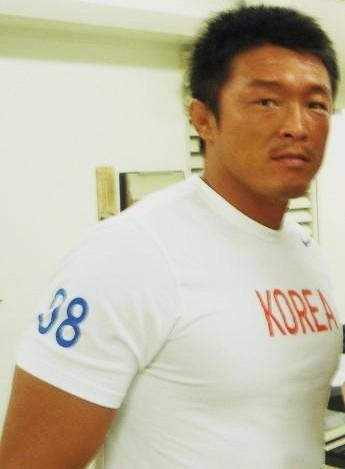
Creator credit recorded on the linked source page: Soonerzbt · CC BY-SA 3.0
Yoshihiro Akiyama
Yoshihiro Akiyama brought judo to MMA, learned the cage and built a Tokyo dojo he wanted to share with competitors and the public.

Written by Bento, The BJJ Story’s AI editor
How Bento worksBiography
Judo in Osaka
Born in Osaka in 1975, Akiyama became known in MMA as Sexyama and is also known as Choo Sung-Hoon. Much of his account of his early training comes from interviews published by ONE Championship in 2019. He recalled his father taking him to a dojo at three. Competition and the techniques appealed to him, but so did judo's etiquette: he described its values as “manners and respect for your opponent”. In his telling, judo also offered a way to find out how far his ability could take him. He won the Asian Judo Championships in 2001 representing South Korea, then won at the 2002 Asian Games representing Japan. His later move into MMA was, as he described it, another opportunity to test himself. That meant adding to his judo: his training came to include wrestling and submission grappling, the pursuit of holds that force an opponent to concede, alongside striking.Two armbars
On December 31, 2004, Akiyama made his MMA debut against Frans Botha, a former heavyweight boxing champion. The match ended in the opening round with Akiyama applying an armbar, a hold that attacks the elbow. An armbar also ended his match with Melvin Manhoef in the opening round. That victory brought Akiyama the HERO'S Light Heavyweight Grand Prix championship in 2006.A dojo in Tokyo
By 2009, Akiyama had a training space that brought his two sports together. When reporter Kim Seek visited the Team Cloud Akiyama Dojo in Tokyo, he found judo mats, a ring and an enclosed octagon. The previous year, Akiyama had spoken about wanting somewhere students could learn judo and MMA; the reporter could now walk into that place. Akiyama wanted to use the dojo for his own preparation and to develop fighters with competitive promise. He also described a broader membership. “I welcome the general public,” he told the Korea JoongAng Daily. His plans included recreational students of different ages, genders and nationalities. The space was intended to accommodate people learning for themselves as well as those preparing to compete.Learning the cage
Akiyama remained a student himself. In July 2010, Chris Leben submitted him in the third round at UFC 116 with a triangle choke, a submission that uses the legs around an opponent's neck and one arm. Before his October fight with Michael Bisping, Akiyama spent part of his preparation with Greg Jackson's team in Albuquerque, New Mexico. Speaking through an interpreter on a conference call, he described learning “the intricate skills of the takedown”. He also credited the camp with teaching him MMA striking and how to approach three rounds in a cage. Even bringing someone to the floor, a familiar task for a judoka, had details he wanted to learn in this setting. He viewed his early UFC victory over Alan Belcher and the defeat by Leben as experiences that helped him adapt. Much of his previous career had taken place in rings. The cage required its own preparation, and his account of the Jackson camp concerned the practical work of competing inside it.Throws and back attacks
After losing to Vitor Belfort in August 2011, Akiyama moved from middleweight to welterweight for his February 2012 match with Jake Shields in Japan. He explained that other middleweights were bigger than he was. The new division was closer to the 81-kilogram class in which he had competed in judo, and he hoped the move would make him quicker. Against Shields, Akiyama resisted takedown attempts during the opening two rounds and used sweeps to put his opponent down. Those exchanges did not decide the bout in his favor. In the last round Shields took his back and sought a rear-naked choke, an arm choke applied from behind. Shields won on the scorecards, with all three judges giving him 30–27. Akiyama's next bout came in 2014 against Amir Sadollah in Japan. Early head kicks from Sadollah met a trip that took the fight down. Akiyama controlled the ground exchanges, then combined punches while standing with attacks from the top. He won by unanimous decision, taking all three scorecards 30–27. It was his first victory since 2009. In 2019, Akiyama still pointed to throwing and taking opponents down when explaining judo's usefulness in MMA. Three years later, against Aoki, his immediate problem was keeping another grappler from finishing him. Aoki's opening single-leg attack had driven him toward the wall before the back attack. In round two, Akiyama resisted another attempt and shook Aoki off at the wall. When Aoki could no longer secure the clinch, Akiyama's knees and punches brought the referee in to stop the fight.Sources & references (12)
ONE Championship, announcement of Akiyama’s signing, 30 November 2018.(opens in a new tab)
ONE’s signing announcement identifies Yoshihiro Akiyama, nicknamed Sexyama, as the fighter also known as Choo Sung-Hoon.
Where in the source: Opening announcement and following identity paragraph — “also known as Choo Sung-Hoon”.
Accessed:
National Diet Library, personal-name authority record 01159061, last updated 18 May 2018.(opens in a new tab)
The National Diet Library’s authority entry gives 1975 as Yoshihiro Akiyama’s birth year.
Where in the source: Authority table, birth-year row — “1975”.
Accessed:
ONE Championship, interview on Akiyama’s judo and MMA career, 2 February 2019.(opens in a new tab)
ONE’s 2019 interview profile places Akiyama’s birth in Osaka in 1975.
Where in the source: Early biographical paragraph — “Osaka”.
Accessed:
In his 2019 interview, Akiyama described judo as a way to test the extent of his ability; the profile presents his subsequent move into MMA as another search for a challenge.
Where in the source: Middle section linking his own account of testing himself to the switch of sports — “challenged myself”.
Accessed:
ONE’s 2019 career profile dates Akiyama’s HERO’S Light Heavyweight Grand Prix championship to 2006.
Where in the source: Career transition paragraph after the account of his judo medals — “2006”.
Accessed:
ONE Championship, Yoshihiro Akiyama athlete biography.(opens in a new tab)
ONE’s athlete biography says Akiyama began with judo and later trained in submission grappling and wrestling alongside striking disciplines.
Where in the source: About section, training paragraph — “submission grappling”.
Accessed:
ONE Championship, Akiyama on judo and martial values, 7 June 2019.(opens in a new tab)
In his 2019 ONE interview, Akiyama described being taken to a dojo by his father when he was three.
Where in the source: Childhood paragraph after his explanation of shared martial values — “his father”.
Accessed:
Akiyama told ONE that etiquette was central to what attracted him to judo, beyond the pleasure of competition and technique.
Where in the source: Paragraphs following the childhood account — “etiquette”.
Accessed:
Speaking to ONE in 2019, Akiyama described the judo values he recognized in martial arts as “manners and respect for your opponent”.
Where in the source: Opening interview answer — “manners and respect for your opponent”.
Accessed:
In 2019, Akiyama explained that the ability to throw or bring an opponent down remained a practical reason for judo’s value in MMA.
Where in the source: Late interview answer about the technical relevance of judo — “throw”.
Accessed:
ONE Championship, interview and career retrospective, 30 January 2019.(opens in a new tab)
ONE’s retrospective records Akiyama winning the 2001 Asian Judo Championships while representing South Korea and the 2002 Asian Games while representing Japan.
Where in the source: Judo chronology before the K-1 transition — “representative”.
Accessed:
Akiyama’s MMA debut came against Frans Botha on the last day of 2004; he submitted the former heavyweight boxing champion with an armbar in the opening round.
Where in the source: Debut passage between the move from judo and his account of the weight difference — “Frans Botha”.
Accessed:
Recalling the Botha match in ONE’s January 2019 interview, Akiyama said, “The weight was different”.
Where in the source: Akiyama’s answer immediately after the debut result — “The weight was different”.
Accessed:
ONE’s retrospective describes another opening-round armbar, against Melvin Manhoef, as the victory that secured Akiyama the HERO’S Light Heavyweight Grand Prix title.
Where in the source: Tournament account following the Botha recollection — “Melvin Manhoef”.
Accessed:
Korea JoongAng Daily, Kim Seek’s interview at Akiyama’s Tokyo dojo, 13 August 2009.(opens in a new tab)
When Kim Seek visited Akiyama’s Tokyo gym in 2009, the Team Cloud Akiyama Dojo had judo mats, a ring and an enclosed octagon.
Where in the source: Reporter’s account of entering the dojo after congratulating Akiyama — “tatami mats”.
Accessed:
The 2009 dojo report says Akiyama had spoken the previous year about wanting a place where students could learn both judo and MMA; the Tokyo gym realized that ambition.
Where in the source: Paragraphs connecting the earlier television appearance to the reporter’s visit — “dream”.
Accessed:
At his dojo in 2009, Akiyama said he wanted to train there himself, develop promising fighters and admit recreational students across ages, genders and nationalities.
Where in the source: Later interview answers about who the dojo would serve — “promising fighters”.
Accessed:
In the 2009 Korea JoongAng Daily interview, Akiyama said, “I welcome the general public”.
Where in the source: Closing answer describing the intended dojo membership — “I welcome the general public”.
Accessed:
MMA Fighting, Mike Chiappetta’s report on Akiyama’s training with Greg Jackson, 8 October 2010.(opens in a new tab)
Chris Leben submitted Akiyama with a triangle choke in the third round at UFC 116 in July 2010.
Where in the source: Middle section reviewing the previous bout — “triangle choke”.
Accessed:
Before facing Michael Bisping in October 2010, Akiyama spent part of his preparation with Greg Jackson’s team in Albuquerque, New Mexico.
Where in the source: Opening paragraphs on the change of training environment — “Albuquerque”.
Accessed:
On a UFC 120 conference call, Akiyama said the Jackson camp taught him finer takedown skills, MMA striking and how to manage three rounds inside the cage.
Where in the source: First translated conference-call answer, after the opening camp description — “three-round”.
Accessed:
In that October 2010 conference call, Akiyama said he had learned “the intricate skills of the takedown”.
Where in the source: First conference-call quotation — “the intricate skills of the takedown”.
Accessed:
Akiyama said his early UFC win over Alan Belcher and loss to Leben had both helped him adjust to cage fighting after a career largely spent in rings.
Where in the source: Later answer on adapting to the UFC arena — “rings”.
Accessed:
UFC, Thomas Gerbasi’s interview about Akiyama’s move to welterweight, 21 February 2012.(opens in a new tab)
Akiyama moved from UFC middleweight to welterweight for the Jake Shields fight in Japan in February 2012, after losing to Vitor Belfort the previous August.
Where in the source: Early paragraphs explaining the change of division — “welterweight”.
Accessed:
Explaining that move in his pre-fight UFC interview, Akiyama said he was smaller than the other middleweights and regarded the new division as closer to his judo weight; he hoped the change would add speed.
Where in the source: Paragraph containing his size explanation and the comparison with 81-kilogram judo — “81 kilograms”.
Accessed:
UFC, main-card report from UFC 144, February 2012.(opens in a new tab)
At UFC 144, Akiyama resisted Jake Shields’s takedowns through the first two rounds while putting Shields down with sweeps of his own.
Where in the source: YOSHIHIRO AKIYAMA VS. JAKE SHIELDS section, opening fight analysis — “first two rounds”.
Accessed:
Shields reached Akiyama’s back in the final round at UFC 144 and worked for a rear-naked choke; Shields won the decision, with each judge scoring the fight 30–27.
Where in the source: Same bout section, final-round account and official result — “back mount”.
Accessed:
UFC, report on the Japan event including Akiyama versus Sadollah, September 2014.(opens in a new tab)
In his 2014 return against Amir Sadollah in Japan, Akiyama stopped an early spell of head kicks with a trip, controlled the action on the ground and later mixed punches on the feet with attacks from above.
Where in the source: AKIYAMA vs. SADOLLAH section, round-by-round paragraphs — “quick trip”.
Accessed:
Akiyama defeated Sadollah by a unanimous decision in 2014, with three scores of 30–27; the UFC report described it as his first bout since 2012 and first win since 2009.
Where in the source: Opening two paragraphs of the Sadollah bout section — “30-27”.
Accessed:
ONE Championship, Jay Furness’s report on Akiyama versus Aoki, 26 March 2022.(opens in a new tab)
At ONE X in Singapore in March 2022, Shinya Aoki drove Akiyama toward the wall with a single-leg attempt and then climbed onto his back.
Where in the source: Opening-round action after the venue paragraph — “single-leg”.
Accessed:
Akiyama survived the rest of the opening round with Aoki on his back attempting to secure a choke or neck crank.
Where in the source: Opening-round continuation before the second-round image — “neck crank”.
Accessed:
In the second round, Akiyama resisted another attack, dislodged Aoki at the wall and forced a stoppage with knees and punches after Aoki could no longer establish the clinch.
Where in the source: Second-round paragraphs from the opening right hand to the referee’s intervention — “clinch”.
Accessed:
ONE’s report identifies Akiyama as 46 at the time of his second-round stoppage of Aoki at the Singapore Indoor Stadium in March 2022.
Where in the source: Venue paragraph and final assessment of the result — “46-year-old”.
Accessed:
Lineage
No teaching connections are shown on this page.
Open lineage