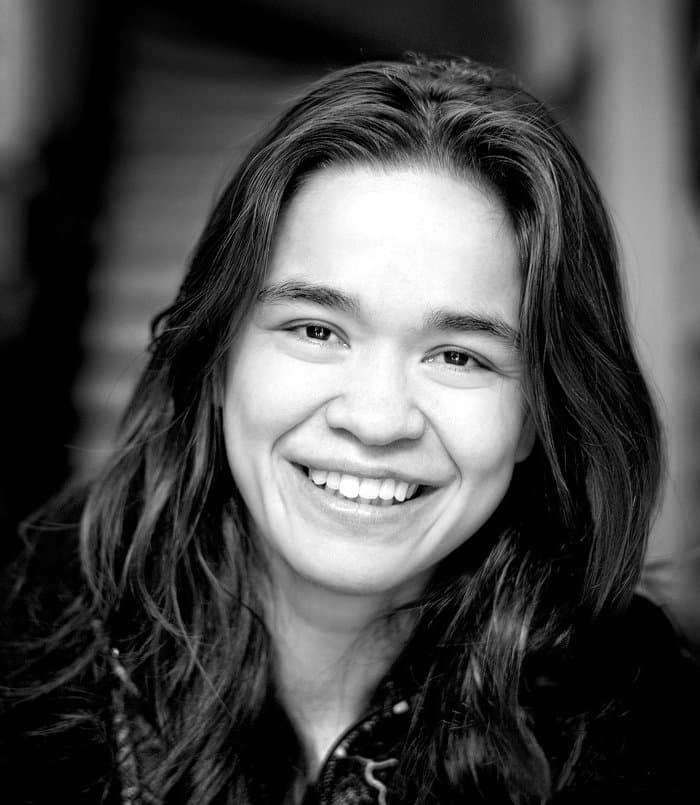
Creator credit recorded on the linked source page: Richard Goulding · CC BY-SA 3.0
Rosi Sexton
A Cambridge mathematician who became Britain's first woman in the UFC, Rosi Sexton later qualified as an osteopath and earned a BJJ black belt.
Biography
Sources for this profile
Wikipedia, article Rosi Sexton, read 21 October 2026(opens in a new tab)
Rosi Sexton was born in 1977 in Versailles, France, and grew up and was educated in the United Kingdom.
Where in the source: Infobox (birth date and place) and the Education and early life section
Accessed:
Wikipedia gives Sexton's nationality as British.
Where in the source: Infobox, Martial arts career block, nationality line
Accessed:
Sexton took a first-class mathematics degree at Trinity College, Cambridge in 1998, then a master's in mathematical logic at the University of Manchester in 2000 and a PhD in theoretical computer science there.
Where in the source: Mathematics section: Trinity College admission and degree years, then the Manchester MSc and PhD
Accessed:
In 2018, at age 41, Sexton was promoted to black belt in Brazilian jiu-jitsu by Paul Rimmer.
Where in the source: Mixed martial arts career section, paragraph on osteopathy and clinic: age and the “promoted to black belt” sentence
Accessed:
Before turning to mixed martial arts Sexton already held dan grades in jujutsu and taekwondo. In 2000, after about ten years of martial arts, she began training MMA and Brazilian jiu-jitsu to test whether what she had learned worked in real life.
Where in the source: Mixed martial arts career section, opening paragraph: existing “dan grades” and the year she turned to MMA and BJJ
Accessed:
On 26 November 2005 Sexton won the inaugural Cage Warriors women's bantamweight title, listed as the 132-pound championship, with a third-round corner stoppage of Dina Van den Hooven.
Where in the source: Mixed martial arts record table, 26 November 2005 row and its notes column; achievements list
Accessed:
In BodogFight she beat Carina Damm by armbar in December 2006 in Saint Petersburg and Julia Berezikova by armbar in August 2007 in Vancouver.
Where in the source: BodogFight section and record table rows for 16 December 2006 and 24 August 2007
Accessed:
She beat Debi Purcell by split decision on a ShoXC card for EliteXC in August 2008, and at Bellator 12 in June 2009 she submitted Valerie Coolbaugh with an armbar.
Where in the source: EliteXC and Bellator sections; record table rows for 15 August 2008 and 19 June 2009
Accessed:
At Cage Warriors 40 in February 2011 she beat Roxanne Modafferi by unanimous decision. In June 2012 she beat Aisling Daly by unanimous decision in a Cage Warriors 125-pound tournament semifinal. The final against Sheila Gaff, set for October 2012, was cancelled when Gaff withdrew.
Where in the source: Cage Warriors Fighting Championship section: 26 February 2011, 2 June 2012, and the cancelled October final
Accessed:
Sexton has written about performance-enhancing drugs in combat sports and supports the Voluntary Anti-Doping Association (VADA); VADA testing was carried out in the weeks before her planned October 2012 Cage Warriors final. She has also been a spokesperson for SafeMMA, an organisation focused on competitor safety.
Where in the source: Mixed martial arts career section, paragraph on doping and SafeMMA; Cage Warriors section on the planned final
Accessed:
Sexton lost her UFC debut to Alexis Davis by unanimous decision at UFC 161 in Winnipeg on 15 June 2013, and lost to Jessica Andrade by unanimous decision at UFC Fight Night 30 in Manchester on 26 October 2013. She was released from the promotion soon afterwards and announced her retirement from MMA on 21 June 2014.
Where in the source: Ultimate Fighting Championship section and the final line on her retirement announcement
Accessed:
Bleacher Report, MMA Interview with Rosi Sexton, byline Liam Parker, 23 May 2009(opens in a new tab)
In a 2009 interview Sexton said she began taekwondo at 13 and moved to Japanese jiu-jitsu at university. Around the time she was working toward her black belt she doubted herself, since she had never been in a real fight, and a television documentary on mixed martial arts convinced her to try it. She had planned only a couple of fights to prove it to herself.
Where in the source: Interview, 23 May 2009, answer on what drove her into the ring: “crisis of confidence”
Accessed:
In May 2009 Sexton lived and trained in Manchester and thanked her coach Karl Tanswell and her training partners at SBG Manchester, saying she believed the gym had one of the best women's teams anywhere.
Where in the source: Interview, 23 May 2009, closing thanks to her coach and gym: “Karl Tanswell”
Accessed:
Grapplearts, Stephan Kesting interview with Rosi Sexton, 23 January 2019(opens in a new tab)
In a 2019 podcast interview with Stephan Kesting, Sexton said she first met martial arts through a taekwondo club as a teenager looking for self-defence, then tried other arts. Around 1999 a television documentary introduced her to mixed martial arts, and her interest in MMA and Brazilian jiu-jitsu grew toward the end of her PhD. She meant to have a couple of fights, and it became a twelve-year MMA career.
Where in the source: Podcast transcript, opening answers on her degrees and how she came to MMA: “around 1999”
Accessed:
Sexton said she turned to sports injuries after she and teammates were hurt and few therapists understood the demands of grappling and MMA. She began a five-year osteopathy degree in the UK, qualified in 2010 while still fighting, and after retiring in 2014 built a clinic focused on combat-sport athletes.
Where in the source: Podcast transcript, answer on injuries and osteopathy: “qualified in 2010”
Accessed:
UFC.com, feature by Thomas Gerbasi, 12 June 2013(opens in a new tab)
Sexton's professional debut came in May 2002. She took the bout when she was offered it a day before the event after an opponent dropped out, and she won by submission over Angela Boyce.
Where in the source: UFC.com feature by Thomas Gerbasi (12 June 2013), account of her debut: “The girl pulled out”
Accessed:
Sexton described her first years as a struggle to find opponents and shows willing to book women's fights; in 2002 there was almost no women's MMA in the UK, and after a March 2003 bout she did not fight again for nearly a year.
Where in the source: Same feature, passage on her first years of finding opponents and shows
Accessed:
Her first fight outside the UK was against Gina Carano on 15 September 2006, signed at 135 pounds and changed to a catchweight of 139. Sexton, a 125-pounder, was knocked out in the second round and said she did not yet understand how much weight other fighters cut.
Where in the source: Same feature, Carano passage: “young and stupid”, signed weight and catchweight
Accessed:
After the 2006 Carano loss, Sexton did not lose again until a defeat to Zoila Frausto Gurgel in June 2010, according to UFC.com.
Where in the source: Same feature, paragraph after the Carano fight: “wouldn’t lose again”
Accessed:
Sexton said she had not expected a UFC women's division in time for her career. After Ronda Rousey's fight with Liz Carmouche in early 2013 she talked it over with her coach Paul Rimmer and her manager, and they decided to try for a UFC place at 135 pounds. UFC.com presented her 15 June 2013 debut against Alexis Davis in Winnipeg as a meeting of the first UK and Canadian women in the Octagon, and Sexton called herself the first UK woman given the chance.
Where in the source: Same feature, passage on the UFC women’s division, her coach and manager, and “first UK woman”
Accessed:
UFC.com described Sexton in 2013 as an ambassador for the sport and a pioneer in the UK, and as a Brazilian jiu-jitsu brown belt at that time.
Where in the source: Same feature, paragraph on her wins: “pioneer in the UK” and her belt
Accessed:
MMA Rising, Robert Sargent, Rosi Sexton prepares for main event bout at CWFC 40, 21 February 2011(opens in a new tab)
In February 2011, before headlining Cage Warriors 40 against Roxanne Modafferi, Sexton said her November 2010 win over Sally Krumdiack in Cork was her first fight since she began training at Next Generation, and that the camp felt very different. The article says she had improved her striking and was also working on wrestling and jiu-jitsu.
Where in the source: Article, Sexton quote on the Krumdiack fight: “training at Next Generation”
Accessed:
The Independent, Paul Bignell, Dr Rosi Sexton: 'Fighting is a normal part of human nature', 7 September 2013(opens in a new tab)
The Independent on Sunday wrote in September 2013 that Sexton had recently become the first British woman in the UFC and would make her second UFC appearance in Manchester the following month. It said she still practised osteopathy part-time and had become interested in health care through the sport.
Where in the source: Profile standfirst and opening paragraphs; closing paragraphs on osteopathy
Accessed:
BJJEE, interview with Rosi Sexton ahead of the TUFF Invitational, 25 November 2014(opens in a new tab)
A November 2014 interview introduced Sexton as British No-Gi Open 2012 champion at brown belt and an ADCC 2011 participant, and as the former Cage Warriors women's 132-pound champion.
Where in the source: Introduction paragraph above the interview: “ADCC 2011 Participant”
Accessed:
After retiring from MMA Sexton prepared for a 20-minute submission-only superfight against Vanessa English at the TUFF Invitational in Gillingham, Kent, set for 6 December 2014. She said she enjoyed focusing on grappling and liked the submission-only format.
Where in the source: Interview, answer on the submission-only format, and the event announcement (6 December, Gillingham)
Accessed:
In late 2014 Sexton said Paul Rimmer at Next Generation was still her main coach, and that she also worked with Steve Campbell at Stealth BJJ and trained with Factory BJJ and Fighting Fit in Manchester. She named Marcelo Garcia as a grappler she had long admired.
Where in the source: Interview, answer on a typical training day: “my main coach”
Accessed:
BJJEE, interview with Vanessa English ahead of the TUFF Invitational, 8 September 2014(opens in a new tab)
Her opponent Vanessa English said in September 2014 that Sexton was admired by the female martial arts community and had an impressive no-gi game.
Where in the source: Interview with Vanessa English, 8 September 2014, answer about her opponent
Accessed:
Lineage
No teaching connections are shown on this page.
Open lineage