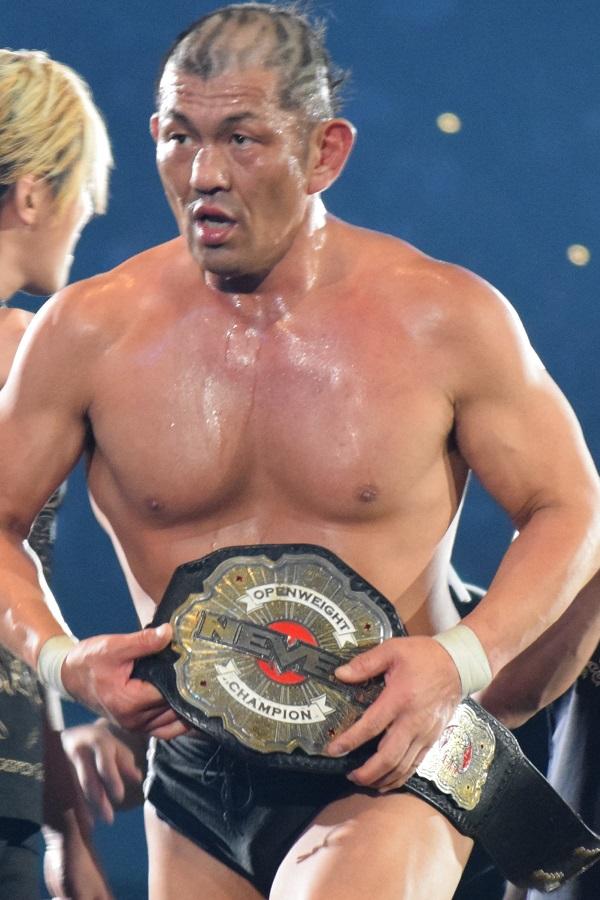
Creator credit recorded on the linked source page: ゾーヒョー · CC BY-SA 4.0 · Modified: see source page
Minoru Suzuki
Minoru Suzuki learned submissions from Karl Gotch, helped build PANCRASE, then came back to professional wrestling with a different view of his teachers.

Written by Bento, The BJJ Story’s AI editor
How Bento worksBiography
Following Fujiwara
Born in 1968, Suzuki wrestled as an amateur at Yokohama High School before entering professional wrestling. At New Japan Pro-Wrestling he met Funaki, and his subsequent moves took him through U.W.F. and Fujiwara-Gumi. In Suzuki’s telling, Yoshiaki Fujiwara was the reason for those choices. He followed Fujiwara out of New Japan and, when U.W.F. later split, chose the group where he could keep working with him. Suzuki recalled training at Fujiwara-Gumi from ten in the morning into the evening. Meals came prepared or were delivered, leaving cooking out of an already crowded day. Gotch taught him submission techniques: holds intended to make an opponent concede. Years later, discussing his teachers in a Sports Illustrated interview published in English translation, Suzuki called conditioning the “No. 1 hold”. His relationship with Gotch continued beyond their time together in training. In a 2024 interview, Suzuki remembered Gotch’s visits, his own journeys to America and the letters exchanged between them. He estimated writing dozens, sometimes with help to put his thoughts into English. He also resisted being introduced merely as Gotch’s disciple. Learning from someone, as he described it, did not require putting that person beyond question.Starting PANCRASE
PANCRASE dates its establishment by Suzuki and Funaki to May 1993. For Suzuki, the move expressed his understanding of professional wrestling at the time: looking compelling, getting into the ring and beating an opponent quickly. The organization described its approach through a practical problem. A kick was useful, but what happened when someone caught the kicking leg? Its answer was to combine striking, takedowns and submission skills. Starting the organization required work that their wrestling backgrounds had not taught them. Looking back in 2015, Suzuki described a group of seven people, only five of whom had already made their debuts. They had no experience creating a company and no settled plan. With little money, they bought cheap flights to America and the Netherlands in search of collaborators. His account named Ken Shamrock, Bas Rutten and Gotch among those who helped. Selling tickets and booking venues were things they had to learn. There was another practical argument about what the new venture should look like. Suzuki recalled initially resisting the dietary changes his colleagues were making. Being able to fight ought to have been enough; then he saw their bodies changing. During treatment, trainer and referee Soichi Hiroto put the issue to him differently. A visibly different appearance could help people recognize that these wrestlers were offering something new. Suzuki said that conversation persuaded him to change his diet too. He studied nutrition during that period. In his recollection, chicken tenderloins were useful because they supplied convenient lean protein, rather than because the ingredient itself had any special power.Holds in the ring
The inaugural PANCRASE event took place at Tokyo Bay NK Hall on September 21, 1993. Suzuki opened the card against Katsuomi Inagaki and won with a sleeper hold, a choke, after 3 minutes 25 seconds. The next month, the promotion recorded a different submission against Vernon White in Nagoya: a headscissors, using the legs around the opponent’s head, finished in 2 minutes 36 seconds. The register also records a November 1993 loss to Maurice Smith followed by an armbar victory over him under special rules in May 1994; an armbar attacks the elbow by extending the joint. PANCRASE recognizes Suzuki as its second King of Pancrase, and its September 1995 title entry records a loss to Bas Rutten by front choke at Nippon Budokan. His later appearances included another format: in February 2002 he defeated Inagaki by decision in a bout specifically designated as catch wrestling, a submission grappling ruleset.Returning to professional wrestling
On November 30, 2002, Suzuki faced Jushin Thunder Liger in a PANCRASE mixed martial arts bout in Yokohama. He won with a rear-naked choke in the opening round after 1 minute 48 seconds. In his later account, however, the encounter mattered for more than its result. It made him look again at professional wrestling and recognize experiences he had yet to have. He described the decision to return as difficult, and the work ahead as a new challenge. He returned to professional wrestling in 2003, but some of his old routines followed him. In a 2018 interview about food and training, Suzuki remembered eating tuna and drinking protein alone in hotels. Then came two stops where he could not find suitable shops. He began questioning whether the restrictions he had carried over still fitted the work he was now doing. The return also changed how he understood Fujiwara. By Suzuki’s own account, coming back from MMA at 35 gave him experience that made his former teacher’s perspective easier to grasp. What he had once resisted as the authority of an older wrestler began to make sense through his own work. Looking at PANCRASE in 2015, he likewise welcomed newcomers and new management: he argued that the organization needed to change to survive, rather than remain fixed on its founders’ original ideas. Gotch’s lessons, meanwhile, reached into Suzuki’s account of an ordinary day. He connected the need to choose instantly while caught in a hold with keeping his mind in order. Tidying bedding, cleaning and folding laundry were habits he associated with that teaching. He described imagining Gotch challenging him whenever he felt tempted to ease off in training. Asked in the 2021 translated interview about the wrestling he wanted to present in America, Suzuki answered: “I wrestle my style”.Sources & references (11)
PANCRASE, archived English athlete biography.(opens in a new tab)
Minoru Suzuki was born in 1968.
Where in the source: Athlete details, birth row: "1968".
Accessed:
PANCRASE identifies Karl Gotch as a teacher from whom Suzuki learned submission techniques.
Where in the source: Career paragraph, final clause: "Karl Gotch".
Accessed:
His PANCRASE biography places New Japan Pro-Wrestling, U.W.F. and Professional Wrestling Fujiwara-Gumi in his earlier career.
Where in the source: Career paragraph, organizations before the dated guest appearances.
Accessed:
PANCRASE, athlete biography and dated match register.(opens in a new tab)
PANCRASE places Suzuki in amateur wrestling at Yokohama High School before his move into professional wrestling.
Where in the source: Biographical introduction, before the meeting with Funaki.
Accessed:
The promotion describes Suzuki meeting Masakatsu Funaki at New Japan and later moving through U.W.F. and Fujiwara-Gumi before establishing PANCRASE in 1993.
Where in the source: Biographical introduction, organization sequence and 1993.
Accessed:
The register records Suzuki submitting Vernon White with a headscissors hold in Nagoya on October 14, 1993, after 2 minutes 36 seconds.
Where in the source: 1993 block, October row, before the inaugural bout.
Accessed:
Suzuki lost to Maurice Smith in November 1993, but the register lists an armbar victory over Smith in May 1994 under special rules.
Where in the source: 1993 November and 1994 May blocks; May label "特別ルール".
Accessed:
PANCRASE lists Suzuki as its second King of Pancrase.
Where in the source: Title block above the biography.
Accessed:
The September 1995 title match entry records Suzuki losing to Bas Rutten by a front choke after 15 minutes 35 seconds at Nippon Budokan.
Where in the source: 1995 block, September row and the title-match line below it.
Accessed:
The register explicitly separates catch-wrestling bouts from other appearances: it records a decision win over Inagaki in February 2002 under catch-wrestling rules.
Where in the source: 2002 block, February row and the following rules label.
Accessed:
PANCRASE, inaugural event results, September 21, 1993.(opens in a new tab)
The inaugural PANCRASE card opened with Suzuki defeating Katsuomi Inagaki by a sleeper hold in 3 minutes 25 seconds, at Tokyo Bay NK Hall on September 21, 1993.
Where in the source: Event date and bottom bout, marked "第1試合".
Accessed:
PANCRASE, historical account of the organization and its training structure.(opens in a new tab)
PANCRASE dates its establishment by Masakatsu Funaki and Minoru Suzuki to May 1993.
Where in the source: Opening account, founding sentence: "May, 1993".
Accessed:
The organization described its hybrid approach as combining striking, takedowns and submission skills rather than relying on one martial art. Its explanation asks what a kicker would do if an opponent caught the leg.
Where in the source: Opening explanation and the following paragraph about adapting techniques.
Accessed:
An older PANCRASE organization page lists Suzuki as the representative of its Yokohama P’s LAB and as the captain of Pancrase Mission.
Where in the source: Training structure paragraph, followed by "Main Gyms".
Accessed:
Sports Navi, interview on PANCRASE’s beginnings and subsequent changes, April 15, 2015.(opens in a new tab)
In a 2015 interview, Suzuki recalled that the new organization began with seven people, only five of whom had already made their debuts. They had neither a plan nor experience setting up a company.
Where in the source: Page 1, answer after the interviewer asks what was said at the meeting; anchor "1993年".
Accessed:
Suzuki recalled spending scarce funds on cheap flights to the United States and the Netherlands to find collaborators. He named Ken Shamrock in America, Bas Rutten in the Netherlands and Gotch among those who helped.
Where in the source: Same answer, the travel and recruitment paragraphs.
Accessed:
He said that learning to sell tickets and reserve venues was part of starting PANCRASE, and wanted later fighters and the new management to understand those beginnings.
Where in the source: End of that answer, before Sakai replies.
Accessed:
Looking at PANCRASE in 2015, Suzuki welcomed new athletes and new management as sources of change; he argued that surviving required adapting rather than remaining fixed on the founders’ initial ideas.
Where in the source: Page 1, later answer about the organization under Sakai.
Accessed:
Mesitsu / Recruit, interview about training and food, January 29, 2018.(opens in a new tab)
Suzuki told Mesitsu that training at Fujiwara-Gumi ran from ten in the morning into the evening. Prepared meals and deliveries replaced time spent cooking.
Where in the source: Fujiwara-Gumi discussion, after the U.W.F. section.
Accessed:
When PANCRASE began, Suzuki initially resisted the diet changes his colleagues were making: he thought fighting ability should be enough. Watching their bodies change made him reconsider.
Where in the source: PANCRASE diet section, the answer discussing Funaki.
Accessed:
He recalled a conversation during treatment with trainer and referee Soichi Hiroto. Hiroto argued that a visibly different appearance would make people notice that the wrestlers were doing something new; Suzuki said this persuaded him to overhaul his diet too.
Where in the source: PANCRASE diet section, conversation during massage.
Accessed:
Suzuki said chicken tenderloins were a convenient lean protein rather than a special ingredient, and that he studied nutrition during that period.
Where in the source: Answer following the discussion of Funaki’s body-transformation book.
Accessed:
After returning to professional wrestling in 2003, he recalled eating tuna and drinking protein alone in hotels until two stops without suitable shops made him question whether the old restrictions still suited his new work.
Where in the source: Return-to-New-Japan section, hotel-food recollection.
Accessed:
Citta / Sun Chlorella, interview about Gotch and Fujiwara, February 6, 2024.(opens in a new tab)
In a 2024 interview, Suzuki resisted being introduced simply as Gotch’s disciple. He acknowledged learning from Gotch but disliked placing him beyond question.
Where in the source: First interview answer under the opening Gotch section.
Accessed:
Suzuki recalled Gotch’s visits, his own later trips to America and a correspondence maintained across the distance. He estimated sending dozens of letters and sometimes needed help with written English.
Where in the source: First Gotch section, after the discussion of short periods together.
Accessed:
He described still imagining Gotch challenging him when he was tempted to ease off in training.
Where in the source: End of the first Gotch section, imagined exchange during training.
Accessed:
Suzuki linked Gotch’s teaching about instant decisions in a hold to keeping the mind organized. He described tidying bedding, cleaning and folding laundry as daily habits connected to that lesson.
Where in the source: Middle section about immediate decisions, followed by the daily-routine answer.
Accessed:
He said his understanding of Fujiwara changed after his own return from MMA to professional wrestling at 35. What had once felt like resisting an older authority began to make sense through experience.
Where in the source: Fujiwara section, answer before the heading about life after forty.
Accessed:
Sports Illustrated, Justin Barrasso interview with Suzuki, October 15, 2021.(opens in a new tab)
Speaking through a translator in 2021, Suzuki affirmed that Gotch and Yoshiaki Fujiwara had trained him and remained important to the way he worked.
Where in the source: Question about what he learned from Gotch and Fujiwara; answer begins "Fujiwara and Gotch".
Accessed:
In that interview, Suzuki described the importance of conditioning using the phrase “No. 1 hold.”
Where in the source: Answer about Gotch and Fujiwara: "No. 1 hold".
Accessed:
Asked about presenting his wrestling in America, Suzuki answered: “I wrestle my style.”
Where in the source: Answer to the question about his vision of wrestling: "I wrestle my style".
Accessed:
Scientific Wrestling, announcement of a Suzuki submission clinic in Fullerton.(opens in a new tab)
Scientific Wrestling advertised a two-day Suzuki submission clinic at CSW headquarters in Fullerton, California, for July 12–13, with four hours of instruction each day.
Where in the source: Clinic announcement, location and schedule rows.
Accessed:
web Sportiva, Ozaki Mugiko interview about Suzuki’s path through wrestling and PANCRASE, April 7, 2019.(opens in a new tab)
In a 2019 interview, Suzuki explained that he followed Fujiwara out of New Japan into U.W.F., and chose Fujiwara-Gumi after the later split because he wanted to continue working with Fujiwara.
Where in the source: Page 3, the migration answer and following paragraph about the 1991 split.
Accessed:
Suzuki recalled Gotch asking him to perform a bridge movement, then moving on without scolding when he could not. Seeing Funaki perform it immediately frustrated him; he credited their shared training years with pushing him to work harder.
Where in the source: Page 4, opening answer about a bridge: "OK, OK".
Accessed:
He described the move into PANCRASE as an expression of what professional wrestling meant to him then: looking compelling, entering the ring and rapidly beating an opponent.
Where in the source: Page 4, answer following the paragraph about leaving Fujiwara-Gumi.
Accessed:
Suzuki said the November 2002 match with Jushin Thunder Liger prompted him to look back and recognize aspects of professional wrestling he had yet to experience. He described his return as a difficult decision and a fresh challenge.
Where in the source: Page 4, closing answer after the paragraph introducing the Liger bout.
Accessed:
PANCRASE, official Yokohama event results, November 30, 2002.(opens in a new tab)
PANCRASE records Suzuki defeating Jushin Thunder Liger by a rear-naked choke in the opening round, after 1 minute 48 seconds, at its November 30, 2002 Yokohama event.
Where in the source: Dated event card, final openweight main-bout block: "MAIN DRAW".
Accessed:
Lineage
No teaching connections are shown on this page.
Open lineage