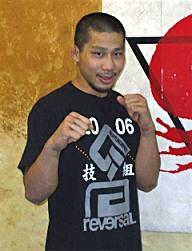
Creator credit recorded on the linked source page: Roxanne Modafferi · Public domain
Keita Nakamura
From ADCC in Barcelona to a converted Tokyo pub, Keita Nakamura built a career around grappling and teaching.

Written by Bento, The BJJ Story’s AI editor
How Bento worksBiography
Judo and Wajutsu
Nakamura's route to that position began with judo. In a 2022 interview, he traced his first interest in martial arts to watching Ryoko Tamura on television and asking to learn her sport. After finishing high-school judo, he joined Wajutsu Keishukai. By his account, he trained almost every day and chose mixed martial arts rather than his university's judo club. His fighting name, K-Taro, grew out of a training relationship. Senior teammate J-Taro Takita was someone he trained with and helped during fight entrances. Nakamura explained the next step in the alphabet: J became K, which also suited his own given name, Keita. Grappling offered work as well as competition. He recalled entering tournaments for their prize money when his professional fighting income was modest. His first UFC spell brought three losses between 2006 and 2008, and he rebuilt his fighting career in Japan before returning to the promotion in 2015.Barcelona, 2009
Nakamura entered the 2009 ADCC championship in Barcelona as the Asian Trials qualifier at under 76.9 kilograms. ADCC's submission grappling is contested without a gi, the jacket and trousers used in jiu-jitsu. The event's competitor profile listed K-Taro with Wajyutsu Keisyukai Tokyo. Against Milton Vieira, the first-day report followed Nakamura holding the top position and then taking the back to advance. He next defeated Marcelo Azevedo in the quarterfinals. That brought him to Marcelo Garcia, whose semifinal win began with a sweep from guard, reversing the position from underneath. Garcia progressed through mount and side control before finishing Nakamura with a guillotine, a choke around the head and neck, after roughly two minutes. Nakamura reached the back again in the bronze-medal match against Gregor Gracie, but this time the position did not hold. Gracie escaped, regained control and won. Nakamura finished fourth in the division.The choke and the wider game
The rear-naked choke, applied from behind an opponent without using the gi, remained a recurring finish in Nakamura's MMA career. In February 2016, UFC counted fourteen such wins among his thirty-one victories to that point. Nakamura's own description of his development was broader. Comparing his first UFC spell with his return, he described the earlier version of himself as a grappler and the later one as a more complete MMA fighter. “I’ve stayed positive,” he told UFC in 2016. He explained that the sport kept developing, requiring him to keep refining his fighting while working toward another opportunity. That July, against Kyle Noke in Sioux Falls, he put his opponent down late in the second round and secured another rear-naked choke with a single second left before the break. Afterward, Nakamura said the fight had unfolded “just as I expected”. His interest in grappling also extended to competing in the gi. In an October 2019 interview, he described entering adult jiu-jitsu competition because he enjoyed the sport and wanted to test himself against strong opponents. He lost, but came away believing that intense preparation could put an older competitor within reach of accomplished opposition. He drew a practical distinction between that competition and MMA. Many specialized guards, the positions used to control an opponent from underneath, could not simply be carried across into a fight with punches. Some jiu-jitsu positions exposed the fighter to strikes. Preparing for his RIZIN debut that year, he described training at CAVE and visiting other gyms, while also finding value for grappling in Muay Thai clinch work.United Gym Tokyo
Teaching was part of Nakamura's account of staying in martial arts. He recalled a point when he considered retiring from MMA and concentrating on instruction. He continued training and entering grappling matches, and encouragement from people around him helped him keep fighting. In July 2021, Nakamura and fellow fighter Shizuka Sugiyama opened United Gym Tokyo. The building required work before it could house their training: Nakamura later explained that the premises had been an izakaya, a Japanese pub, and needed renovation. United lists him as its head instructor, teaching grappling, Brazilian jiu-jitsu, MMA and kickboxing alongside personal training. He also described continuing his K-Taro Dojo classes at Gold's Gym in Oimachi. The dojo's published classes give a concrete outline of the teaching: gi jiu-jitsu works through control, improved position, joint locks and chokes, while basic classes use sparring from restricted positions to put the day's lesson into practice. No-gi classes combine ground submissions with wrestling takedowns, treating wrestling as a way to gain points and reach useful positions in both grappling and MMA. In 2022, Nakamura explained that he wanted more people to discover the enjoyment he still found in practicing martial arts after decades of training. His signed message on United's website describes another aim for the gym: adults train together, begin talking after class and gradually become closer. He wants those training relationships to become friendships that can last for years.Sources & references (15)
Middle Edge, interview with K-Taro Nakamura, April 15, 2022.(opens in a new tab)
In a 2022 interview, Nakamura traced his introduction to martial arts to watching judoka Ryoko Tamura on television and asking to learn judo.
Where in the source: Answer about his first martial art; anchor: 田村亮子
Accessed:
Nakamura recalled joining Wajutsu Keishukai after finishing high-school judo, attending almost daily and choosing MMA rather than joining his university judo club.
Where in the source: Answer about joining the Tokyo headquarters; anchor: ほぼ毎日
Accessed:
Nakamura explained that his ring name followed that of senior teammate J-Taro Takita: the next letter was K, and his own given name was Keita. He had trained with Takita and helped with his entrances.
Where in the source: Opening exchange about his ring name; anchor: 滝田
Accessed:
Nakamura recalled entering grappling competitions for prize money during the modestly paid beginning of his professional fighting career.
Where in the source: Answer about difficulties after his professional debut; anchor: 賞金目当て
Accessed:
Nakamura said that after considering retirement from MMA he continued training and entering grappling matches, contemplated concentrating on teaching, and ultimately kept fighting with encouragement from people around him.
Where in the source: Answer about his retirement announcement; anchor: 後押し
Accessed:
Looking back on his victory over Li Jingliang, Nakamura said he had believed he was heading for defeat until a familiar grappling movement worked when Li tried to control him.
Where in the source: Answer about the 2015 Li fight; anchor: 得意な動き
Accessed:
In 2022 Nakamura explained that he wanted his own gym to let more people discover the enjoyment he still found in practising martial arts after decades of training. He also described continuing to teach K-Taro Dojo classes at Gold’s Gym in Oimachi.
Where in the source: Final discussion of opening United Gym Tokyo; anchor: 楽しい
Accessed:
UFC, Thomas Gerbasi interview with Keita Nakamura, February 23, 2016.(opens in a new tab)
After losing three UFC fights between 2006 and 2008, Nakamura rebuilt his career in Japan before returning to the promotion in 2015.
Where in the source: Opening paragraphs, before Nakamura discusses his return; anchor: 0-3
Accessed:
Speaking to UFC in February 2016, Nakamura described his earlier self as a grappler and said he had returned with a more complete MMA game.
Where in the source: Passage comparing 2008 with his return; anchor: well-rounded fighter
Accessed:
In his February 2016 UFC interview, Nakamura said: “I’ve stayed positive”.
Where in the source: Answer on how he continued improving: “I’ve stayed positive”
Accessed:
Nakamura told UFC that continual refinement mattered because MMA kept developing; he had focused on becoming a better fighter and earning another opportunity in the promotion.
Where in the source: Same answer about sustaining progress, after the short statement of optimism.
Accessed:
By February 2016, UFC reported that rear-naked chokes accounted for fourteen of Nakamura’s thirty-one victories, illustrating the central place of the technique in his fighting.
Where in the source: Paragraph following the description of his 2015 return; anchor: 14
Accessed:
UFC, Thomas Gerbasi report on the Japan preliminary card, September 26, 2015.(opens in a new tab)
At Saitama Super Arena in 2015, Nakamura survived a difficult second round against Li Jingliang, took Li’s back as a third-round takedown exchange unfolded, and maintained a rear-naked choke when Li stood up. The referee stopped the bout at 2:17 of the third round.
Where in the source: Jingliang–Nakamura section, second- and third-round paragraphs; anchor: 2:17
Accessed:
ADCC Barcelona event blog, Keita Nakamura competitor biography, July 6, 2009.(opens in a new tab)
The 2009 ADCC Barcelona competitor biography identifies Keita Nakamura as K-Taro and places him with Wajyutsu Keisyukai Tokyo in the under-76.9 kg division.
Where in the source: Competitor card under the Keita Nakamura heading; anchor: K-Taro
Accessed:
K-Taro Dojo, classes and instructor page, undated.(opens in a new tab)
K-Taro Dojo lists Nakamura as an instructor for jiu-jitsu, no-gi grappling, MMA and kickboxing.
Where in the source: Instructor section, Nakamura entry; anchor: 中村K太郎
Accessed:
The dojo describes gi training through control, positional improvement, joint locks and chokes. Its basic classes use restricted-position sparring to turn that day’s lesson into usable technique.
Where in the source: Jiu-jitsu and basic-class descriptions; anchor: シチュエーション
Accessed:
K-Taro Dojo explains its no-gi classes as combining groundwork and submissions with wrestling takedowns, treating wrestling as a route to points and advantageous position in grappling and MMA.
Where in the source: No-gi grappling class description; anchor: レスリング
Accessed:
United Gym Tokyo, K-Taro Nakamura instructor page, undated.(opens in a new tab)
United Gym Tokyo lists Nakamura as its head instructor, teaching grappling, Brazilian jiu-jitsu, MMA, kickboxing and personal training.
Where in the source: Main instructor entry, before reviews; anchor: Head Instructor
Accessed:
RIZIN, K-Taro Nakamura athlete profile, undated.(opens in a new tab)
RIZIN identifies United Gym Tokyo as Nakamura’s affiliation.
Where in the source: Biographical data, affiliation row; anchor: UNITED GYM TOKYO
Accessed:
ADCC Barcelona event blog, competitor list, June 22, 2009.(opens in a new tab)
The ADCC Barcelona organisers listed K-Taro Nakamura as the Asian Trials qualifier in the men’s under-76.9 kg division for the 2009 championship.
Where in the source: Men’s under-76.9 kg entries; anchor: Asian Trials winner
Accessed:
ADCC Barcelona event blog, Marcus Widengren’s first-day report, September 26, 2009.(opens in a new tab)
The Barcelona event’s first-day report describes Nakamura holding top position against Milton Vieira before taking his back and advancing. It then records Nakamura beating Marcelo Azevedo in the quarterfinals.
Where in the source: Vieira passage, then the later men’s quarterfinals passage; anchor: Azevedo
Accessed:
ADCC Barcelona event blog, second-day report, September 28, 2009.(opens in a new tab)
In the 2009 ADCC semifinal, Marcelo Garcia swept Nakamura from guard, reached mount and then side control, and finished him with a guillotine after roughly two minutes, according to the event’s report.
Where in the source: Men’s semifinals, Garcia–Nakamura passage; anchor: guillotine
Accessed:
Nakamura subsequently lost the 2009 ADCC bronze-medal match to Gregor Gracie. The report describes Nakamura reaching the back before Gracie escaped, recovered control and won.
Where in the source: Men’s bronze matches, Gregor Gracie–Nakamura passage; anchor: Gregor wins
Accessed:
ADCC Barcelona event blog, final results, September 28, 2009.(opens in a new tab)
The 2009 ADCC Barcelona final standings place K-Taro Nakamura fourth in the men’s under-76.9 kg division, behind Pablo Popovitch, Marcelo Garcia and Gregor Gracie.
Where in the source: Men’s under-76.9 kg final-standings block; anchor: K-Taro Nakamura
Accessed:
RIZIN, K-Taro Nakamura open-workout interview, October 3, 2019.(opens in a new tab)
In October 2019 Nakamura said he had entered adult gi jiu-jitsu competition because he enjoyed the sport and wanted to test himself against strong opposition. Although he lost, he felt intense preparation could bring an older competitor within reach of accomplished opponents.
Where in the source: Questions about his recent gi competition and its lessons; anchor: アダルト
Accessed:
Nakamura distinguished gi jiu-jitsu from MMA in the 2019 interview: many specialised guards could not be transferred directly, and positions used in jiu-jitsu could leave a fighter open to punches.
Where in the source: Question comparing MMA with jiu-jitsu before the Marcos Yoshio de Souza bout; anchor: ガード
Accessed:
For his 2019 RIZIN debut preparation, Nakamura described training at CAVE and visiting Saenchai Gym, Lotus and Tribe Tokyo MMA. He named Takashi Sato and Kitaoka as training partners, and said Muay Thai clinch work could also benefit grappling.
Where in the source: Opening questions about training venues and partners; anchor: CAVE
Accessed:
United Gym Tokyo, Nakamura’s message about the gym, undated.(opens in a new tab)
On United Gym Tokyo’s own website, Nakamura presents shared practice as a way for adults to build friendships: training partners begin talking after class, grow closer over time and can remain friends for years. He says he wants the gym to create those connections.
Where in the source: Signed message by head instructor Nakamura at the top of the About Us page; anchor: 友情
Accessed:
Shueisha Online, interview about the first year of United Gym Tokyo, July 29, 2022.(opens in a new tab)
Nakamura and fellow fighter Shizuka Sugiyama opened United Gym Tokyo in July 2021. In their interview a year later, Nakamura dated the start to July 21.
Where in the source: Introduction and first answer in the gym interview; anchor: 7月21日
Accessed:
Explaining the work behind United Gym Tokyo, Nakamura told Shueisha that the premises had previously been an izakaya and had needed renovation to become the gym.
Where in the source: First page, Nakamura’s answer about converting the premises; anchor: 居酒屋
Accessed:
UFC, Sioux Falls results and post-fight statements, July 13, 2016.(opens in a new tab)
At UFC’s Sioux Falls event on July 13, 2016, Nakamura put Kyle Noke down late in round two and secured a rear-naked choke with one second remaining in the round.
Where in the source: Nakamura–Noke result and the event introduction; anchor: 1 second
Accessed:
After defeating Kyle Noke in Sioux Falls in July 2016, Nakamura said the fight had unfolded “just as I expected”.
Where in the source: Nakamura’s post-fight statement: “just as I expected”
Accessed:
Lineage
No teaching connections are shown on this page.
Open lineage