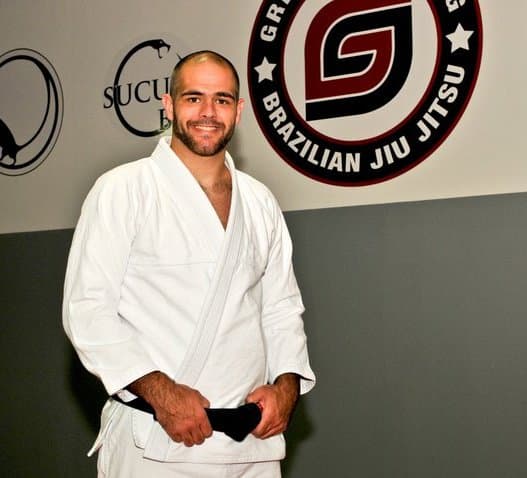
Creator credit recorded on the linked source page: Housejohnson · CC BY-SA 3.0
Jeremy Arel
“The Gerbil”
Source: bjjheroes.comJeremy "The Gerbil" Arel went to Rio as a purple belt chasing a world title, wrote about it on Sherdog, and came home a Roberto Correa black belt.
Biography
Sources for this profile
BJJ Heroes, fighter database profile of Jeremy Arel, published 16 August 2011.(opens in a new tab)
Jeremy James Arel was born in Northampton, Massachusetts, on 7 September 1981.
Where in the source: Biography section, first sentence — '7th of September, 1981'
Accessed:
The nickname 'The Gerbil' came from his first BJJ instructor at Alliance, Luis Togno, at the Tennessee state championships in 2004: Arel, used to kickboxing, stood in a striking stance with his hands up, and Togno said he looked like a gerbil. Arel disliked the name, and it stuck.
Where in the source: Nickname entry — 'looked like a gerbil'
Accessed:
Before Brazil, Arel worked full time as a bouncer and trained as a hobby; he then decided to move to Brazil to train full time and saved money for the trip.
Where in the source: Biography, paragraph 4 — 'bouncer'
Accessed:
Arel first planned to train in Rio with Ricardo Pires, whom he knew of through one of his instructors, Charles Heabrink. When that arrangement fell through and left him without a place to stay, Dennis Asche of Connection Rio offered him accommodation, and it was through Connection Rio that he met Roberto 'Gordo' Correa.
Where in the source: Biography, paragraph 5 — 'Connection Rio'
Accessed:
After his brown belt Arel went home and sold what he owned, planning to spend two to four years in Rio; Correa took to his style and at times let him teach at the academy, and on 11 December 2010 Correa promoted him to black belt.
Where in the source: Biography, paragraph 6 — 'December 11th, 2010'
Accessed:
BJJ Heroes gives his lineage as Mitsuyo Maeda, Carlos Gracie Sr., Carlos Gracie Jr., Roberto Correa, Jeremy Arel.
Where in the source: Lineage entry
Accessed:
BJJ Heroes lists among his main results a Tennessee state title (2004), North Carolina state titles in the gi advanced division (2006 and 2007), a Hayastan Grappling Challenge title in no-gi advanced (2007), silver medals at the BUD Cup in the advanced division (no-gi 2010, gi 2011) and a bronze medal at the Rio Open (2010).
Where in the source: Main Achievements list
Accessed:
BJJ Heroes lists a NAGA title in the advanced division in 2007.
Where in the source: Main Achievements list, NAGA line
Accessed:
BJJ Heroes lists him as competing in the super heavyweight division (100 kg) and names closed guard and half guard as his favourite positions.
Where in the source: Weight Division and Favourite Position entries
Accessed:
By 2011 BJJ Heroes described Arel as well known in the online jiu-jitsu community for his instructional videos and his activity on major grappling forums.
Where in the source: Opening paragraph
Accessed:
Wikipedia, article 'Jeremy Arel' (last edited 25 September 2026).(opens in a new tab)
Wikipedia describes Arel as an American grappler born in Northampton, Massachusetts, United States.
Where in the source: Lead sentence and infobox Born row — 'an American grappler'
Accessed:
Great Grappling Brazilian Jiu Jitsu, academy website, instructor biography of Jeremy Arel (undated).(opens in a new tab)
Arel was drawn to martial arts by his uncle Robert Arel, whom the academy describes as a Black Belt Hall of Fame inductee. He began informal training at seven and, after a year of asking, was enrolled at a local school to study Isshinryu karate.
Where in the source: Instructor biography, paragraph 1 — uncle and first karate school
Accessed:
He took up Tae Kwon Do in 1994 and in autumn 1996 joined a Jeet Kune Do Concepts school, where he soon dropped other after-school activities to train six days a week, often four to six hours a day.
Where in the source: Instructor biography, paragraphs 1–2 — 'Jeet Kune Do Concepts'
Accessed:
After six years the Jeet Kune Do school reshaped its curriculum as mixed martial arts while keeping its belt system, and Arel earned a black belt in that system; the academy itself notes that a black belt in 'MMA' is an unusual thing.
Where in the source: Instructor biography, paragraph 3 — curriculum change and belt
Accessed:
In 2004 he tried out for the WKA USA national kickboxing team: he beat the reigning super heavyweight champion in the quarterfinal, lost the final on a judges' decision and was named an alternate. Over the next two years he led the school's boxing and kickboxing classes.
Where in the source: Instructor biography, paragraph 4 — 'WKA USA'
Accessed:
He served in Operation Iraqi Freedom as a member of the Army National Guard, and afterwards graduated from Winthrop University in Rock Hill, South Carolina, with a bachelor's degree in health and physical education, qualifying as a teacher for kindergarten through 12th grade.
Where in the source: Instructor biography, paragraph 5 — 'Winthrop University'
Accessed:
In 2004 he started Brazilian jiu-jitsu as a white belt at Alliance Jiu Jitsu of Charlotte under Luis 'Sucuri' Togno, arranged his college timetable so he could attend daytime classes as well, stayed with Alliance for about four years and competed widely on the US east coast.
Where in the source: Instructor biography, paragraph 6 — 'Alliance Jiu Jitsu of Charlotte'
Accessed:
Luis Togno promoted Arel to purple belt at Alliance of Charlotte.
Where in the source: Instructor biography, paragraph 6, closing sentence — purple belt award
Accessed:
After purple belt he also trained in a no-gi Combat Jiu Jitsu programme, was asked to teach its beginners class within six months, and after two years of training and teaching received a brown belt in Combat Jiu Jitsu.
Where in the source: Instructor biography, paragraph 7 — 'Combat Jiu Jitsu'
Accessed:
After three months in Rio de Janeiro living at the ConnectionRio house and training under Roberto 'Gordo' Correa, Arel was promoted to brown belt in July 2009.
Where in the source: Instructor biography, paragraph 8 — 'July of 2009'
Accessed:
After about six months in Brazil he returned home for seven months and taught at a number of academies in North and South Carolina before going back to Rio to pursue his black belt.
Where in the source: Instructor biography, paragraph 8, middle sentences — return home and teaching
Accessed:
His academy's biography states that in December 2010 he became only the second non-Brazilian student promoted to black belt by Roberto Correa.
Where in the source: Instructor biography, paragraph 8, last sentence — '2nd non-Brazilian'
Accessed:
Arel returned to South Carolina in January 2011 to open his own academy, and Great Grappling Brazilian Jiu Jitsu opened in May 2011.
Where in the source: Instructor biography, paragraph 9 — 'May 2011'
Accessed:
Great Grappling Brazilian Jiu Jitsu is based in Fort Mill, South Carolina, in the United States.
Where in the source: Page header and footer contact address (town and state)
Accessed:
Sherdog Forums, thread 'Moving to Brazil on 05/06/2009', started 1 May 2009.(opens in a new tab)
On 1 May 2009, posting as 'Gerbiljiujitsu' on the Sherdog forums, Arel announced he was moving to Brazil for six months to train three to four times a day. He described himself as a purple belt and full-time grappling instructor whose goal was to compete at Abu Dhabi, and said he would keep the thread going to help others who wanted to train in Brazil.
Where in the source: Opening post by Gerbiljiujitsu, dated 1 May 2009 — 'I'M PUMPED!'
Accessed:
The Sherdog thread in which Arel documented his time in Brazil ran to 124 pages, with posts from May 2009 to October 2010.
Where in the source: Thread page navigation (last page 124) and post dates on pages 1 and 124
Accessed:
Sherdog Forums, thread 'Moving to Brazil on 05/06/2009', page 28.(opens in a new tab)
In a post dated 11 July 2009 in his Brazil thread, Arel wrote that he was now registered as a brown belt.
Where in the source: Page 28, post by Gerbiljiujitsu dated 11 July 2009 — 'registered as a brown belt'
Accessed:
Jiu-Jitsu Times 'Off the Mat' interview with Jeremy Arel, 4 April 2016, as republished on the Sensō Jiu Jitsu blog.(opens in a new tab)
In a 2016 interview Arel said he started karate as a child, moved to Tae Kwon Do, began Jeet Kune Do Concepts at 14 with boxing and kickboxing, and considered becoming an MMA fighter; his instructor at the time suggested he join a BJJ school to improve his ground game.
Where in the source: Interview, first answer (how he started) — 'ground game'
Accessed:
Arel said sparring had always been his favourite part of any martial art, but in his earlier training it was rare and poorly pitched; in his first BJJ class he found that rolling against a resisting partner, with few injuries, was a regular part of every session.
Where in the source: Interview, second answer (what got him hooked)
Accessed:
Arel named Luis Togno and Roberto Correa as his two biggest influences: Togno, a black belt in Charlotte at a time when the area had very few BJJ teachers, built his technical foundation, while Correa developed his strategy and choice of technique. Arel framed it as the difference between a teacher and a coach.
Where in the source: Interview, third answer (biggest influences) — 'technique selection'
Accessed:
Arel said he was one of only two black belts Correa had awarded to foreigners.
Where in the source: Interview, third answer — 'awarded to foreigners'
Accessed:
Arel described his time in Brazil as a first stay of six and a half months, a short return to the US to sell his belongings, and a second stay of nine and a half months, close to a year and a half in total.
Where in the source: Interview, answer on living in Rio, opening lines
Accessed:
In Rio, Arel said, there was for the first time more training available than his body could handle, at a higher intensity than he was used to, and he was constantly injured. He called the stay life-changing and said it made him re-evaluate his place in the community and his relationship with training.
Where in the source: Interview, answer on living in Rio, middle paragraphs
Accessed:
Arel said he went to Brazil expecting to become a world champion, although he had never rolled with a black belt; his instructor in Charlotte had never rolled with him. His first rolls with black belts in Rio were a revelation, and within about three months he concluded he would never be a black belt world champion in the adult division, which he described as traumatic.
Where in the source: Interview, answer on living in Rio, closing paragraphs — 'eye opening'
Accessed:
Arel said he worked as a bouncer and security guard for more than five years and relied on jiu-jitsu whenever he had to lay hands on someone, striking a person only once in that time and otherwise using foot trips and arm drags.
Where in the source: Interview, answer on sport-only techniques, later paragraph — 'foot trip'
Accessed:
Asked about sport-oriented techniques such as the berimbolo and lapel guards, Arel said BJJ is both a martial art and a sport, that the evolution of techniques over the previous decade was good for the art, and that problems arise only when students learn such techniques without a well-rounded base.
Where in the source: Interview, answer on sport-only techniques, opening paragraphs
Accessed:
Arel said the YouTube channel grew out of one of the mission statements he set when opening his school, to give BJJ to as many people as possible. His approach in the videos is to give clear teaching cues so that students can link the key points of a non-linear technique, a 'connect the dots' way of learning.
Where in the source: Interview, answer on the YouTube channel — 'connect the dots'
Accessed:
In 2016 Arel said he taught more than 30 hours a week and made his living from his academy, and that he still competed a few times a year so his students could see him win and lose, to keep up with trends and to hold himself accountable.
Where in the source: Interview, answers on the place of jiu-jitsu in his life and on competing — '30 hours'
Accessed:
Arel said the most important lesson jiu-jitsu teaches is how to deal with losing: people are defined by their victories rather than their losses, failure is frequent, and a single win at the right moment can change a life. His advice to students was to keep coming to class, review material soon after class and keep a notebook, and stay open-minded about techniques that may fit them later.
Where in the source: Interview, answers on advice and philosophy (numbered points and final reflection)
Accessed:
BJJ Beltchecker, community-verified member profile of Jeremy Arel (self-maintained).(opens in a new tab)
Arel's Beltchecker profile lists his current rank as black belt.
Where in the source: Profile header — 'Black belt 4th degree'
Accessed:
Arel's Beltchecker profile lists his current rank as black belt, fourth degree.
Where in the source: Profile header, rank line under the name
Accessed:
Great Grappling Brazilian Jiu Jitsu, academy website, instructor page of Evan Goyette (undated).(opens in a new tab)
Evan Goyette, an instructor at Great Grappling, received his black belt from Arel on 27 October 2020.
Where in the source: Instructor biography — 'Black Belt from Jeremy Arel'
Accessed:
Great Grappling Brazilian Jiu Jitsu, academy website, instructor page of Shane Segars (undated).(opens in a new tab)
Shane Segars, an instructor at Great Grappling, received his black belt from Arel on 1 October 2020.
Where in the source: Instructor biography — 'Black Belt from Jeremy Arel'
Accessed:
Great Grappling Brazilian Jiu Jitsu, academy website, instructor page of Fred Jennings (undated).(opens in a new tab)
Fred Jennings received his black belt from Arel on 28 April 2021 and fills in for him in the academy's adult classes.
Where in the source: Instructor biography — 'Black Belt from Jeremy Arel'
Accessed:
Great Grappling Brazilian Jiu Jitsu, academy website, instructor page of Johnny Lea (undated).(opens in a new tab)
Johnny Lea received his black belt from Arel on 21 May 2022.
Where in the source: Instructor biography — 'Black Belt from Jeremy Arel'
Accessed:
Great Grappling Brazilian Jiu Jitsu, academy website, instructor page of Jake Boehmann (undated).(opens in a new tab)
Jake Boehmann, an instructor at Great Grappling, is a black belt under Arel.
Where in the source: Instructor biography, opening sentence — 'under Jeremy Arel'
Accessed:
Great Grappling Brazilian Jiu Jitsu, academy website, instructor page of Nelson Mercado (undated).(opens in a new tab)
Nelson Mercado, listed among Great Grappling's instructors, was a blue belt alongside Arel under Luis Togno.
Where in the source: Instructor biography — 'blue belts together'
Accessed: