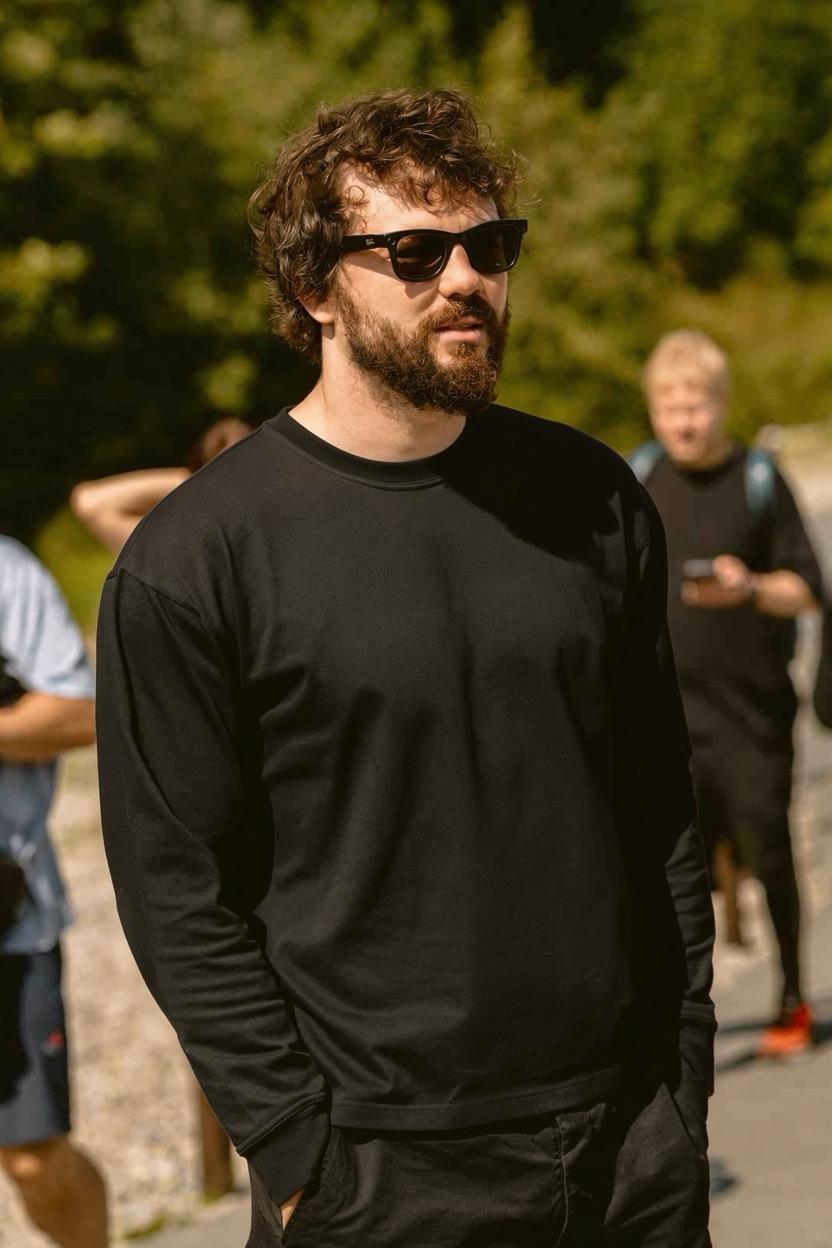
Creator credit recorded on the linked source page: Grotmmc · CC BY 4.0 · Modified: see source page
Artem Kuzmich
“Grot”
Source: censor.netArtem Kuzmich, known as Grot, turned his own jiu-jitsu experience into work building TMS Hub's veterans' training community.

Written by Bento, The BJJ Story’s AI editor
How Bento worksBiography
Sources & references (5)
Vadym Kuts, Censor.NET, June 2021.(opens in a new tab)
Artem Kuzmich is known as Grot.
Where in the source: Named opening and complete quoted account.
Accessed:
By June 2021, Grot was already seeking premises and supporters for a veterans' gym.
Where in the source: End of Korchynska's quoted account.
Accessed:
Kamlach, Mediazona/Zerkalo, January 2024.(opens in a new tab)
He lost part of his leg after a mine injury in 2019 and returned to military service as an instructor.
Where in the source: Injury section and return to service.
Accessed:
Friends invited him to try jiu-jitsu roughly eighteen months after his injury; early difficulty gave way to successful sparring after several months.
Where in the source: Complete first-training account.
Accessed:
Brazilian training spaces organised around mobility classes inspired his inclusive gym idea, which he developed with TMS in 2023.
Where in the source: Brazil inspiration and TMS construction passage.
Accessed:
He described TMS Hub as free training open to military members with or without injuries.
Where in the source: Whole access-and-community answer.
Accessed:
NYT/The Star, July 2026.(opens in a new tab)
By July 2026, Grot was a jiu-jitsu black belt.
Where in the source: Grot's own training section.
Accessed:
He helped establish TMS Hub in Kyiv with a local jiu-jitsu organisation in 2023.
Where in the source: Founding and funding paragraphs.
Accessed:
Head coach Oleh Iskra taught veterans to train without prostheses and to distinguish unfamiliar skills from physical limits.
Where in the source: Complete Iskra teaching account.
Accessed:
Grot said around two hundred veterans had trained at the hub by the 2026 report.
Where in the source: Dated participation paragraph.
Accessed:
Skliarenko, RBC-Ukraine, March 2026.(opens in a new tab)
He left military service in spring 2021 to concentrate on veterans' sporting initiatives.
Where in the source: Military timeline and choice of civilian work.
Accessed:
Recalling a white-belt win in Kharkiv in May 2021, he said it convinced him to develop grappling opportunities for other veterans.
Where in the source: Answer on choosing jiu-jitsu.
Accessed:
In March 2026 he said grants covered a coach, an administrator and rent, while contributions funded other costs.
Where in the source: Complete funding answer.
Accessed:
While seeking a larger gym, he planned a restaurant to create veterans' jobs and reduce dependence on donations.
Where in the source: Restaurant-origin and expansion answers.
Accessed:
Nova Ukraine, TMS Hub competition report.(opens in a new tab)
Nova Ukraine supported TMS Hub's team at the Abu Dhabi World Para Jiu-Jitsu Championship.
Where in the source: Whole named public partner post.
Accessed:
The charity reported Grot among the team's gold medallists and quoted him describing growth from five travelling athletes to ten.
Where in the source: Same complete report and Grot quotation.
Accessed:
Lineage
No teaching connections are shown on this page.
Open lineage