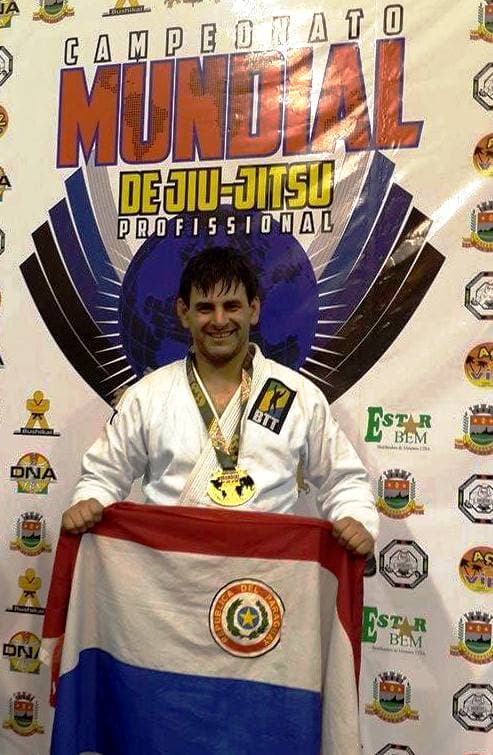
Creator credit recorded on the linked source page: Erih wolkang · CC BY-SA 4.0
Alfredo Sotelo
Alfredo Sotelo led a student-organized 2014 seminar bringing judo, BJJ and sambo practitioners together for competition training.
Biography
Sources for this profile
ABC Color, Sotelo competition report, 25 July 2013.(opens in a new tab)
In July 2013, ABC Color reported that Wolkang judo teacher Alfredo Sotelo won a CBJJO club-world brown-belt 100kg/super-heavy class in Niterói. He said injury had made his participation uncertain and credited his faith. The report also described preparation for November's Pan-American jiu-jitsu event.
Where in the source: Result, personal reaction and teaching paragraph.
Accessed:
Wolkang, personal history, 9 July 2011.(opens in a new tab)
In his signed 2011 account, Sotelo recalled starting judo at La Paz in Formosa in 1987 with Marciano Cespedes, then learning technique and tactics from Marciano’s son Nelson. He taught children as a judo brown belt in 1993 and became the school's first black belt in 1994. He began teaching in Asunción in June 1996, including at the Japanese-Paraguayan centre, military institutions and universities. With supporters, he founded Wolkang in October 2010 as a community of mutual help.
Where in the source: Complete signed personal chronology.
Accessed:
Wolkang, teaching essay, 10 July 2011.(opens in a new tab)
Wolkang's July 2011 teaching essay described a coach as part of pupils' family and community life. It advocated movement learning for children, more demanding technical practice for adolescents, and adult instruction adjusted to age and daily routine.
Where in the source: Complete age-specific teaching discussion.
Accessed:
Wolkang, Nova União announcement, 31 March 2014.(opens in a new tab)
Wolkang's March 2014 announcement named Sotelo and Francisco Lefebvre as directors developing Nova União in Paraguay through Marcos Broa's connection. It described a six-gym network for BJJ and submission grappling, including Academia Lefebvre and Wolkang in Asunción, with other affiliates in Central Department.
Where in the source: Directors, gym network and development aims.
Accessed:
Wolkang, grappling seminar report, 16 August 2014.(opens in a new tab)
Wolkang reported that its students organised a Sotelo-led seminar at Training Comp in the Ameliano club on 9–10 August 2014. Practitioners came from judo, BJJ and sambo, including Formosa. Seven hours targeted competition preparation; the school described using the gi as a teaching tool and grappling through throws, positions and submissions.
Where in the source: Completed seminar, participants and training description.
Accessed:
Wolkang, classes programme, undated.(opens in a new tab)
Wolkang's undated classes page lists Sotelo for BJJ, judo and sambo, and Juan Baez for additional BJJ sessions, including children. Its judo description stresses individual tactical and technical needs, with separate children's sessions.
Where in the source: Full named class and teaching descriptions.
Accessed:
Última Hora, Irigoitía interview, 6 May 2016.(opens in a new tab)
In a 2016 Última Hora interview, Carlos 'Chicho' Irigoitía named Sotelo among his judo influences, while identifying Francisco Lefebvre and Guillermo Hansen as jiu-jitsu references.
Where in the source: Athlete's named disciplinary influences.
Accessed:
Wolkang, athlete biography, 10 September 2015.(opens in a new tab)
Wolkang's biography dated 10 September 2015 described Sotelo as a BJJ black belt since 2013. It recorded technical leadership of Paraguay's judo team at Medellín in 2010 and cup events in 2011 and 2013, as well as seminars and camps in Brazil, Japan and the Netherlands.
Where in the source: Full dated athlete and coaching biography.
Accessed:
Wolkang, pupil report, 2 September 2019.(opens in a new tab)
At the 2019 Sajonia anniversary event, Wolkang's report named Rebeca Reinoso and Ruben Alvarez among its judo winners. Sotelo commended all his athletes, emphasising their attachment to the school and willingness to meet new challenges.
Where in the source: Named pupils and coach's closing assessment.
Accessed:
CBLP, professional gi world results, August 2016.(opens in a new tab)
CBLP's 2016 professional gi world results list Alfredo Sotelo Sotelo of Nova União first in Senior 1 male, black belt, over 100.5kg.
Where in the source: Page 22: complete senior black heavyweight standings.
Accessed:
Gracie Brasil RS, Pedro Braga biography, undated.(opens in a new tab)
Gracie Brasil RS's account of Pedro Braga credits him with developing Alfredo Sotelo and Francisco Lefebvre at the Assuncion Fighter Club in Paraguay.
Where in the source: Paraguay academy and named athletes.
Accessed:
Wolkang, technical teaching essay, 11 July 2011.(opens in a new tab)
A July 2011 Wolkang essay recommended visualisation and repeated practice as tactical preparation for standing and ground exchanges. It discussed combinations of foot or leg techniques in different directions and recognising available space, rather than treating every contest as identical.
Where in the source: Complete tactical-practice discussion.
Accessed:
Deportivo Sajonia, martial-arts programme, undated.(opens in a new tab)
Deportivo Sajonia's programme lists Sotelo teaching Brazilian jiu-jitsu from age twelve and judo in groups for ages five to twelve, thirteen to seventeen, and adults. The BJJ sessions are scheduled twice during the week and on Saturdays.
Where in the source: Named judo groups and BJJ programme.
Accessed:
Lineage
No teaching connections are shown on this page.
Open lineage